

Table of Contents
- 10 Storytelling Techniques for New Authors
- 1. Show, Don't Tell: The Foundation of Compelling Storytelling
- 2. Develop Your Protagonist with Depth and Contradiction
- 3. Create Genuine Conflict and Narrative Tension
- 4. Narrative Techniques and Examples for Writers
- 5. Master Pacing and Momentum to Keep Readers Engaged
- 6. How to Improve Fiction Writing Skills Step by Step
- 7. Common Pitfalls New Authors Should Avoid
- Conclusion
- Frequently Asked Questions
Last Updated: September 17, 2026
10 Storytelling Techniques for New Authors
Most new authors sit down to write with a clear story in mind but no real idea how to tell it. They know what happens, the plot points, the characters, the ending, but when they start writing, the pages feel flat. The dialogue sounds stilted. The tension disappears. The reader never connects with anyone on the page.

This is where storytelling techniques for new authors come in. These aren't fancy literary tricks. They're the practical tools that separate a story that works from one that sits unfinished in a drawer. WriteInspire has spent over 30 years helping writers master these fundamentals, and the difference they make is immediate.
Below, we'll walk through 10 essential storytelling techniques that will strengthen your narrative, deepen your characters, and keep readers turning pages. Each one addresses a specific problem new writers face. Each one is something you can apply to your manuscript today.
1. Show, Don't Tell: The Foundation of Compelling Storytelling
Show, don't tell is the most important rule in storytelling techniques for new authors, and the one most writers misunderstand.
Telling is stating what happened or what a character feels. Showing is dramatising it on the page so the reader experiences it directly. The difference determines whether your story lives or dies.
Tell: Sarah was angry.
Show: Sarah's jaw tightened. She set her coffee cup down so hard it sloshed onto the table. When she spoke, her voice came out low and controlled, the kind of control that made people step back.
The second version doesn't announce the emotion. It reveals it through action, physical detail, and dialogue. The reader feels the anger because they see it happening.
New writers often tell because it's faster. You can summarise a scene in one sentence instead of writing it out. But summary kills momentum. It puts distance between the reader and the story. When you show instead, the reader is there, watching it unfold in real time.
This is the foundation of every other technique that follows. Everything else, dialogue, tension, character development, depends on your ability to show rather than tell.
2. Develop Your Protagonist with Depth and Contradiction
A protagonist readers care about isn't perfect. They're contradictory.
They want something desperately but are afraid of it. They believe one thing about themselves but behave in ways that contradict it. They have a strength that's also their weakness. This contradiction is what makes them human.
New authors often create protagonists who are too consistent. The character always acts the way you expect them to. They're likeable or they're not. They're brave or they're cowardly. But real people aren't like that. Real people contain multitudes.
Think about your protagonist's core contradiction. What does your character want more than anything? What are they willing to do to get it? And what are they not willing to do, what's the line they won't cross? The tension between desire and principle is where character lives.
Then give them a flaw that matters. Not a quirk (doesn't like peas, always late to meetings). A flaw that actually costs them something. A flaw that makes their journey harder. A protagonist who struggles with trust might push away the one person who could help them. A protagonist driven by ambition might sacrifice relationships they later regret. These flaws create conflict without needing an external villain.
WriteInspire's Creative Story Mastery module on Character Development walks through this in detail, showing how to build characters whose motivations feel inevitable and whose choices drive the story forward.

3. Create Genuine Conflict and Narrative Tension
Conflict isn't just the plot problem. It's what makes readers care.
New authors often confuse plot with conflict. Plot is what happens. Conflict is what the character wants versus what stands in their way. Tension is the reader's uncertainty about whether the character will get it.
There are three levels of conflict:
Internal conflict is the character fighting themselves, their fear, their doubt, their desire pulling them in two directions at once.
Interpersonal conflict is character versus character. Two people want different things. Their goals collide. Neither is wrong; they're just in opposition.
External conflict is character versus circumstance, a deadline, a storm, a system, a rival. The world is working against them.
Module 1 - Creative Story Mastery →
The strongest stories weave all three together. Your character is fighting an external problem (the plot), but they're also fighting someone else (another character) and fighting themselves (their own doubts and contradictions). When all three are present, tension builds on itself.
The key is stakes. What does the character lose if they fail? Make it specific. Make it hurt. A vague threat ("things could go wrong") creates no tension. A concrete one ("if you don't find the letter by Friday, your mother will sell the house") does.
4. Narrative Techniques and Examples for Writers
Storytelling techniques for new authors include several specific tools that control how the reader experiences your story.
Point of view determines whose eyes we see through. First person ("I walked into the room") puts readers inside one character's head. Third person ("She walked into the room") lets you move between characters. Unreliable narration, where the narrator is lying or mistaken, creates tension because the reader knows more than the character does.
Foreshadowing plants a detail early that pays off later. A character mentions they're afraid of water. Fifty pages later, that fear becomes crucial. The reader didn't notice the detail the first time, but when the payoff comes, it lands with force.
Subtext is what's not being said. Two characters have a conversation about the weather, but we know they're really talking about their broken relationship. The tension comes from the gap between the surface conversation and the real one underneath.
Sensory details make scenes real. Don't just tell us the character walked into a room. Let us smell the dust. Feel the cold floor. Hear the floorboards creak. These details anchor the reader in the moment.
Dialogue reveals character voice. Each character should sound different, different word choices, different rhythms, different concerns. Dialogue also advances plot and reveals conflict without the author explaining it.
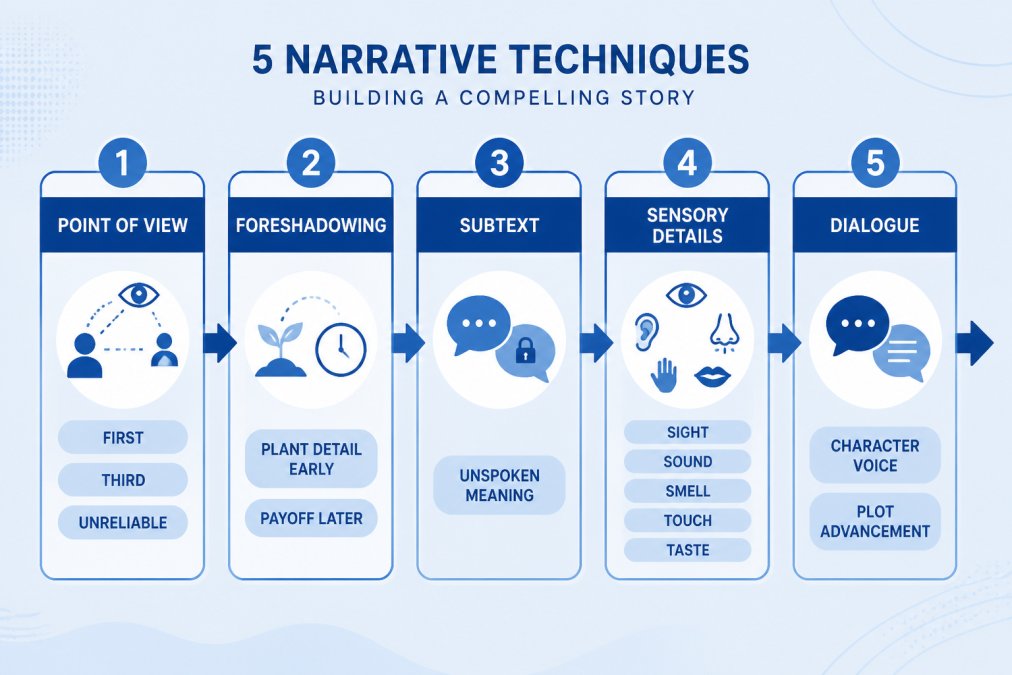
These techniques work together. When you combine specific point of view with foreshadowing and subtext, you create a narrative that feels inevitable but still surprising.
5. Master Pacing and Momentum to Keep Readers Engaged
Pacing is the rhythm of your story. It's how fast or slow the narrative moves.
New writers often pace everything the same way. Every scene gets the same amount of space. Every revelation gets the same weight. The result is monotonous. Readers get bored.
Strong pacing varies. Short scenes and short paragraphs create urgency. Long scenes and longer paragraphs allow readers to breathe. Mix them together.
A tense confrontation scene might be all short sentences and quick exchanges.
6. How to Improve Fiction Writing Skills Step by Step
Storytelling techniques for new authors improve with practice, not talent.
7. Common Pitfalls New Authors Should Avoid
New authors make the same mistakes over and over. Knowing them in advance saves you months of wasted writing.
Conclusion
Storytelling techniques for new authors aren't mysterious. They're tools you can learn and practice. Show, don't tell. Build contradictory characters. Create genuine conflict. Use narrative techniques deliberately. Control your pacing. Practice regularly. Avoid the common pitfalls.
Frequently Asked Questions
What are the most effective storytelling techniques for beginners?
Start with show, don't tell, it's the foundation that transforms flat exposition into vivid scenes. Layer in strong character motivation, clear conflict, and purposeful dialogue. These four techniques work together: your protagonist drives the action through what they want and fear, conflict creates tension that propels the narrative arc, and dialogue reveals character while advancing plot. Practise these before experimenting with complex narrative structures.
How can I use narrative techniques and examples to improve my own writing?
Read published fiction in your genre and identify how authors use point of view, foreshadowing, and subtext. When you spot a passage that grips you, analyse it: Is the tension built through action or restraint? Does dialogue carry hidden meaning? Then apply that same technique to your own scenes. Writing workshops and coaching like the Script Development Program offer structured feedback on your specific manuscript, showing you exactly where these techniques strengthen or weaken your work.
What's the difference between narrative technique and writing style?
Narrative technique is the structural choice you make, point of view, pacing, how you reveal information. Writing style is how your voice comes through in word choice, sentence rhythm, and tone. A writer might use the same technique (unreliable narrator) but their style makes it distinctive. Both matter equally. You can master technique through study and practice, but style develops as you write authentically over time and refine your language choices.
How do I choose the right storytelling technique for my genre?
Different genres reward different approaches. Literary fiction often prizes interior monologue and ambiguity; thrillers demand tight pacing and withholding information; romance centres on emotional intimacy and dialogue. Study how successful authors in your chosen genre handle point of view, tension, and revelation. If you're uncertain, a writing consultation can help you identify which techniques best serve your story and genre expectations.
Can I really improve my fiction writing skills step by step, or do I need natural talent?
Storytelling is a skill that develops through deliberate practice and feedback. You don't need to be born with it. Each technique, showing conflict through action, building character motivation, pacing scenes, can be learnt and refined. The key is consistent application and honest feedback on your work. Many authors spend years developing craft before their first publication. Coaching and structured programs like the 90-Minute Draft Method accelerate this learning by giving you frameworks and accountability.