

Table of Contents
- Why Your Authorial Voice Matters in Storytelling
- 1. Module 7 - Creative Story Mastery - Words: Master Tone, Rhythm, and Authentic Expression
- 2. Module 1 - Creative Story Mastery - Finding a Story: Discover Your Unique Perspective
- 3. The 90-Minute Draft Method: Build Momentum and Voice Through Consistent Practice
- 4. Writer Coaching & Guided Resources: Develop Character-Driven Voices with Professional Support
- 5. Writing Consultation Creative Support: Refine Your Style Through One-on-One Feedback
- Exercises for Finding Your Writing Voice
- Examples of Distinct Authorial Voice in Literature and How to Learn From Them
- Frequently Asked Questions
Last Updated: September 24, 2026
Your authorial voice is the distinctive way you choose words, structure sentences, and reveal character, the fingerprint that makes your prose unmistakably yours. Developing authorial voice requires deliberate practice, honest feedback, and tools that help you recognise patterns in your own writing. Below are five resources that work: structured methods writers use to find, refine, and strengthen the voice that's already inside them.
Why Your Authorial Voice Matters in Storytelling
Your voice is the contract between you and your reader. It's not decoration or style for its own sake, it's the vehicle that carries your story's emotional truth. When your authorial voice is weak or uncertain, readers feel the hesitation. When it's strong and consistent, they trust you immediately, even if your story is unconventional or challenging.
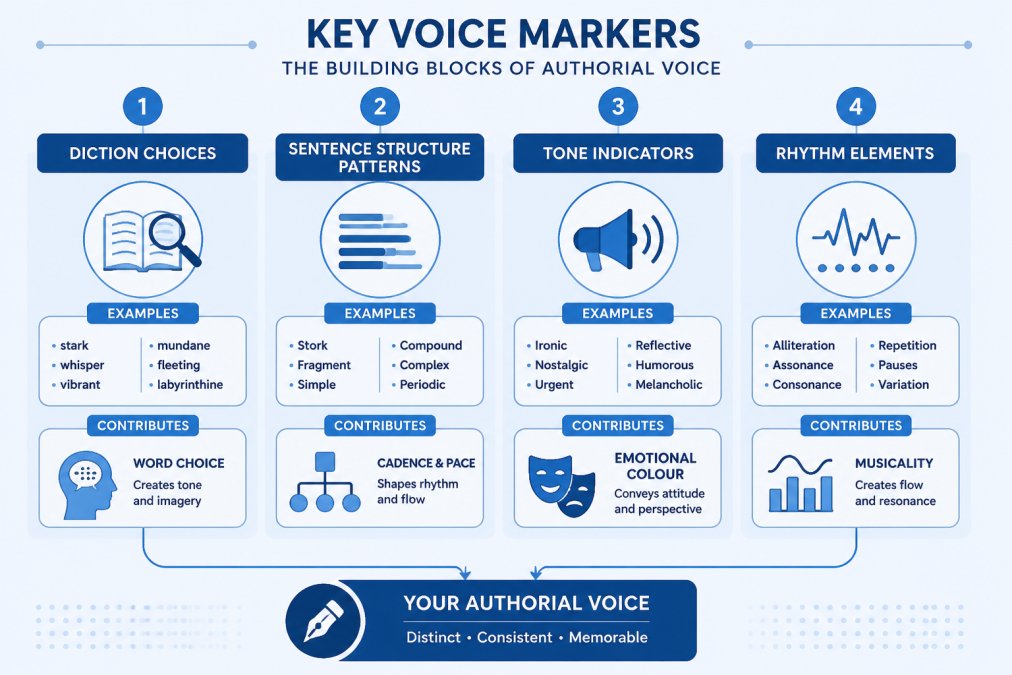
Most new writers confuse voice with technique. You can master grammar and plot and still sound like everyone else. Voice lives in smaller decisions: sentence rhythm, word specificity, and what you leave unsaid.
Readers feel whether they're in capable hands. Strong voice makes them willing to follow you anywhere. Weak voice makes them question every sentence.
1. Module 7 - Creative Story Mastery - Words: Master Tone, Rhythm, and Authentic Expression
This module cuts straight to the craft of language itself. It focuses on how deliberate word choice, rhythm, and tone work together to create an authentic voice that serves your story's purpose.
This module teaches you to choose words strategically, recognise how tone serves story purpose, and balance clarity with literary beauty throughout your entire story.
You learn to revise language for maximum impact, create mood through word choice, and see why one word works and another doesn't.
Research on prose rhythm and reader engagement from the Journal of Literary Studies shows that consistent rhythm patterns are one of the strongest markers of authorial voice. This module trains you to develop those patterns deliberately rather than by accident.
Best for: Writers uncertain whether their language choices serve the story, or who've been told their writing feels "flat" or "unclear."
| Element | What You Learn | Impact on Voice |
|---|---|---|
| Tone | How tone aligns with story purpose | Reader trusts your emotional direction |
| Rhythm | How pacing affects reader experience | Voice feels natural, not forced |
| Diction | How word choice reveals character and mood | Prose becomes distinctive and memorable |
| Clarity | How to balance beauty with understanding | Readers stay engaged without confusion |
2. Module 1 - Creative Story Mastery - Finding a Story: Discover Your Unique Perspective
Finding your voice begins with recognising what stories are worth telling and why you're the right person to tell them.
This module addresses where your unique voice comes from: your lived experience, observations, and way of seeing the world. Most writers second-guess themselves or chase trends instead of writing the story they need to tell.
Narrative voice studies from the Modern Language Association confirm that readers respond most strongly to stories told from genuine conviction. When you're writing something you actually care about, something rooted in your perspective, that authenticity comes through in every sentence.
This module teaches you to capture story ideas from your own life, overcome creative blocks, and build confidence through consistent practice.
Best for: New writers who feel stuck, or anyone unsure what "write what you know" actually means.
3. The 90-Minute Draft Method: Build Momentum and Voice Through Consistent Practice
Developing authorial voice requires consistent practice. The 90-Minute Draft Method gives you a structured process that works under pressure and fits a busy life.

It's modular: you define story problem, build character drive, map scenes, draft, then sharpen language. In 90 minutes, you move from nothing to a workable draft, prioritising momentum over perfection.
Voice work happens in the language-sharpening phase. You're recognising the voice already emerging in your draft and strengthening it.
Voice develops through repetition. You find it by writing multiple drafts and recognising patterns in your choices.
Best for: Busy writers who have limited time but want to build real momentum. If you've got maybe an hour or two a week to dedicate to writing, this method actually works with that constraint instead of fighting it.
Module 7 - Creative Story Mastery →
4. Writer Coaching & Guided Resources: Develop Character-Driven Voices with Professional Support
Consistent practice alone isn't enough. Writer coaching provides feedback from someone who recognises patterns you're too close to see, helping you clarify what your story is about.

It's rigorous development work. You formulate premise, theme, tone, and emotional engine. You develop narrative arc, strengthen characters, and refine language so every word earns its place.
The voice work in coaching is specific: you're learning to recognise how your character choices reveal who they are and what they believe. You're finding the story inside the dialogue so what characters say reveals motive, advances action, and deepens relationships. You're refining language to drive the story forward with clarity, rhythm, and voice.
This service works best when you're ready to commit to the process. Your coach will help you build the book properly, shape it with craft, and keep it moving until it's real. The outcome is a manuscript that's properly shaped, character-driven, emotionally credible, paced for momentum, dialogue-alive, and polished in language.
5. Writing Consultation Creative Support: Refine Your Style Through One-on-One Feedback
Sometimes you don't need a year-long partnership. You need focused, expert feedback on specific sections, the opening chapter that isn't landing, the dialogue that feels wooden, the prose that's lost its rhythm somewhere in the middle.
Writing consultation provides exactly that: a private, one-on-one session tailored to your needs. You come with a specific problem, structure, grammar, style, clarity, confidence, or flow, and you leave with personalised guidance designed to help you fix it.

The voice work in consultation is surgical. Your consultant reads your manuscript or excerpt and identifies the patterns that are working and the ones that aren't. They show you where your voice is strongest and where it's weakening. They help you recognise your own stylistic choices and whether they're serving your story or working against it.
Writing Centre research on feedback effectiveness shows that specific, targeted feedback produces faster improvement than general advice. Consultation gives you exactly that, feedback focused on your actual prose, your actual choices, your actual voice.
Best for: Writers who know what they've written isn't quite right but can't figure out why. If you've been staring at the same paragraph for hours, a consultation can unlock it in minutes by bringing fresh eyes and specific expertise.
Exercises for Finding Your Writing Voice
Developing authorial voice isn't passive. It requires active practice and deliberate reflection. Here are exercises that actually work:
Read aloud and listen. Your voice is rhythm. When you read your own prose aloud, you hear where the rhythm breaks, where sentences are too long, where the pacing stutters. Record yourself reading. Listen back. You'll hear your voice, the actual sound of your choices, in ways you can't when you're reading silently.
Transcribe writers you admire. Don't copy them. Transcribe a passage, by hand, slowly, from a writer whose voice you love. Feel how their sentences are constructed. Notice their word choices, their rhythm, their tone. This isn't imitation; it's apprenticeship. Your own voice will develop partly in reaction to what you've absorbed.
Write the same scene three ways. Take a scene you've written and rewrite it three times, each time with a different emotional tone or perspective.
Examples of Distinct Authorial Voice in Literature and How to Learn From Them
Every writer has a recognisable voice. Study how different writers create theirs.
Frequently Asked Questions
Can a unique writing voice be learned, or is it something you're born with?
Your authorial voice develops through deliberate practice and self-awareness, not innate talent alone. Reading widely, writing consistently, and receiving feedback all strengthen your voice over time. Many writers discover their authentic voice only after years of experimentation and refinement. The key is recognising that voice emerges from your choices: the words you select, the rhythm you create, the perspective you bring to your story. With structured coaching and exercises, you can accelerate this discovery significantly.
What are the five elements of a unique writing voice?
The core elements of authorial voice include: diction (your word choices), syntax variation (how you structure sentences), tone and mood (the emotional quality of your prose), rhythm and pacing (how sentences flow), and perspective (your narrative viewpoint and worldview). These five dimensions work together to create the distinctive fingerprint readers recognise as yours. Developing authorial voice means becoming intentional about each element rather than letting them happen by accident.
What exercises help in developing a consistent authorial voice?
Effective exercises for finding your writing voice include reading aloud to hear your prose rhythm, transcribing passages from authors you admire to internalise their techniques, writing daily pages without editing to access authentic expression, and recording yourself speaking about your story to capture natural cadence. Practising character-specific voices through dialogue work also strengthens your overall narrative voice. The 90-Minute Draft Method and Creative Story Mastery modules offer structured exercises designed specifically to build this consistency over time.
How does character voice differ from authorial voice?
Authorial voice is your distinctive presence as a storyteller, how you narrate, describe, and guide readers through your world. Character voice is how individual characters speak and think within that world. Strong fiction requires both: a clear authorial voice that frames the story, and distinct character voices that reveal personality and motivation. Developing authorial voice first gives you a stable foundation from which character voices emerge naturally. This distinction matters because readers need to hear you as the storyteller before they can trust the characters you've created.