

Table of Contents
- Why Character Development Questions Matter
- Question 1: What Does Your Character Want More Than Anything?
- Question 2: What Internal Conflict Stops Them From Getting It?
- Question 3: How to Write Compelling Character Arcs That Earn Change
- Question 4: Who Are They When Nobody's Watching?
- Building a Character Profile Template That Works
- Question 5: What Would Break Them?
- Putting It All Together
- Frequently Asked Questions
Last Updated: September 18, 2026
Why Character Development Questions Matter
Asking the right character development questions is how writers transform flat archetypes into people readers actually care about. At writeinspire, the difference between a manuscript that lands and one that doesn't almost always comes down to character depth. When you understand your character's motivations, internal conflicts, and what would genuinely break them, everything else, plot, dialogue, action, flows from that foundation.
Most writers skip the hard work of understanding WHO their character is before writing WHAT happens to them. Surface-level questionnaires won't help. The five core questions below force you to build genuine, multidimensional people on the page.
Question 1: What Does Your Character Want More Than Anything?
Your character's deepest desire is the engine that drives your story. It's not "get rich" or "find love", it's the specific, personal yearning that shapes every choice they make.
Make the want concrete. "I want my mother to acknowledge that I was right about leaving the family business" works. "I want to be happy" doesn't. What someone desperately wants reveals what they value and what they fear losing.
Strong character wants create plot momentum naturally. If your protagonist wants something badly enough, they'll take action and create conflict simply by pursuing it. Vague wants produce flat stories.
Question 2: What Internal Conflict Stops Them From Getting It?
Internal conflict is the gap between what your character wants and what they believe they deserve or are willing to do to get it. This is where character arcs happen and readers see themselves.
External obstacles are easy. Internal conflict requires understanding your character's psychology, what belief system stops them, what fear, what past experience made them doubt themselves.
A character might desperately want recognition from a parent but believe they're not good enough to earn it. That belief drives every interaction and makes them sabotage their own success.
The strongest internal conflicts aren't resolved by external victory. A character can win the external battle and still lose the internal one. This is why character development questions matter, you're mapping the psychological journey, not just plotting events.
| Internal Conflict Type | Example | Impact on Story |
|---|---|---|
| Belief vs. Reality | Character believes they're unlovable; discovers they're not | Forces character growth |
| Desire vs. Morality | Character wants revenge; knows it's wrong | Creates genuine moral stakes |
| Ambition vs. Fear | Character wants success; fears failure more | Drives self-sabotage |
| Loyalty vs. Self-Interest | Character must choose between friend and survival | Creates impossible decisions |
Question 3: How to Write Compelling Character Arcs That Earn Change
A character arc is the journey from who they are at the start to who they've become by the end. Change happens when internal conflict forces them to confront what they believe about themselves, not through external events alone.
Strong character arcs have three components: a genuine flaw or limiting belief that drives choices; that flaw tested repeatedly under pressure; and a conscious choice to change or not change. Passive transformation doesn't feel earned.
Your character's arc shape depends on their psychological archetype. A reluctant hero's arc differs from a tragic anti-villain's, which differs from a mentor figure's or coming-of-age character's.
The Reluctant Hero starts resistant to growth, forced into circumstances that demand change. Their arc works when readers see them gradually accept responsibility because they realise the cost of refusing.
The Anti-Villain begins with understandable motivations but increasingly questionable methods. Their arc leads to reckoning or descent. The key is readers understand why they made each choice, even when it becomes indefensible.
The Mentor or Guide experiences a reverse arc, beginning confident, then discovering limitations. Their arc succeeds when they're genuinely changed by the relationship, not just imparting wisdom.
The Coming-of-Age Character moves from innocence to hard-won understanding through a moment of disillusionment that shatters their worldview. The arc's power depends on how irreversible that discovery is.
Genre shapes arc trajectory. In a thriller, the arc compresses into a high-stakes choice. In literary fiction, it unfolds across small realisations. In romance, it's mutual. In fantasy, it spans multiple books.
Learning a lesson happens in a scene. Real change is the slow, painful process of unlearning old patterns and discovering who you become when you stop running from yourself.
The best character arcs respect inevitability. By the transformation, readers should feel it was the only possible ending because every earlier choice led logically to it. Understanding your character's archetype helps you plot the specific sequence that feels inevitable for that particular person.
Question 4: Who Are They When Nobody's Watching?
This question cuts to the heart of authenticity. Who your character is when they're alone, their private thoughts, habits, fears, the things they'd never admit, is often completely different from the persona they show the world.
Real people code-switch. They're different with parents than friends, different alone than in public. The gap between public self and private self is where character depth lives.
Here's a structured way to map this gap:
The Public Persona: What image does your character work to maintain? A character might present as confident, competent, or unflappable. The persona is a deliberate construction, sometimes conscious, sometimes so habitual they don't realise it.
The Private Reality: What contradicts the persona? A character who presents as confident might obsessively check reflections or catastrophise about minor mistakes. A character who performs humility might harbour secret resentment.
The Trigger Moments: When does the mask slip? Fatigue, alcohol, emotional overwhelm, or trusted company can crack the facade. These moments show readers the real person beneath the performance.
The Cost of the Gap: What does maintaining this persona cost your character? Exhaustion? Loneliness? A character performing confidence might collapse into depression at home. One performing strength might be unable to ask for help. The larger the gap, the higher the emotional toll.
This framework works differently across genres. In a thriller, the gap is the plot. In literary fiction, it's psychological. In romance, two characters learn each other's private selves. In fantasy, a character hides their identity or magic.
Write two versions of the same scene: one with internal monologue, one with only dialogue and actions. The gap between them is your character's authenticity.
Building a Character Profile Template That Works
A character profile template should capture the five core questions we've covered, plus the practical details that make your character feel real. But here's the key: a template is only useful if it forces you to think deeply, not if it lets you coast with surface answers.
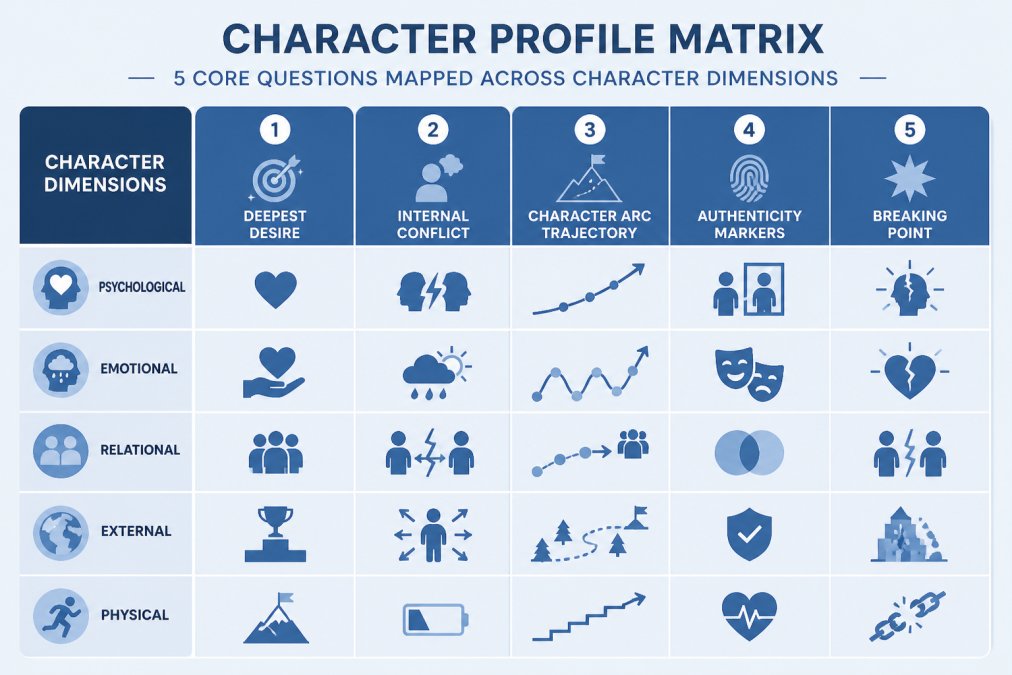
Question 5: What Would Break Them?
Every character has a breaking point. Understanding what would genuinely break your character, not just upset them, but fundamentally shatter their sense of self, tells you where the real stakes of your story live.
Putting It All Together
Character development questions aren't something you answer once and move on. They're tools you return to throughout your writing process. When a scene feels flat, when dialogue sounds generic, when a character's decision doesn't quite land, go back to these five questions. The answer is almost always there.
Frequently Asked Questions
What are the most important character development questions to ask when building a character?
The five core questions, what they want, what stops them, how they change, who they are privately, and what breaks them, form the foundation of character development. These questions work together to reveal motivation, internal conflict, character arc, authenticity, and emotional stakes. Answering them thoroughly creates characters readers understand and care about, even when they disagree with the character's choices. Start with these five, then layer in genre-specific or story-specific questions as your narrative demands.
How do character development questions improve narrative depth?
Character development questions force you to move beyond surface traits. They push you to explore why your character acts the way they do, what they fear, and how they'll change through your story. This depth creates authentic character motivation, reveals internal conflict that readers feel, and ensures character choices feel earned rather than convenient. Deeper characters drive stronger plots because their decisions matter, they're rooted in genuine contradiction and desire, not just plot convenience.
Should I answer character questions from the author's perspective or the character's perspective?
Both. Start as the author, you need to understand the character's world, backstory, and psychology. Then answer as the character would, in their voice and from their limited perspective. This dual approach reveals the gap between who your character thinks they are and who they actually are, which is where authentic internal conflict lives. The character's answers show their self-awareness (or lack of it); the author's answers show the truth beneath the surface.
Can character questionnaires help overcome writer's block?
Yes. When you're stuck, character questions give you something concrete to explore instead of staring at a blank page. They shift focus from 'what happens next' to 'who is this person and why do they act this way.' This often unsticks your story because you discover motivations that naturally drive plot forward. Many writers find that answering character questions deeply, even questions that don't directly appear in the story, builds confidence in the character's authenticity, which makes writing their scenes feel less forced.
Strong characters don't happen by accident. They're built through rigorous questioning, honest self-examination of your character's psychology, and the willingness to let them be flawed, contradictory, and real. The five character development questions we've covered are your foundation. Use them, return to them, and watch your characters transform from archetypes into people readers won't forget.