

Table of Contents
- Why Plot Twists Matter in Your Storytelling
- Exercise 1: The Red Herring Hunt
- Exercise 2: Reverse Engineering Effective Plot Twists in Literature
- Exercise 3: Character Secrets Inventory
- Exercise 4: Foreshadowing Techniques for Writers
- Exercise 5: How to Write a Plot Twist That Surprises Readers
- Exercise 6: The Misdirection Map
- Exercise 7: Editing for the Twist Payoff
- Bringing It Together: Practice, Revision, and Growth
- Frequently Asked Questions
Last Updated: September 22, 2026
Why Plot Twists Matter in Your Storytelling
A well-executed plot twist can transform a good story into an unforgettable one. It's the moment readers gasp, flip back through pages to catch what they missed, or sit in stunned silence realizing everything they thought was true has shifted. At writeinspire, we've learned that the difference between a twist that lands and one that falls flat comes down to deliberate craft, not luck.
The best plot twists aren't accidents. They're built through foreshadowing, character motivation, misdirection, and careful narrative structure. Most writers struggle because they either telegraph the twist too obviously or pull it out of nowhere, leaving readers feeling cheated rather than delighted.
Below are seven creative writing exercises plot twists that will sharpen your ability to construct plot twists that genuinely surprise readers while feeling inevitable.
| Exercise | Focus Area | Time Investment | Best For |
|---|---|---|---|
| Red Herring Hunt | Misdirection | 30 minutes | Building reader suspicion |
| Reverse Engineering | Analysis | 45 minutes | Understanding twist mechanics |
| Character Secrets Inventory | Motivation | 20 minutes | Deepening character depth |
| Foreshadowing Techniques | Setup | 40 minutes | Planting subtle clues |
| Surprise & Inevitability | Execution | 50 minutes | Perfecting the reveal |
| Misdirection Map | Structure | 35 minutes | Mapping reader expectations |
| Editing for Payoff | Refinement | 60 minutes | Polishing the twist |
Exercise 1: The Red Herring Hunt
A red herring is a false lead that pulls readers toward the wrong conclusion. It's not a lie, it's a strategic truth that points in the wrong direction.
Take a scene from your manuscript and identify one piece of information that could be misinterpreted, nervous behaviour that seems suspicious but has an innocent explanation, or a detail that appears to confirm a false theory. Write that scene twice: once as written, once with the red herring amplified.
In the amplified version, make the false lead more prominent with dialogue and physical details that reinforce the misdirection. Ask: would a reader believe this false lead? The goal is to give them enough plausible evidence to choose the wrong path, making the real twist land harder.
Exercise 2: Reverse Engineering Effective Plot Twists in Literature
The best way to understand plot twists is to study them in published work. Deconstruct a twist you admire, mapping how the author planted clues and managed reader expectations.
Choose a novel or short story with a twist you admire. Mark every moment where the author plants foreshadowing, highlight subtle clues, and note where they misdirect you. Create a timeline showing when readers learn each piece of information and when they learn the truth.
Ask yourself: what did the author reveal early that you missed? How did they use character motivation to make the twist feel inevitable? How much time passed between setup and payoff?
You're learning the grammar of twist construction by studying a master's work. The patterns you identify become tools in your own writing.
Exercise 3: Character Secrets Inventory
Every character has secrets. This exercise asks you to list every secret each major character holds, both the ones that drive your twist and the ones that don't.
Create a table for each main character listing what they want, what they fear, and what they're hiding. Include secrets unrelated to your plot twist, financial trouble, past relationships, ambitions, shame, or hidden skills.
Readers sense when characters withhold information. When you plant a secret that becomes the twist, readers have already absorbed the sensation of concealment. The twist feels earned rather than arbitrary.
Work through this inventory before you write. Know what each character is hiding, why, and what they'd do to keep it safe. This clarity transforms your dialogue and scenes. Characters reveal themselves through what they choose not to say.
Exercise 4: Foreshadowing Techniques for Writers
Foreshadowing is planting clues that readers won't fully understand until the twist arrives. It's about being present without being obvious.
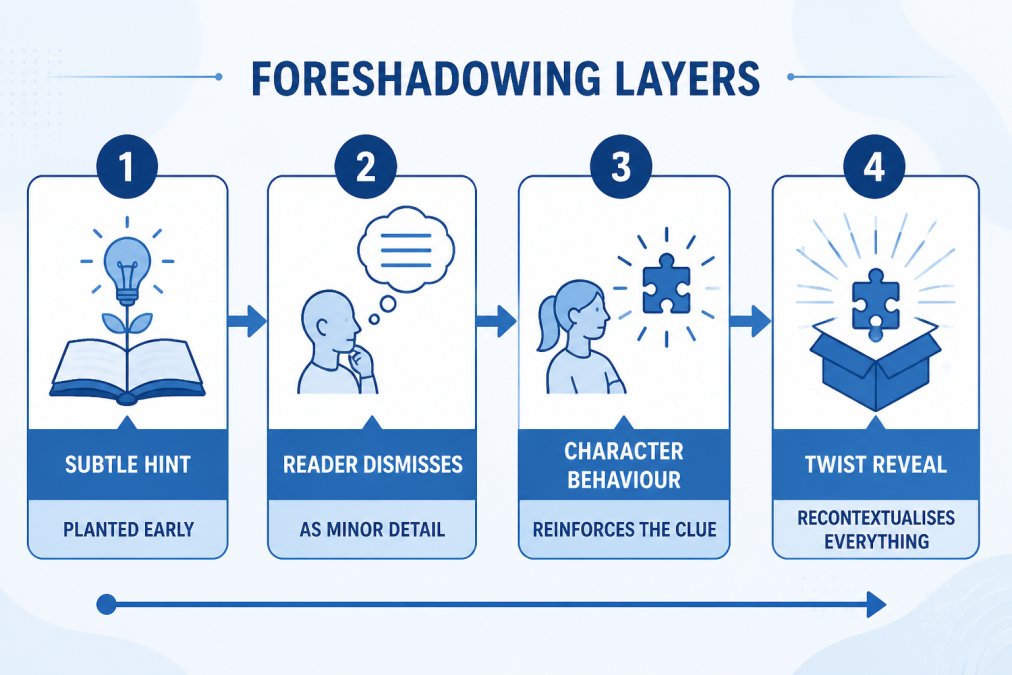
Symbolic foreshadowing uses objects or imagery to hint at what's coming, a character's fear of water before a water-based climax, or repeated references to doors and locks before a twist about access. Dialogue foreshadowing hides clues in throwaway lines or double meanings. Behavioral foreshadowing shows characters acting in ways that make sense only after the twist, nervousness that was actually guilt, or kindness that masked manipulation.
Module 2 - Creative Story Mastery →
Write a scene using at least two foreshadowing techniques, one through dialogue, one through a physical detail or symbolic object. Make both present but not obvious. The clues should feel natural, not forced. In editing, verify they make perfect sense in hindsight while remaining invisible on first read.
Exercise 5: How to Write a Plot Twist That Surprises Readers
The core tension of twist writing is balancing surprise with inevitability. This exercise teaches you to balance those two demands.
Identify your twist in one sentence. Write two versions of the reveal scene. In the first, make it as shocking as possible, bury clues, misdirect aggressively. In the second, make it feel earned, show readers the clues they missed, make character motivation clear.
Neither version is perfect alone. Your manuscript lives in the middle: surprising enough to delight readers, inevitable enough to satisfy them.
The exercise teaches you to consciously choose where that balance point lies rather than leaving it to chance.
Exercise 6: The Misdirection Map
Misdirection is deliberately pointing readers toward the wrong conclusion. Unlike a red herring (a single false clue), misdirection is a sustained pattern that creates a false narrative.
Map your story's misdirection on a timeline. Mark every moment where you're steering readers toward the wrong theory. When do you plant evidence? When does misdirection peak (usually just before the reveal)?
Ensure your misdirection is consistent. If readers should suspect Character A, every piece of evidence should point toward A until the twist reveals Character B. Inconsistent misdirection feels unfair; consistent misdirection feels inevitable.
This also helps you spot over-misdirection.
Exercise 7: Editing for the Twist Payoff
Once you've drafted your manuscript with the twist intact, edit to ensure it lands perfectly. This exercise is about revision with intention.
Bringing It Together: Practice, Revision, and Growth
These seven creative writing exercises plot twists form a complete toolkit for developing plot twists that surprise and satisfy readers. Pick one and spend time with it. The craft of twist construction is learned through doing, not reading.
Frequently Asked Questions
What are the most common mistakes writers make when crafting a twist?
The biggest mistake is making the twist feel arbitrary. Readers resent surprises that break the story's internal logic. Other common errors include telegraphing the twist too obviously (destroying suspense), revealing it too late (leaving no time for impact), or failing to plant enough clues so the twist feels earned rather than cheap. The twist must be both surprising and inevitable, something that makes readers think, 'I didn't see that coming, but now it makes perfect sense.'
How do I use foreshadowing to set up a successful plot twist?
Foreshadowing works best when it's subtle and multi-layered. Plant clues early, a character's throwaway comment, a small physical detail, a contradiction in behaviour, that readers won't recognise as important until after the twist lands. The key is burying genuine hints among red herrings so readers can't separate signal from noise. Effective foreshadowing techniques for writers include dialogue that hints at hidden motivations, settings that echo the twist's theme, and character actions that seem innocent but reveal something crucial in hindsight.
How can I make my plot twists feel earned rather than forced?
An earned twist grows naturally from character motivation and story logic. Everything the twist reveals must have been possible from the beginning, not hidden by authorial sleight of hand, but genuinely present in the narrative. Build your twist on the foundation of what your characters want, fear, and hide. Show their contradictions early. Let readers see the pieces; just don't let them assemble them until you're ready. A forced twist ignores character consistency or introduces information from nowhere. An earned twist makes readers feel clever for catching the clues they missed.
Can plot twists work in all genres of fiction?
Yes, but the execution differs by genre. Literary fiction often uses subtle, psychological twists rooted in character revelation. Mystery demands a twist that reframes all previous events fairly. Science fiction and fantasy can employ structural twists about the world itself. Romance typically uses emotional or relational twists rather than plot reversals. The principle remains the same: the twist must serve the story's core question and feel true to the genre's expectations. Readers of any genre will accept a twist if it's logical, well-foreshadowed, and meaningful to the narrative.
What's the difference between a plot twist and a red herring?
A plot twist fundamentally changes how readers understand the story. It reframes events, reveals hidden truth, or shifts the central conflict. A red herring is a false lead, a clue or subplot designed to mislead. Red herrings are tools that support a twist by creating misdirection. Effective plot twists in literature often use multiple red herrings to bury the real answer. The twist is the payoff; the red herrings are the setup. Both are essential to surprising readers without betraying them.