

Table of Contents
- Why Online Author Mentorship Works When Writers Feel Stuck
- Creative Writing Coaching for Authors: What Changes When Someone Reads Your Pages Properly
- Access to Mentors and Peers You Would Never Meet Locally
- How Long Does a Writing Mentorship Program Last?
- The Benefits of Manuscript Development Services for Unfinished Drafts
- Setting Up Your Online Mentorship: Tools, Etiquette and Weekly Rhythm
- What Online Mentorship Cannot Fix, and How to Avoid the Common Pitfalls
- Frequently Asked Questions
Last Updated: October 2, 2026
Why Online Author Mentorship Works When Writers Feel Stuck
The benefits of online author mentorship programs start with a simple truth: most writers don't stop because they run out of ideas. They stop because they run out of momentum.
That's where structured author mentorship changes things.
Below, we'll show you exactly what these programs do well, what they can't fix, and how to set one up so it fits your week.
Creative Writing Coaching for Authors: What Changes When Someone Reads Your Pages Properly
Creative writing coaching for authors works because it replaces guesswork with structured feedback. You stop wondering whether a scene lands and start knowing why it does or doesn't.

Feedback That Builds Confidence Instead of Crushing It
Good feedback is specific, not brutal. A mentor points to the paragraph where your protagonist's motivation goes fuzzy, then asks what she actually wants in that moment. That's a solvable problem.
What most guides miss is that confidence comes from evidence. When a mentor shows you three places where your dialogue already reveals character, you stop believing you can't write dialogue.
Accountability and Momentum Between Sessions
The real engine of author mentorship is the gap between sessions. Deadlines, custom exercises, and next-step targets keep the draft moving when life gets busy.
A common mistake is treating mentorship like a monthly appointment you show up to empty-handed. The writers who finish are the ones who send pages before the session, not during it.
Access to Mentors and Peers You Would Never Meet Locally
Online programs remove geography from the equation entirely. If you live somewhere without a strong writing community, a mentorship program connects you to industry specialists, dramaturgs, and other writers you'd otherwise never encounter.
That peer-to-peer learning matters as much as the one-on-one sessions.
Networking access is a genuine benefit, but it's a byproduct, not the point. The point is craft.
How Long Does a Writing Mentorship Program Last?
A writing mentorship program typically runs anywhere from a few weeks to a full year, depending on how much structure your draft needs.
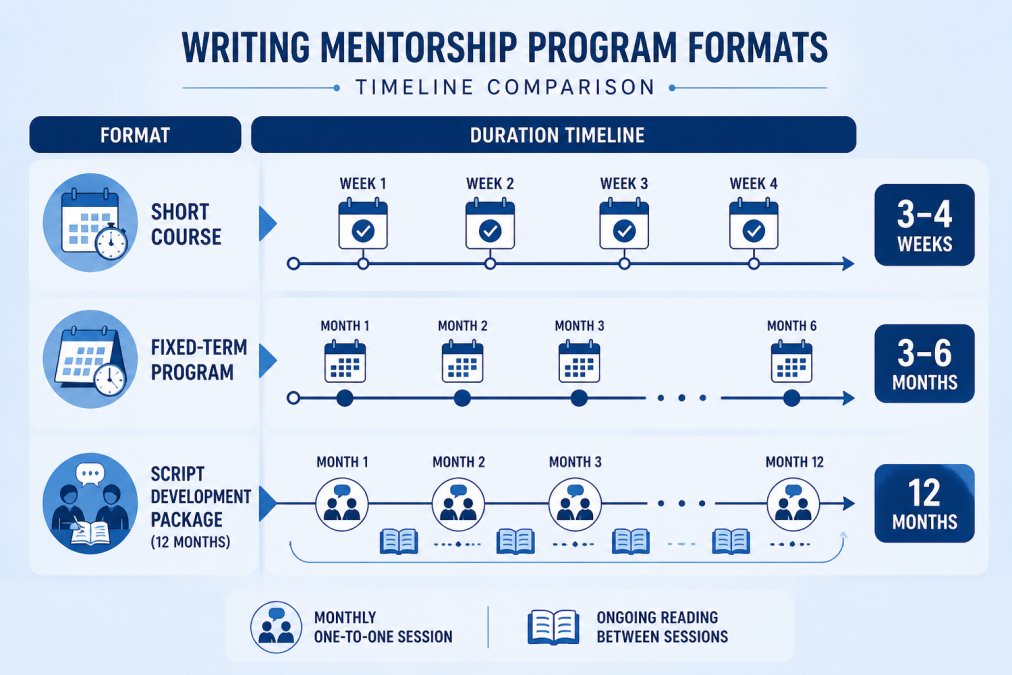
The format matters more than the length. A 12-month program with monthly one-to-one sessions and ongoing reading between sessions gives you steady momentum.
For a script or a full manuscript, a year is realistic. For a short story or a single act, weeks are enough.
The Benefits of Manuscript Development Services for Unfinished Drafts
Manuscript development services exist for the drawer draft. That half-finished novel you've been carrying around for five years is exactly the kind of project structured coaching is built for.
Development is different from editing. An editor fixes what's on the page. A development partner questions whether the chapter should exist, whether your antagonist's logic holds, and whether the ending delivers what the premise promised.
At writeinspire, our Writing Coaching & Guided Resources are built for exactly this: a professional story partner who helps you shape the manuscript while you write it, rather than taking it away and handing back a corrected version. We also offer a free Creative Writing & Words Collaboration Agreement so you can see the scope of that work before committing.
| Draft Stage | What Helps Most | Typical Format |
|---|---|---|
| Idea only | Story development and premise work | Module-based course |
| Partial draft | Accountability and structural feedback | Ongoing coaching |
| Complete draft | Rewrite decisions and publish-readiness | Manuscript development |
| Script in progress | Dramaturg-led shaping over time | 12-month program |
Setting Up Your Online Mentorship: Tools, Etiquette and Weekly Rhythm
Technical setup is where online mentorship quietly succeeds or fails, and most guides skip it entirely. The good news is that you don't need much. A reliable video platform, a shared document system, and a clear file-naming habit will carry you through a full manuscript.
Choosing Your Tools Without Overthinking It
For live sessions, agreeing on one platform and sticking to it is key, so nobody is hunting for a link five minutes before a session.
For shared documents, a simple system that works: YourName_ProjectTitle_ChapterNumber_Date. That one line saves more time than any productivity app.
For asynchronous chat, email is fine for one-to-one arrangements. None of this is mandatory. The point is to remove friction, not to build a second job out of your tool stack.
Digital Etiquette That Keeps Feedback Useful
Send pages at least 48 hours before a session so your mentor has time to read properly.
Keep asynchronous communication for logistics, not for long critiques that deserve a conversation. Tone is easily misread in writing, and a detailed critique delivered by message often lands harder than intended. Save the substantive notes for the session, or for a document with comments attached.
A Weekly Rhythm That Actually Holds
A workable weekly rhythm looks like this:
- Monday: set your writing target for the week
- Wednesday: draft or revise toward it
- Friday: send pages to your mentor
- Weekend: read their notes, note your questions
- Session: work through the questions, not the whole manuscript
What most guides miss is that one-on-one sessions are for decisions, not for reading. Your mentor should arrive already having read your pages. If they haven't, the session becomes a first read and you lose the value of their prepared thinking.
When the Setup Breaks Down
Time zones are the quiet killer of international programs. If your mentor is several hours ahead, a Friday afternoon send may land in their Saturday morning. Build in a buffer day. Communication fatigue is the other common problem: too many channels, too many messages, and the actual writing gets squeezed out. Pick one channel for chat and one for documents, and let the rest go.
What Online Mentorship Cannot Fix, and How to Avoid the Common Pitfalls
Online mentorship cannot make you write. It cannot replace the hours at the desk, and it cannot turn a premise that doesn't work into one that does. It also can't fix a manuscript you refuse to revise. Those limits are worth stating plainly, because a lot of disappointment in mentorship comes from expecting it to do something it was never designed to do.
The Pitfalls Are Predictable
Writers sign up expecting a pep talk and get honest feedback instead, then disappear. Others treat the mentor as a ghostwriter and wait for direction that never comes, because a good mentor asks questions rather than handing over answers.
There's a subtler pitfall too: mistaking activity for progress. Attending sessions, reading notes, and reorganising your outline can feel like work while the actual drafting stalls.
Matching the Format to the Problem
Different projects need different kinds of support, and choosing the wrong one is the most expensive mistake in terms of time. A short story or a single act usually needs weeks of focused feedback.
Fiction, non-fiction, and academic writing also pull mentorship in different directions. Fiction mentorship leans on voice, structure, and character logic. Non-fiction leans on argument, evidence, and reader trust.
How to Avoid the Common Pitfalls
Ask three questions before you commit to any program. First, what will I have at the end that I don't have now? Second, how much writing is expected of me between sessions? Third, what does the mentor explicitly not do? Honest programs answer all three without flinching.
At writeinspire, we're explicit that we're not a vanity publisher. We won't flatter you into a false sense of readiness or sell you a dream. What we offer is straight feedback and hard work alongside you. If you want a sense of how that plays out over a full year, our Script Development Program includes monthly one-to-one sessions with a dramaturg, ongoing script reading between sessions, and custom exercises and deadlines tailored to your project. For writers who want a lighter entry point, a Writing Consultation Creative Support session focuses on structure, style, and clarity in a single sitting.


The Australian Copyright Council's guidance for authors is worth reading before you share a full manuscript with anyone, mentor or otherwise.
Frequently Asked Questions
What are the main benefits of an online author mentorship program?
The biggest gains are steady, structured feedback on your actual pages, a mentor who knows your project across months rather than one snapshot, and accountability that keeps the draft moving. Writers also get access to mentors and peer groups they would never find locally, which widens the pool of professional guidance available. For many authors, the combination of one-to-one sessions, deadlines and honest critique is what turns a half-finished manuscript into something submission-ready.
How long does a writing mentorship program last, and can it fit around a full-time job?
Length varies with the format. Short courses and workshops can run a few weeks, while structured mentoring often runs monthly for six to twelve months, such as a 12-month script development package with monthly one-to-one sessions and reading between them. Most programs are built for writers with limited time, so an hour or two a week plus a scheduled session is workable. What matters more than hours is consistency: regular small blocks beat occasional long ones.
Are online mentorship programs effective for developing a manuscript?
They are effective when the mentor reads your work in depth and the feedback targets structure, pacing, character motivation and emotional payoff, not just line edits. A mentor who sees your draft evolve can spot patterns you cannot see yourself, which is hard to get from a one-off manuscript assessment. The writers who get the most from online author mentorship treat it as a working relationship: they bring pages, ask specific questions and act on the notes before the next session.
How do I choose between a mentorship program, a short course and hiring an editor?
An editor fixes the manuscript in front of you; a mentor builds your ability to fix the next one. If you have a finished draft and want it polished, editing suits you. If you keep starting projects and stalling, coaching addresses the habit and the craft together. Short courses work well for learning specific skills, while longer one-to-one mentoring suits writers who need sustained accountability through a full manuscript.