

Table of Contents
- Why Character-Driven Stories Feel Plotless Without Structure
- Character Arc vs Plot Structure: What's the Real Difference
- The Role of Internal Motivation in Narrative Structure
- Connecting Character Growth to External Events
- Examples of Character-Driven Plot Structures That Work
- How to Outline a Character-Driven Novel for Maximum Impact
- Common Pitfalls in Character-Focused Plotting
- Frequently Asked Questions
Last Updated: September 20, 2026
Why Character-Driven Stories Feel Plotless Without Structure
Most writers who focus on character development assume plot will follow naturally. It won't. A character-driven story without structure feels like watching someone think for 300 pages. Readers need something to hold onto. They need to see your character face obstacles, make decisions, and change as a result. This is where character-driven plot structures come in.

Many writers discover this the hard way: rich characters with deep motivations, but manuscripts that wander. The problem isn't the character work, it's the lack of structural scaffolding to hang it on.
Character-driven stories absolutely need plot. The plot doesn't exist to move action forward. It exists to force your character to make choices that reveal who they are and who they're becoming. Without that framework, even the most beautifully written character work collapses under its own weight.
Character Arc vs Plot Structure: What's the Real Difference
A character arc is internal, the journey from who your character is to who they become. Plot structure is external, the sequence of events that forces that change. Character arc is the destination; plot structure is the road.
Many writers assume a strong character arc will arrange the plot itself. That's backwards. Plot exists to challenge your character's beliefs, force difficult choices, and make growth feel earned.
Here's the practical difference:
- Character arc: Your protagonist starts closed off and ends vulnerable
- Plot structure: The events that force them to risk vulnerability (and what happens when they do)
Without plot structure, your character arc has no catalyst. Your character just thinks about change instead of being forced into it through circumstance and decision.
The strongest character-driven stories marry these two perfectly. The external events of the plot are designed specifically to test the internal beliefs your character holds. When they work together, readers feel like the character's transformation was inevitable and earned.
The Role of Internal Motivation in Narrative Structure
Internal motivation only matters if it creates external conflict. A character's fear of abandonment means nothing unless it drives them to push away the one person who could help them. Their desire for control only matters if they make choices that lose them control. Motivation must connect to behaviour; behaviour must create consequences.
Structure forces your character's internal motivations into the open. Every plot point should test what your character believes about themselves and the world.
Consider this progression: character holds a limiting belief → inciting incident challenges it → they choose based on the old belief → choices create problems → forced to choose between the old belief or risk something new → their choice determines who they become. Without structure, you show internal motivation. With structure, you prove it through action.
Connecting Character Growth to External Events
Most character-driven manuscripts fail here: writers create beautiful internal change but forget to show it through external action. Characters don't grow in a vacuum. They grow because something external happens that makes their old way of being impossible.
Here's how to connect them:
Step 1: Identify the core belief. Not a personality trait, a belief like "I'm not worthy of love" or "People always leave me."
Step 2: Create an inciting incident that challenges it. If they believe they're unworthy of love, put them where someone offers love anyway.
Step 3: Force them to choose based on the old belief. They push the person away or sabotage the relationship.
Step 4: Make that choice create external consequences. They lose the relationship, the opportunity, the thing they wanted most.
Step 5: Force a final choice. Double down on the old belief, or risk something new?
This structure holds character growth in place. Without it, readers watch characters think instead of watching them change through action.
Examples of Character-Driven Plot Structures That Work
The best character-driven stories bind the character's core wound to every external event. Here's how that works in practice:
Module 3 - Creative Story Mastery →
The Redemption Arc: Character believes they're irredeemable. The inciting incident forces them to help someone, they're the only one who can. Their instinct is to refuse or sabotage. But circumstances pull them back. Each time they help despite their self-image, they're noticed, trusted, relied upon. The climax forces a choice: abandon someone and prove themselves right, or risk being wrong about themselves.
The Coming of Age: Character has a limited worldview shaped by trauma ("the world is unsafe" or "I'm not smart enough"). The inciting incident puts them in an environment that contradicts this. Early plot points force confrontations with their assumption. They make choices based on the old belief and face consequences that prove it incomplete. The climax tests whether they'll revert under pressure or commit to the new understanding.
The Transformation Through Relationship: Character's isolation exists because they believe connection leads to pain. Another character persistently offers genuine connection. The character's response is to push them away, creating plot tension. Each scene of increasing vulnerability is also increasing risk. Small choices to let someone in create external consequences: they become visible, known, accountable. The climax forces a choice between protecting themselves through distance or risking everything through connection.
The Reckoning: Character has built a life avoiding or denying their past. The inciting incident brings the past into the present, a person reappears, a secret surfaces. Their instinct is to run, hide, or lie. But the plot systematically closes escape routes. Each attempt to avoid the past creates new problems. By the climax, they must choose: face what they've done and who they are, or lose everything they've built.
The key pattern: external plot events test the character's core wound directly. Their response reveals their current belief. Consequences either reinforce the old belief (deeper trouble) or crack it open (growth). Writers often miss this, creating thematically relevant events that don't mechanically test the specific wound. A character who believes they're unlovable needs to encounter genuine love and choose to reject or accept it. A character who believes they're powerless needs a situation where their choice matters. Structure only works when external plot directly pressure-tests the internal belief.
How to Outline a Character-Driven Novel for Maximum Impact
Here's a practical framework for outlining character-driven stories. The biggest problem: turning internal change into external action. Most writers know how to write internal realisation but struggle with what comes next, proving it through behaviour in a scene.
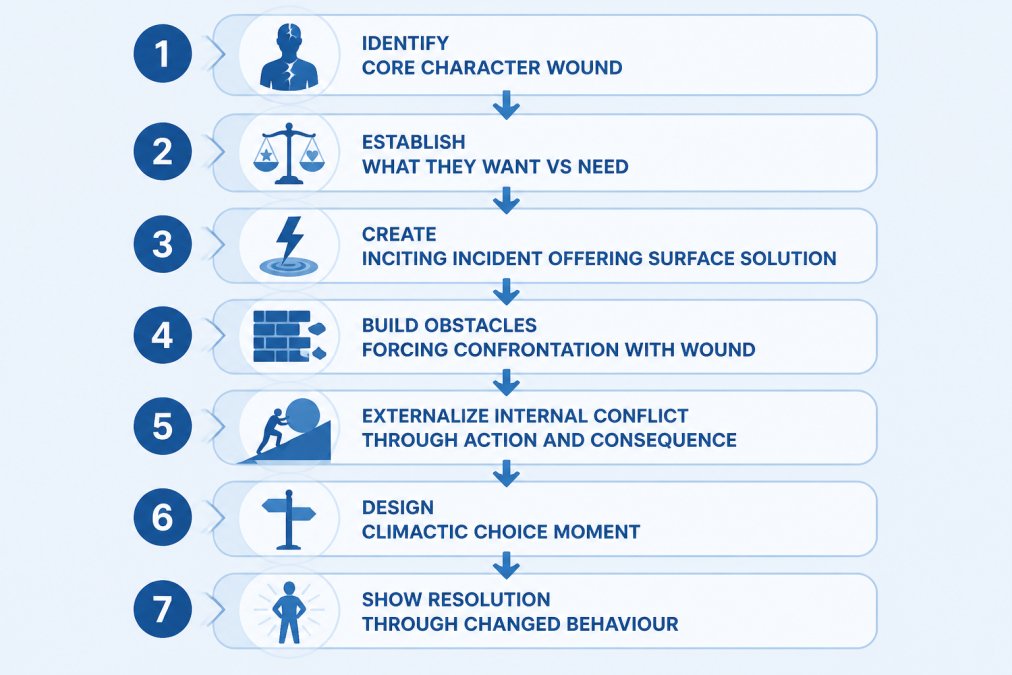
Start with the character's core wound. Not their flaw, the deeper belief beneath it. "I'm not good enough" or "People will hurt me if I let them close." This is your north star.
Identify what they want versus what they need. They might want success but need connection; want control but need to trust. Plot is built around this gap. The inciting incident offers what they want; the plot forces them to confront what they need.
Create an inciting incident that offers what they want. It looks like the answer to their problem but contains a hidden test of their core wound.
Build obstacles that force them to confront their core wound. Most outlines list obstacles without connecting them to character belief. Instead, design each obstacle as direct pressure on the wound. If your character believes they're unworthy, create a situation where someone offers something good and they must decide whether to accept or sabotage it.
The critical step: externalize the internal conflict. A character realises "Maybe I'm not as unlovable as I thought", but then what? Turn it into a scene: internal realisation → new desire or impulse → action in a scene with stakes → external consequence → consequence validates or threatens the new belief.
Example: Character believes they're unlovable, then realises this might be wrong. Realisation alone isn't plot. Externalisation happens when they act: tell someone the truth, ask for help, show up for someone else. That action creates a consequence, acceptance, rejection, complication, or transformation, which forces another choice. This is how internal change becomes plot.
Without externalisation, your novel becomes a character study. Readers watch someone think and feel but never see them act differently. For each major scene, answer: "What old belief does this test?" "What new behaviour does the character attempt?" "What external consequence results?"
Design the climax as a choice, not an action. It should be about whether they choose to risk the old belief or cling to it, externalised through action that proves their new understanding, or doesn't.
Show the resolution through changed behaviour. Don't tell readers they've grown.
Common Pitfalls in Character-Focused Plotting
Mistaking internal conflict for plot. A character wrestling with doubt isn't plot. Plot is when that doubt forces a choice that creates external consequences.
Frequently Asked Questions
What's the key difference between a character-driven story and a plot-driven story?
In a plot-driven story, external events happen to the character and they react. In a character-driven story, the character's internal conflict and choices drive what happens next. Character-driven narratives ask 'who is this person and how will they change?' while plot-driven stories ask 'what happens next?' Both need structure, but character-driven stories require plot that directly challenges the character's core beliefs or flaws.
How do you maintain tension in a character-focused narrative without relying on external action?
Tension in character-driven stories comes from emotional stakes and decision-making. Raise the cost of each choice your character makes. Force them into situations where their internal conflict becomes visible through dialogue and action. Use scene goals that put their values in direct conflict with what they want. Every scene should ask something of the character that matters to their growth, not just move plot forward.
Can a character-driven story have a fast-paced plot?
Yes. Pace isn't about action count, it's about how quickly stakes escalate. A character-driven story moves fast when each scene raises the emotional or relational stakes. External events (conflict, obstacles, deadlines) can happen quickly; what matters is that they force your character into difficult decisions that reveal who they are and push them toward change. Speed and character depth aren't opposites.
What are the common pitfalls when writing character-driven stories?
The biggest mistake is confusing introspection with plot. A character thinking about their problems isn't the same as facing them. Other pitfalls include: no clear inciting incident to disrupt the character's world, stakes that feel internal only (readers need external consequences), pacing that drags because nothing forces decisions, and character growth that happens offstage rather than through earned scenes. Character-driven stories still need structure that externalises internal conflict.