

Table of Contents
- Coaching vs Independent Writing Groups: The Core Differences
- Benefits of Professional Writing Coaching
- Writing Group Best Practices and Peer Support
- How to Start an Independent Writing Group
- Cost Analysis: Coaching and Group Options Compared
- Making the Right Choice for Your Writing Journey
- Conclusion
Coaching vs Independent Writing Groups: The Core Differences
The choice between professional writing coaching and independent writing groups isn't about picking the objectively "better" option. It's about matching your writing stage, personality, and goals to an approach that actually works for how you operate. Writers who succeed pick the model that fits their temperament and their manuscript's needs, not the trendy one.
Coaching vs independent writing groups sit at opposite ends of a spectrum. One gives you a dedicated expert guiding your manuscript through its full development. The other gives you a peer community holding you accountable while you figure it out together. Both work. The difference is who they work for.

Structure and Format
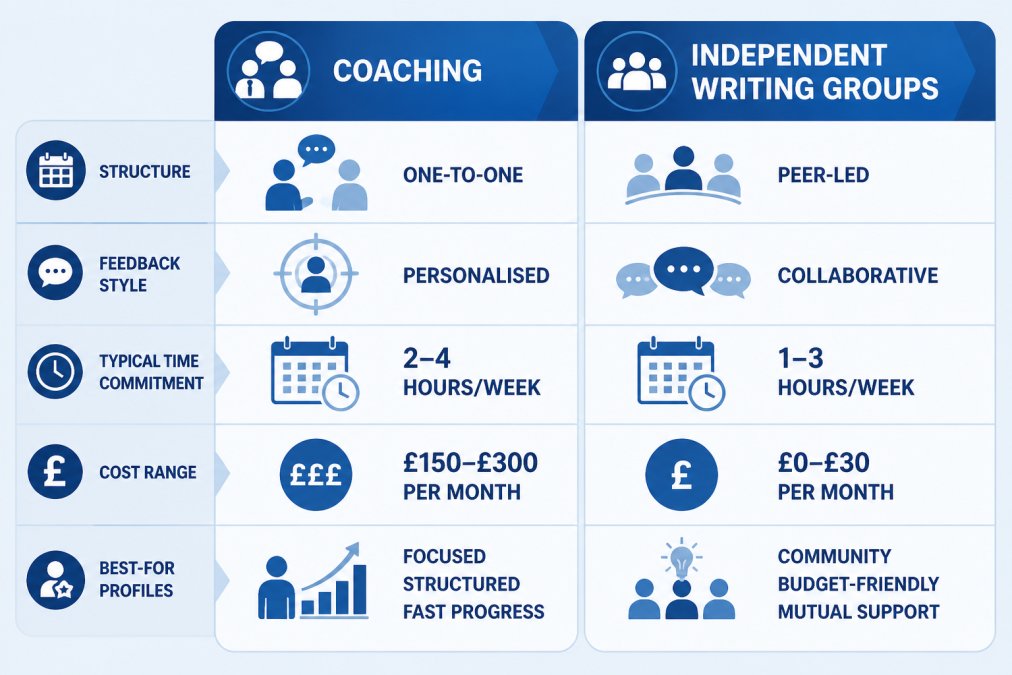
Professional writing coaching is fundamentally one-on-one. You meet with a single coach with deep experience in your genre or manuscript type, and that person's attention is on your work and your development. The feedback is tailored to your specific manuscript, not a generic template.
Independent writing groups are peer-led and collective. Five to twelve writers meet regularly, each bringing work for critique. Everyone gets feedback from everyone else. The group runs itself, with no single person in charge. Feedback comes from writers at various skill levels.
This structural difference cascades into everything else. Coaching is bespoke; groups are democratic. Coaching scales with your needs; groups scale with their membership.
Feedback and Accountability Mechanisms
In coaching, feedback is filtered through one person's expertise and delivered directly to you. Your coach identifies the core problems and tells you exactly what needs fixing and why. The feedback is authoritative, though potentially harder to hear when it's the only voice in the room.
In a writing group, feedback is distributed. One member loves your dialogue. Another thinks your pacing drags. A third identifies character inconsistencies. You get multiple perspectives, which is valuable, but you're responsible for synthesising conflicting opinions and deciding what applies to your work.
Accountability works differently too. In coaching, you're accountable to your coach through a financial commitment and regular check-ins. In groups, you're accountable to your peers, and that only works if your group has strong norms around deadlines and showing up.
Benefits of Professional Writing Coaching
Professional coaching isn't for everyone, but for writers at certain stages, it's the difference between finishing and abandoning a manuscript.
One-on-One Manuscript Development
When a coach reads your manuscript, they're reading for one thing: how to make your specific story work. They're not comparing you to other writers or splitting attention across multiple projects. They're looking at your narrative arc, character development, dialogue, and pacing, asking what your story needs to become what it's trying to be.
This is particularly powerful when you're stuck. You've written 40,000 words and something feels wrong, but you can't name it. A coach can often spot it quickly: your protagonist's motivation isn't credible, your subplot is stealing focus, or your ending doesn't earn its emotional weight. They can show you exactly where the problem lives and give you concrete steps to fix it.
Coaching also means you're not waiting for group feedback cycles. If you need input on a rewritten scene, you get it quickly. That speed matters when you're in the flow of a project.
Personalised Skill Development
A coach can tailor their approach to your specific gaps. If you're strong on character but weak on plot structure, they focus there. If your dialogue sparkles but your action scenes feel static, that's where the work goes. They're not teaching a generic curriculum; they're building the skills your manuscript actually needs.
This personalisation extends to your writing habits and discipline too. A good coach reads you and adjusts their approach accordingly. That flexibility is something a group, by definition, can't offer.
Writing Group Best Practices and Peer Support
Independent writing groups work brilliantly for writers who thrive on peer community, want multiple perspectives, and have the judgment to synthesise conflicting feedback.
Building a Culture of Constructive Feedback
The difference between a writing group that accelerates your work and one that demoralises you is culture. Groups that succeed establish explicit norms around feedback from the start. They define what constructive feedback looks like: specific, not vague; kind, not cruel; focused on the work, not the writer.
A strong group teaches members how to give feedback that actually helps. Instead of "I didn't like this character," members learn to say: "The character's decision in Chapter 3 contradicts what we learned in Chapter 1. That inconsistency pulled me out of the story." Specific, traceable, actionable.
The best groups also rotate who gives feedback and in what order. Some use written feedback so people can revise their thoughts before speaking. Others build in time for the writer to ask clarifying questions before responding.
Group Dynamics and Creative Community
What peer-led groups offer that coaching can't is the sense of shared creative struggle. You're surrounded by other writers wrestling with the same problems you are. That creates a different kind of accountability and support.
Groups also build writing community in a way that matters psychologically. You're part of something. You show up not just to get feedback but to be part of a tribe. That sense of belonging keeps writers showing up even when the work is hard.
The trade-off is that group feedback is only as good as your group's skill level. The best groups have a range of experience levels and a culture where everyone's work is taken seriously.
How to Start an Independent Writing Group
If you've decided a peer-led group fits your needs, the structure matters more than you'd think.
Finding Your People and Setting Expectations
Start by being specific about what you're looking for. Do you want writers working in similar genres, or writers at similar skill levels, or writers committed to finishing a manuscript in the next year? Be clear. This prevents resentment later.
When recruiting members, have a conversation about commitment. How often will you meet? What's the format? How much work does each person bring? What happens if someone misses meetings? These conversations feel awkward, but they prevent problems later.
Size matters too. Five to eight members is ideal. Large enough that you get diverse feedback, small enough that everyone gets meaningful attention.
Establishing Meeting Rhythm and Critique Protocols
Consistency is everything. A group that meets the same day and time every month is more likely to stick together than one that reschedules constantly.
Establish a clear protocol for how feedback works. Do people submit work a week in advance so members can read beforehand? Does the writer listen silently while getting feedback, or do they defend their choices? How long does each person get?
The protocol that works best depends on your group's goals. If you want deep developmental feedback, people need time to read beforehand. If you want to build writing community and accountability, you might meet and do writing sprints together. Both are valid. Just be explicit about which you're doing.
Cost Considerations: Coaching and Group Options
The financial difference between these approaches is real, but it's not the whole story. It's worth thinking about what you're actually paying for and whether the investment aligns with your goals.
Professional writing coaching ranges from one-off consultations to ongoing year-long programs. The investment is direct, you're paying for expert time and attention.

Independent writing groups typically cost nothing or a small shared fee to cover meeting space or shared resources. The trade-off is that you're not paying for expert guidance. You're paying for community and accountability from peers.
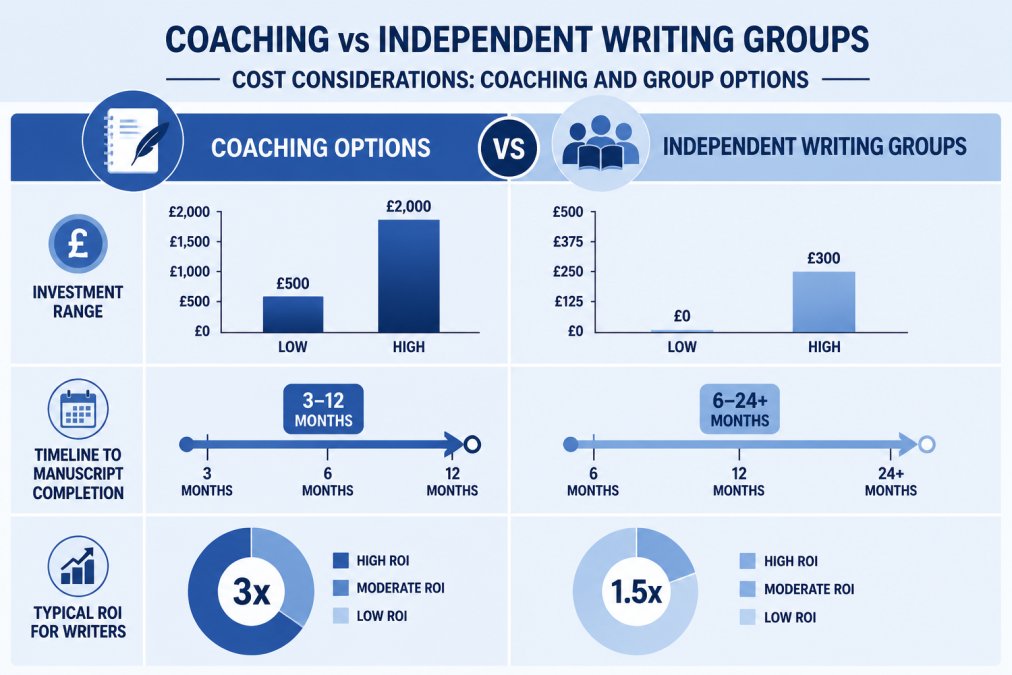
The real cost question is ROI. A writer who invests in coaching and finishes a manuscript in six months has paid for acceleration and expertise. A writer in a group who takes two years to finish because the group lacks accountability might have saved money but lost time.
There's also a hybrid option many writers don't consider: start with a group for accountability and community, then bring in a coach for the final developmental edit when your manuscript is close to done.
Making the Right Choice for Your Writing Journey
The decision between coaching vs independent writing groups comes down to three things: your personality, your manuscript's stage, and your available time.
Personality-Based Matching
Some writers are self-starters who thrive with external structure and expert guidance. They want someone to tell them what's working and what isn't. For these writers, coaching is often the right choice.
Other writers are collaborative by nature. They think better in conversation. They want multiple perspectives. They're energised by community. For these writers, a group is usually the better fit.
Be honest about which you are. The best coaching in the world won't work for a writer who needs peer community. The best group won't help a writer who needs expert guidance and doesn't yet trust their own judgment.
Hybrid Models That Combine Both Approaches
Many writers find that the answer isn't either/or. It's both, sequenced strategically.
One common pattern: start in a group to build accountability and community while you're drafting. Once you have a rough draft, bring in a coach for developmental feedback. The coach helps you see big structural problems and guides you through major revisions. Then, optionally, return to the group for final polish.
Another pattern: work with a coach for intensive manuscript development, then join a group to maintain your writing practice and community between projects.
The hybrid approach works because it acknowledges that coaching and groups serve different functions. Coaching excels at expertise and acceleration. Groups excel at community and accountability. You don't have to choose one. You can sequence them based on what your manuscript and your writing practice need at each stage.
The real measure of success isn't which option you choose. It's whether you finish. Writers who finish are the ones who picked an approach that matches how they actually work, not how they think they should work. If you're someone who needs expert guidance and responds well to one-on-one attention, coaching delivers that. If you're energised by peer community and thrive with collaborative feedback, a writing group is your answer. If you're somewhere in between, a hybrid approach gives you both.
At writeinspire, we work with writers across all three approaches. Whether you're seeking one-on-one manuscript development through our Writing Coaching & Guided Resources, exploring structured support through our Creative Story Mastery program, or building your own peer community, the foundation is the same: rigorous craft, real accountability, and the belief that your story deserves to be finished properly. The best next step is the one that fits your temperament and your manuscript's needs right now.

Frequently Asked Questions
What are the primary benefits of professional writing coaching?
Professional writing coaching offers one-on-one attention focused on your specific manuscript, craft gaps, and writing goals. A coach helps you shape story structure, develop characters with emotional depth, strengthen dialogue, and maintain momentum until completion. Unlike peer feedback, coaching provides expert guidance grounded in years of craft experience. It's particularly valuable if you've been carrying an unfinished manuscript for years or struggle with accountability. The relationship is built on moving your work forward consistently, not just critique.
How do independent writing groups foster peer accountability?
Independent writing groups create accountability through regular meetings, shared deadlines, and mutual commitment to read and critique each other's work. Members know they'll report progress or present pages at the next session, which naturally motivates output. The peer-support dynamic differs from coaching: you're accountable to your writing community, not a single expert. Groups work best when members establish clear expectations upfront, agree on feedback styles, and maintain consistent attendance. This collaborative learning environment builds writing discipline and keeps projects moving through social commitment rather than professional obligation.
Can you participate in both a writing group and coaching simultaneously?
Yes, and many writers do. A hybrid model works well: coaching provides deep structural and craft guidance for your manuscript, while a writing group offers peer support, community, and regular feedback loops. Some writers use coaching during intensive manuscript phases and maintain group membership for ongoing creative accountability. The combination addresses different needs: coaching handles complex story problems and skill gaps, whilst the group sustains momentum and creative confidence. However, managing both requires time commitment and clear boundaries about which work you're developing in each space.
Is a writing coach better for beginners or experienced authors?
Both benefit from coaching, but for different reasons. Beginners need coaching to build foundational craft skills and avoid years of trial-and-error. Experienced authors often hire coaches to break through specific problems: finishing a manuscript, revising structural issues, or elevating their work toward publication. A coach's value isn't about your experience level; it's about having someone skilled enough to see what your manuscript needs and guide you toward it. The right coach meets you where you are and accelerates your progress, whether you're on your first draft or your fifth.
What should you look for when joining an independent writing group?
Look for groups where members share your writing genre or goals, so feedback feels relevant. Check that the group has clear meeting schedules, established critique protocols, and a culture of constructive feedback rather than harsh critique. Ask about group size (smaller groups offer more feedback per person), how long members have been together, and whether they focus on manuscript development or general writing practice. Trust your instinct about the people: you'll spend time with them regularly, so personality fit matters. The best groups balance honest critique with genuine encouragement.
This article was written using GrandRanker