

Table of Contents
- What Makes Creative Writing Worth Learning
- How to Improve Fiction Writing Skills Step by Step
- Character Development: Creating People Readers Care About
- Plot Structure and Narrative Arc: Building Your Story's Backbone
- How to Structure a Novel Manuscript from Start to Finish
- Creative Writing Exercises for Beginners That Actually Work
- Essential Creative Writing Tools for Authors
- Common Beginner Mistakes and How to Avoid Them
- Frequently Asked Questions
Last Updated: September 25, 2026
What Makes Creative Writing Worth Learning
Creative writing isn't just about crafting stories, it's about learning to see the world differently and translating that vision onto the page. At writeinspire, we've worked with hundreds of writers over three decades, and the ones who succeed aren't necessarily the most naturally gifted. They're the ones who understand that creative writing basics are learnable skills, not mysterious talents you either have or don't.

The truth is simpler than most people think. Creative writing fundamentals, character development, plot structure, dialogue, pacing, follow patterns you can study, practise, and improve. Once you grasp these foundations, your imagination has a framework to work within, which paradoxically makes it more creative, not less.
Learning creative writing teaches you how to communicate with precision and emotion simultaneously. You discover how to show rather than tell, how to build tension, how to make readers care about people who don't exist. These aren't abstract skills. They transfer to emails, presentations, proposals, anywhere clarity and engagement matter.
How to Improve Fiction Writing Skills Step by Step
Building Your Foundation
Before you can improve, you need to know what you're building on. Many writers skip this phase entirely, which is why they plateau. They write intuitively, hit a wall, and don't understand why their work isn't landing.
Start by reading deliberately. Not passively consuming books, but actively studying them. When you read, ask: Why did this scene work? How did the author create tension here? What made me care about this character? This is how you internalize the patterns that make fiction work.
Next, write badly. Seriously. Most beginners are terrified of writing something terrible, so they write cautiously and produce something mediocre instead. Give yourself permission to write a first draft that's messy, clunky, and full of clichés. That's the entire point of a first draft.
Then commit to a routine. You don't need hours every day. Thirty minutes, five days a week, beats sporadic weekend marathons. Consistency builds the neural pathways that make writing easier over time. Your brain learns to enter the creative state faster when you show up regularly.
Developing Your Unique Voice
Your voice is the fingerprint of your writing, the way your sentences move, the rhythm of your dialogue, the metaphors you reach for. It's not something you find in week one. It develops through years of writing and reading, but you can accelerate it by being intentional.
Read writers whose voice you admire, then write in response to them. Not copying, responding. Notice what they do with sentence length, punctuation, word choice. Then deliberately experiment with those techniques in your own work.
Write about what matters to you. Readers sense when you're writing about something you genuinely care about versus something you think will sell. Your voice emerges strongest when you're exploring territory that fascinates you, even if nobody else thinks it's interesting yet.
The creative writing basics include understanding that your voice will sound like you, your particular way of seeing, your particular cadence, your particular obsessions. That's not a flaw to overcome. That's your competitive advantage.

Character Development: Creating People Readers Care About
Characters are the engine of fiction. Plot is what happens; character is why it matters. A brilliant plot with flat characters is forgettable. A simple plot with compelling characters is unforgettable.
Strong characters need three things: clear motivation, authentic flaws, and change over the course of the story. Motivation answers why your character does what they do. Not surface motivation, the real reason underneath. A character might say they want to win a competition, but what they actually want is to prove they're worthy of love. That deeper motivation is what drives the story.
Flaws aren't decorative. They're the source of conflict. A character's flaw should create genuine obstacles to what they want. If your protagonist is stubborn and their journey requires compromise, that's organic conflict. If they're stubborn but the plot doesn't challenge that stubbornness, it's just a personality trait.
Change is the payoff. By the end of the story, your character should be different, not necessarily happier, but transformed by what they've experienced. This is the narrative arc. It's what separates a story from a sequence of events.
The creative writing community resources emphasise that character work is iterative. You don't nail your character on the first pass. You discover them through writing, revising, and asking hard questions about their choices.
Plot Structure and Narrative Arc: Building Your Story's Backbone
Every story has a shape. Understanding that shape, the narrative arc, is foundational to creative writing basics.
The classical structure has five movements: exposition (setup), inciting incident (the event that disrupts everything), rising action (escalating complications), climax (the point of maximum tension), and denouement (resolution). Not every story follows this exactly, but most successful ones follow the underlying logic: introduce a world and character, disrupt their equilibrium, force them to respond, reach a breaking point, and show the consequences.
Module 1 - Creative Story Mastery →
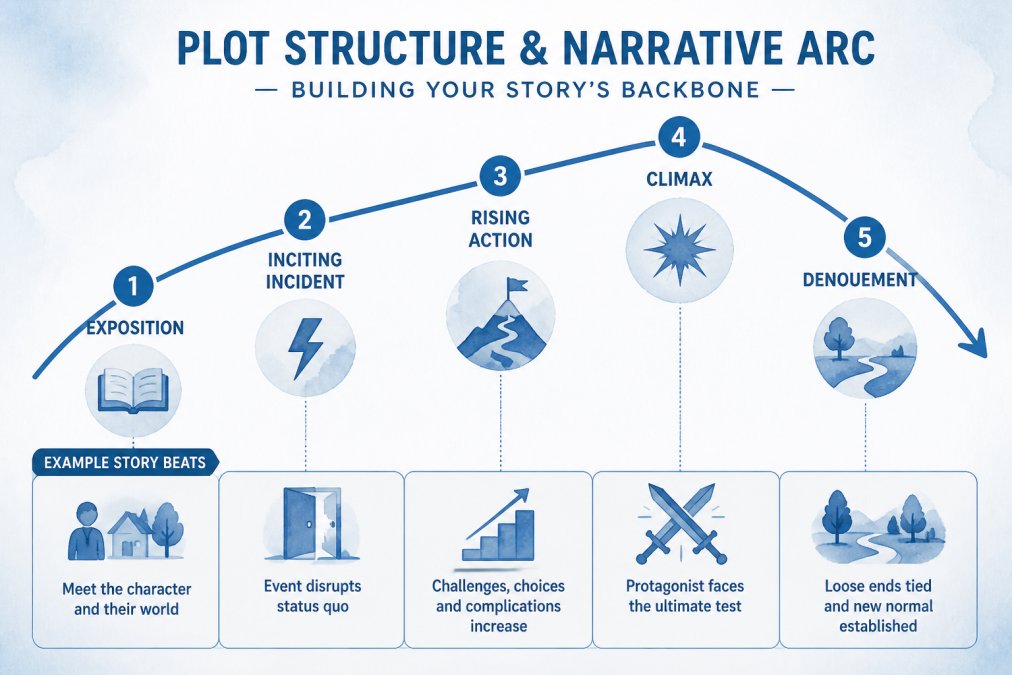
The inciting incident is crucial. It's the moment everything changes, the event that makes the story necessary. Without a clear inciting incident, your story drifts. Readers don't know what they're supposed to be invested in.
Rising action is where you escalate. Each scene should raise the stakes or deepen the character's dilemma. If your scenes feel repetitive or stalled, you're probably not escalating enough. The character should be in worse shape (emotionally, practically, or both) at the end of each scene than at the beginning.
The climax is the point where the character faces their central conflict directly. They can't avoid it anymore. The outcome is uncertain until it happens. This is where tension peaks.
Denouement is the aftermath. It's brief, just enough to show the new equilibrium. Don't linger here. The story ends when the central question is answered.
How to Structure a Novel Manuscript from Start to Finish
A novel is a long commitment. Understanding structure before you start saves months of frustration.
Begin with a premise: a situation, a character, and a central question. Not a detailed outline, just clarity on what the story is fundamentally about. At writeinspire, we've found that writers who can articulate their premise in one sentence rarely get lost in the manuscript.
Then outline at whatever level serves you. Some writers need a scene-by-scene breakdown. Others need only major plot points. The outline isn't the story, it's a map. You'll deviate from it, and that's fine. The point is to have direction.
Write in sections. Most novels are 70,000 to 100,000 words. That's intimidating as a single task.
Creative Writing Exercises for Beginners That Actually Work
Dialogue-only scenes: Write a scene using only dialogue. No narration, no description, no action tags. Just what characters say. This forces you to convey emotion, tension, and information through speech alone. You'll discover how much dialogue normally carries that you didn't realise.
Essential Creative Writing Tools for Authors
You don't need expensive software to write well. You need tools that get out of your way and let you focus on the work.
Common Beginner Mistakes and How to Avoid Them
Overexplaining motivation. Readers don't need to understand why a character does something before they do it. Show the action first, reveal the motivation later. This creates mystery and keeps pages turning.
Frequently Asked Questions
What are the fundamental elements of a compelling story?
A compelling story combines character, conflict, and consequence. Your protagonist needs a clear goal, an antagonist or obstacle blocking them, and genuine stakes. The narrative arc, moving from exposition through inciting incident to climax, creates tension that keeps readers engaged. Theme gives your story meaning beyond the surface plot. Together, these elements create a story worth telling and worth reading.
What is the difference between showing and telling in fiction?
Showing means using sensory details and action to reveal character and emotion rather than stating them directly. Instead of 'She was angry,' show her jaw clenching, her fists tightening, her voice dropping to a whisper. Telling is summary: efficient but distant. Strong fiction balances both, showing the crucial emotional moments and telling only when pace demands it. This balance keeps readers immersed rather than observing from outside.
How do I develop a unique writing voice?
Your voice emerges from how you combine word choice, sentence rhythm, perspective, and tone. Read widely to absorb different styles, then write regularly to find what feels natural to you. Don't imitate; instead, notice what you naturally emphasise, what details catch your attention, how you naturally speak. Your voice becomes distinctive when you write authentically about what matters to you. It develops through drafting, revision, and permission to be yourself on the page.
What are the most common mistakes beginner writers make?
Beginners often tell rather than show, create flat characters without clear motivation, rush through the opening without establishing stakes, and lose pacing by over-explaining. Many abandon projects mid-draft instead of pushing through revision. They also write to impress rather than to tell the story they actually care about. The antidote: write regularly, finish first drafts without editing, revise with intention, and focus on the story's core truth rather than perfect prose.
How can I improve my character development skills?
Start by understanding your character's core motivation, what do they want and why? Create their internal conflict (what they fear or believe that holds them back) and external conflict (the obstacle blocking their goal). Show character through action and dialogue, not description. Let them make choices that reveal who they are. A strong character arc shows how they change or resist change through the story. Practice building characters with clear goals, flaws, and growth potential.
How do I structure a narrative arc effectively?
Begin with exposition that establishes your world and character. The inciting incident disrupts their normal life and forces them into the story. Rising action builds tension through escalating obstacles and complications. The climax is the moment of highest stakes where the protagonist must act. Falling action shows the consequences of that choice, and denouement resolves the story. Each phase serves a purpose. Strong structure keeps readers moving forward because they always want to know what happens next.