

Table of Contents
- Why Organizing Story Ideas Matters for Your Writing
- Set Up a Capture System for Your Story Ideas
- Best Software for Writers: Digital vs. Analog Organization
- Create a Story Bible Template to Track Characters and Plot
- Categorize and Tag Your Ideas for Easy Retrieval
- Creative Writing Organisation Tips: From Decluttering to Development
- Systematize Idea Retrieval and Overcome Creative Overwhelm
- Conclusion
Most writers accumulate ideas like squirrels collecting acorns. A brilliant character concept arrives at 2 AM. A plot twist surfaces during your morning commute. A world-building detail emerges mid-conversation. Without a system to capture and organize these scattered story ideas, they vanish or pile up in chaotic notes that become impossible to navigate when you actually sit down to write.
The real cost isn't just lost ideas, it's creative paralysis. When your story concepts live scattered across notebooks, voice memos, and sticky notes, you can't see the connections between them. You don't know which ideas are half-baked and which are ready to develop. You waste energy searching for that one character detail you know you wrote down somewhere. The mental overhead of managing disorganised ideas drains the energy you need for actual writing.

At writeinspire, we've worked with many writers who struggled with this exact problem. The ones who got unstuck weren't necessarily more talented, they were the ones who built a system. They could see their ideas clearly, retrieve them when needed, and develop them intentionally. That shift from chaos to clarity changes everything about how you approach your manuscript.
Set Up a Capture System for Your Story Ideas
Before you can organize anything, you need to capture it. Most writers skip this step or do it haphazardly, which defeats the purpose. You need a single location where every story idea lands immediately, without friction or decision-making.
Brain dump as your starting point
Start by getting everything out of your head and into one place. This is your brain dump, a raw, unsorted collection of every story idea, character name, plot possibility, and narrative fragment you've been holding onto. Don't worry about quality or relevance yet. The goal is to externalize everything so you can see what you're actually working with.
Spend an hour (or a weekend, if you've got years of accumulated ideas) writing down every story concept you remember. Include half-formed ideas, character sketches, "what if" scenarios, and plot fragments. Write them as bullet points, full paragraphs, or scattered phrases, the format doesn't matter at this stage.
This brain dump serves two purposes. First, it clears mental space. You stop using your brain as a filing cabinet and free up that cognitive load for actual creative work. Second, it gives you a baseline inventory. You'll likely discover ideas you'd forgotten about, notice patterns in what you're drawn to, and see gaps in your creative output.
Choose your capture tool
Your capture system needs to be fast, always available, and designed for quick input. The best tool is the one you'll actually use consistently. Some writers prefer digital notebooks; others swear by physical paper.
Digital options offer searchability and sync across devices. A simple note-taking app like Apple Notes, Google Keep, or Notion lets you capture ideas on your phone, tablet, or computer without friction. The advantage is that your ideas are backed up, searchable, and accessible wherever you are.
Analog options, a dedicated notebook, index cards, or a physical journal, appeal to writers who think better on paper. The tactile experience of writing by hand engages different parts of your brain, and some writers find it easier to develop ideas when they're not staring at a screen.
The decision comes down to your workflow. If you're already living in digital tools and sync between devices matters, go digital. If you find yourself reaching for pen and paper naturally, lean into that. The system only works if you use it, so choose based on what feels frictionless to you.
Best Software for Writers: Digital vs. Analog Organization
How to organize scattered story ideas depends partly on whether you think better with digital tools or physical ones. Neither approach is objectively better, what matters is alignment with your actual writing practice.
Digital organisation systems offer real advantages for writers managing multiple projects. You can tag ideas, search across your entire collection, and link related concepts together. A digital system scales well when your idea inventory grows. You can also integrate your story ideas with your actual manuscript if you're using writing software like Scrivener or Google Docs. However, digital tools can feel impersonal to some writers, and the temptation to endlessly tweak your system instead of writing is real.
Analog systems, notebooks, index cards, whiteboards, force you to be more intentional. You can't search infinitely; you have to know roughly where something is. Many writers find that the constraint actually helps. Physical organisation also feels more tactile and creative. The downside is that analog systems don't scale as easily, and you can't easily link ideas across multiple notebooks or search for a specific concept.
The hybrid approach works well for many writers: capture ideas quickly in a digital note-taking tool, then transfer the ones you're actively developing into a physical notebook or index card system for deeper work. This gives you the speed of digital capture with the creative engagement of analog development.
Create a Story Bible Template to Track Characters and Plot
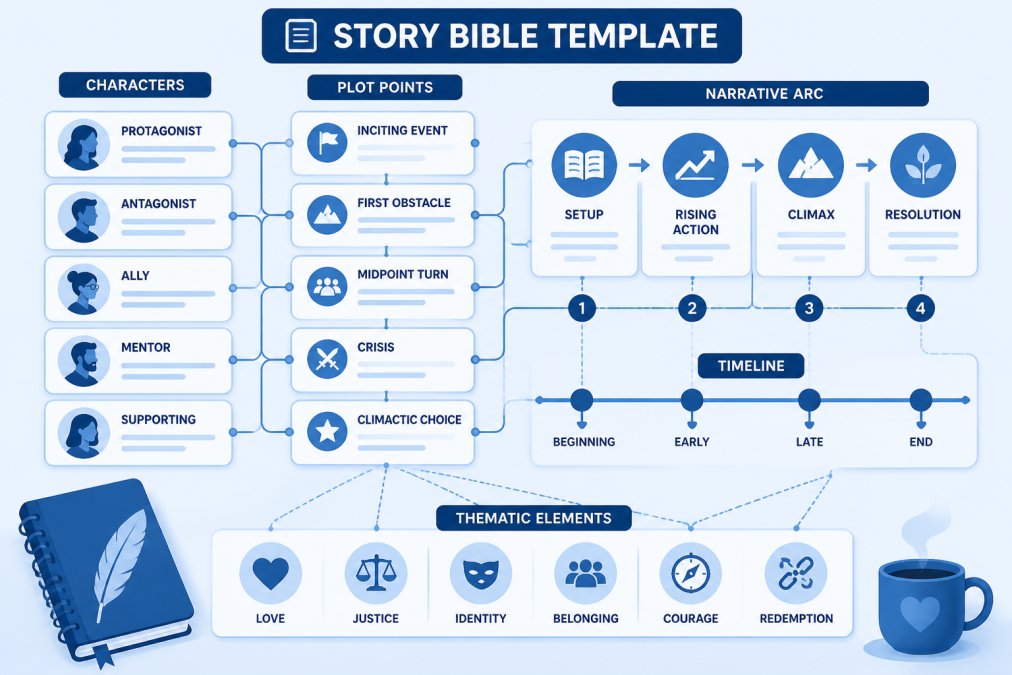
A story bible is your centralised reference document for everything about your manuscript: characters, plot points, timeline, world-building details, narrative arc, and thematic threads. It's not a substitute for your actual manuscript, it's a working document that keeps all the structural elements visible while you're drafting.
What belongs in your story bible
Your story bible should include character profiles with names, ages, backgrounds, motivations, and how they change throughout the story. Add plot points in sequence, noting what happens at each turning point and why. Include your narrative arc, the major structural beats of your story from beginning to end. Add a timeline showing when events occur relative to each other. Note your themes and the specific scenes that explore them.
Don't overcomplicate it. Your story bible exists to serve your writing, not to become a separate creative project. Some writers include visual references, character inspiration images, location sketches, mood boards. Others keep it purely text-based. The format depends on what helps you think clearly about your story.
Linking ideas to characters and narrative arc
The power of a story bible is that it shows connections. When you're developing a character, you can see exactly which plot points involve them and how they change across the narrative arc. When you're revising a scene, you can check it against your thematic notes to ensure it serves the story's deeper purpose.
Create explicit links between your scattered story ideas and the characters or plot points they belong to. If you have a brilliant dialogue snippet, note which character says it and in which scene. If you have a world-building detail, link it to the location where it matters. This transforms your scattered ideas from orphaned fragments into integrated parts of a coherent story.
Categorize and Tag Your Ideas for Easy Retrieval
Once you've captured your ideas, you need a system for finding them again. Categorisation and tagging are how you transform a pile of notes into an organised, retrievable inventory.
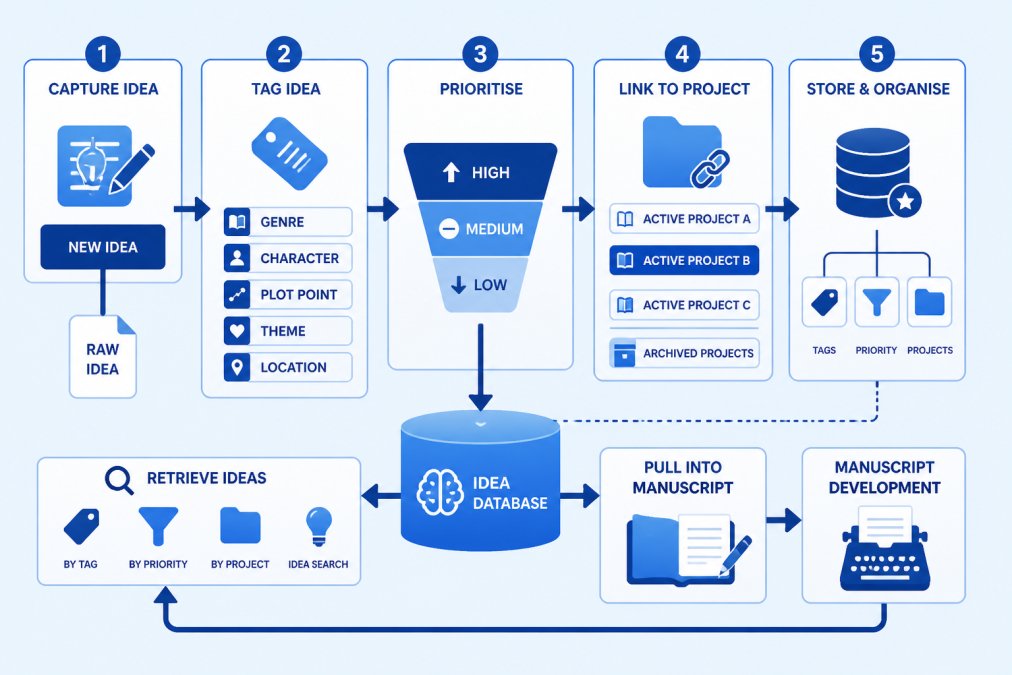
Create a tagging system that reflects how you actually think about your stories. Common tags include genre, character name, plot point, theme, location, or story status (rough idea, developed, ready to write, discarded). Use consistent tags across all your ideas so you can filter and search effectively.
For example, if you tag ideas with both a character name and a plot element, you can quickly pull up "all ideas involving your protagonist" or "all climax-related concepts." This retrieval speed matters when you're in the middle of drafting and need to remember that character detail you captured weeks ago.
Prioritise your ideas too. Mark which ones are core to your current manuscript and which are possibilities for future projects. This prevents creative overwhelm, you're not trying to develop every idea simultaneously, just the ones that matter for the story you're actively writing.
Creative Writing Organisation Tips: From Decluttering to Development
How to organize scattered story ideas also means knowing what to do with ideas that aren't working anymore. Decluttering and developing are both part of a functional system.
Prune ideas that no longer fit
Not every idea you capture will make it into your manuscript. Some will feel brilliant at 2 AM and silly in daylight. Others will conflict with your story's direction as it evolves. Some will be genuinely good but not right for this particular project.
Review your idea collection regularly, monthly or quarterly depending on how actively you're writing. Be honest about what's still serving your story and what's just taking up mental space. Delete or archive ideas that no longer fit. This isn't loss; it's clarity. Removing ideas that don't belong makes room for the ones that do.
Keep an "archive" folder for ideas you're cutting from your current project but might use later. You're not losing them permanently; you're just removing them from your active working inventory so they don't create noise.
Flesh out plot bunnies into outlines
A plot bunny is a story idea that catches your attention but hasn't been fully developed. The creative workflow involves taking these rough concepts and expanding them into workable outlines.
When you encounter a plot bunny worth developing, spend time asking questions about it. What's the core conflict? Who are the main characters involved? What's at stake? How does it resolve? Write out answers to these questions, turning the vague idea into a structured outline with actual story beats.
This process of fleshing out ideas is where scattered fragments become real story material. It's also where you discover whether an idea has actual depth or just initial appeal. Some plot bunnies expand beautifully into full stories. Others collapse under scrutiny, and that's useful information too.
Systematize Idea Retrieval and Overcome Creative Overwhelm
The final piece of a working system is making sure you can actually retrieve and use your ideas when you need them. A beautiful organised system doesn't help if you forget it exists or can't find what you're looking for.
Create a retrieval workflow that matches your writing process. When you're starting a new manuscript, you should be able to pull up all relevant ideas in minutes. When you're in the middle of drafting and need a character detail or plot twist, you should know exactly where to look.
Document your system so it becomes automatic. Write down where you store different types of ideas, what tags you use, how often you review and prune your collection, and how you move ideas from capture to active development. This documentation also helps if you take a break from writing, you won't have to rebuild your system from scratch when you return.
Creative overwhelm often comes from having too many undeveloped ideas competing for attention. A good organisation system prevents this by letting you see what's genuinely important for your current project and what can wait. You're not abandoning ideas; you're prioritising them deliberately.
The writers who finish manuscripts aren't necessarily the ones with the most ideas. They're the ones who can see their ideas clearly, know which ones matter for the story they're writing right now, and have a system for developing them intentionally. That's the difference between scattered story ideas and a working creative practice.
Organising your story ideas transforms them from fragments floating in your head into a usable creative inventory. But organisation alone isn't enough, you need structured guidance on how to develop those ideas into a complete manuscript. WriteInspire's Creative Story Mastery modules walk you through the entire process, from identifying compelling stories worth telling to developing them with intention and clarity. With over 30 years of experience in creative writing coaching, we help writers move from scattered concepts to finished work. Start with the foundational module on finding a story, then progress through story development with expert guidance that treats your ideas with the rigour they deserve.

Frequently Asked Questions
What is the best way to organize story ideas?
Start with a capture system where you write down every idea without judging it, then sort them into a central location like a digital notebook or story bible. Tag each idea by type (character, plot, theme, setting), link related ideas together, and review regularly. The key is consistency: use the same tool and tagging method every time so retrieval becomes automatic, not a hunt through scattered notes.
Should I use digital tools or physical notebooks for organizing story ideas?
Both work, depending on your workflow. Digital tools offer searchability and easy linking between ideas, making retrieval faster as your idea bank grows. Physical notebooks feel more creative for some writers and reduce screen time. Many writers use both: capture ideas in a notebook, then transfer them to a digital story bible for organisation and development. Pick whichever method you'll actually use consistently.
How do I know which story idea to develop first?
Review your organised ideas and ask: which one excites you most right now? Which has the clearest narrative arc or strongest character? Which problem can you solve in your writing process? Tag ideas by readiness level (plot bunny, developing, ready to draft) so you can see at a glance which ones are closest to manuscript stage. Your best story is the one you're genuinely motivated to finish.
How do I keep track of multiple story concepts at once without creative overwhelm?
Centralise everything in one place so your brain isn't holding ideas in memory. Use a tagging system to separate active projects from archived ideas. Set a regular review rhythm (weekly or monthly) to declutter, prune ideas that no longer fit, and flesh out plot bunnies with new details. Seeing your ideas organised visually, rather than scattered, actually reduces anxiety and frees your mind for new creative work.
This article was written using GrandRanker