

Table of Contents
- What Writing Paralysis Actually Is
- How to Stop Perfectionism in Writing
- Break the Paralysis: Practical Starting Techniques
- Daily Writing Prompts for Authors to Kickstart Momentum
- Writing Productivity Tools That Support Your Flow
- Taking Intentional Breaks to Sustain Creative Output
- Recovery After Paralysis: Moving Forward
- Conclusion
What Writing Paralysis Actually Is
Writing paralysis is being completely stuck before you've started or midway through a project, unable to move forward despite wanting to write. It's different from temporary lack of motivation, your mind locks up, your fingers won't move, and the blank page feels impossible.
At writeinspire, we've worked with many writers who describe this exact feeling. They know what they want to say. They have ideas. But something inside them freezes, and they can't access their own creativity. The frustration builds because they want to write, they're not lazy or unmotivated. Something deeper is blocking them.
How writing paralysis differs from writer's block
Writer's block is temporary. You sit down, the words won't come, you take a break, and later the words flow again. Writing paralysis is persistent. You avoid the work for days or weeks. The project sits untouched. When you do sit down, your mind races, your body feels tense, and nothing comes out except self-criticism.
The key difference: writer's block is a stuck moment. Writing paralysis is a stuck state. Block is about words. Paralysis is about fear, perfectionism, and analysis that won't stop.
The role of ADHD and executive dysfunction
Many writers don't realise that ADHD and executive dysfunction play a significant role in writing paralysis (peer-reviewed research). Executive dysfunction makes it hard to initiate tasks, switch between activities, and manage the cognitive load of writing.
For writers with ADHD, the blank page isn't just intimidating, it's overwhelming. There's no external structure, no deadline pressure, and no immediate feedback. Your brain struggles to generate the starting momentum. This isn't laziness. It's a neurological reality. Understanding this changes how you approach the problem. You stop blaming yourself and start building systems that work with your brain instead of against it.

How to Stop Perfectionism in Writing
Perfectionism is the engine that drives writing paralysis. You want your first draft to be brilliant, every sentence perfect, the story flawless. So you sit down, write one sentence, delete it, rewrite it, and suddenly two hours have passed with nothing to show.
The solution isn't to stop caring about quality. It's to separate the stages of writing so perfectionism doesn't sabotage the drafting process.
Lower your expectations for the first draft
Your first draft should be messy, incomplete, and contain sentences you'd never show anyone. This is the point. The first draft is about getting the story out of your head and onto the page, it's about momentum and discovery, not perfection.
When you accept that your first draft will be rough, something shifts. You give yourself permission to write badly. And paradoxically, that's when you actually write. A useful mindset: your first draft is a conversation with yourself. It's messy by design. That's exactly what it should be.
Separate drafting from editing
Most writers get stuck trying to draft and edit simultaneously. They write a sentence, then immediately revise it. They never move forward because they're constantly looking backward.
Separate these processes completely. During drafting, your only job is to move forward. Write the scene. Get the dialogue down. Capture the moment. Don't stop to fix grammar or worry whether a sentence is "good enough." That's editing work, and it doesn't belong in the drafting phase.
Once you have a complete draft, messy and rough, then you edit. You read through, refine, cut what doesn't work, and strengthen what does. Now your perfectionism is useful.
Break the Paralysis: Practical Starting Techniques
You understand the problem now. Perfectionism locks you up. Analysis paralysis keeps you stuck in your head. The solution is to create conditions that make starting easier and momentum more automatic.
Use a writing ritual to signal your brain
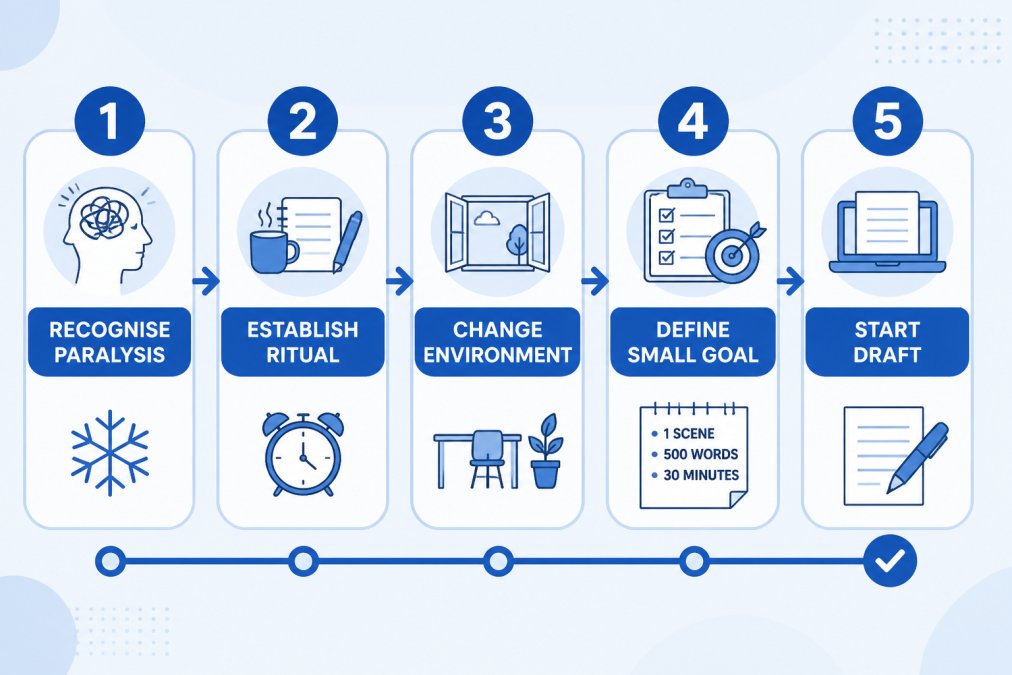
Your brain responds to patterns. When you repeat the same sequence before writing, your brain recognises it as a signal: it's time to write now.
A writing ritual can be simple. Make a specific cup of tea. Put on a particular song or playlist. Light a candle. Sit in a specific chair. The ritual itself doesn't matter. What matters is consistency. When you repeat this sequence daily, your brain begins to associate it with writing mode. This is especially powerful if you have ADHD or executive dysfunction, the ritual provides the external structure your brain needs to initiate the task (the NIH).
Change your environment or eliminate distractions
Your environment shapes your ability to focus. If you write at the same desk where you scroll social media and check email, your brain doesn't have a clear signal that this is different.
Change something about your environment. Write in a different room. Go to a café. Sit outside. The change doesn't have to be dramatic, it just needs to signal to your brain that this is a different context. Close email. Put your phone in another room. Use a distraction-free writing app if that helps. The goal is to remove friction between you and the blank page.
Set small, achievable goals for each session
Don't sit down to "write your novel." Sit down to write one scene, 500 words, or 30 minutes of continuous writing. Make the goal small enough that it feels achievable, not overwhelming.
Small goals do two things. First, they make starting easier because the task feels manageable. Second, they build momentum. You sit down, you hit your small goal, and suddenly you've written something. That success makes the next session easier. Often, once you start, you keep going.
Daily Writing Prompts for Authors to Kickstart Momentum
When your mind is stuck, a writing prompt can bypass analysis paralysis and get you moving. A prompt gives you a starting point, a direction, something concrete to respond to instead of staring at a blank page.
How prompts bypass analysis paralysis
Analysis paralysis happens when you have too many options and no clear direction. Your brain tries to evaluate every possibility at once, and nothing gets written. A prompt removes that burden. It says: start here. Write about this. Respond to this question or scenario.
Prompts work because they move you from thinking into doing. You don't have to decide what to write about. You just have to write. And once you're writing, even in response to a prompt, the creative momentum often carries you forward into your actual project.
Building a prompt habit into your routine
Use prompts as a warm-up before your main writing work. Spend 10 minutes responding to a prompt. Write badly. Write fast. Don't edit. Just get the words flowing.
After 10 minutes of prompt writing, your brain is warm, you're in writing mode, and starting your actual project feels easier. The best prompts for you are ones that spark curiosity or emotion, something that makes you want to write.
Writing Productivity Tools That Support Your Flow
The right tools remove friction and support your natural writing rhythm. They're not a substitute for the work, but they make the work easier.
Timers and distraction-free apps
A simple timer is one of the most effective tools for overcoming paralysis (peer-reviewed research). Set a timer for 25 minutes or 90 minutes, and commit to writing until it goes off. The timer creates urgency and removes decision-making: you just write until time's up.
Distraction-free writing apps like iA Writer, Ulysses, or Google Docs in fullscreen mode remove visual clutter. No toolbars, no browser tabs, no notifications. Just you and the page. Many writers find that removing visual noise makes it easier to focus and access their creative voice.
Structured methods like the 90-minute draft
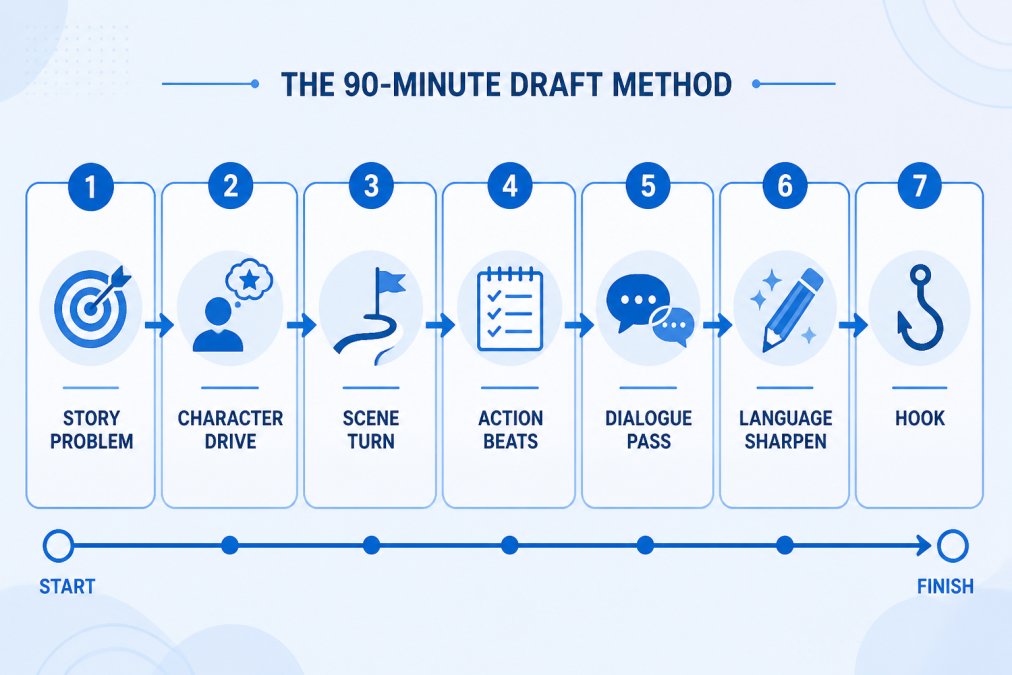
The 90-minute draft method, developed by writeinspire, breaks the process into seven distinct phases: story problem, character drive, scene turn, action beats, dialogue pass, language sharpen, and hook. Each phase has a specific purpose and duration. You're not writing a perfect scene, you're building a workable draft through focused steps.
The structure gives your brain a clear path forward. You know exactly what you're doing in each phase, so analysis paralysis doesn't have room to take hold. This method works particularly well for writers with ADHD or executive dysfunction because the external structure provides the framework your brain needs to initiate and sustain the task.
Taking Intentional Breaks to Sustain Creative Output
Burnout and fatigue are often mistaken for paralysis. You think you're stuck when actually you're exhausted. Your brain needs rest, not more pushing.
Intentional breaks are part of the writing process, not a break from it. When you step away from the work, your subconscious keeps processing. Ideas surface. Problems solve themselves. You come back refreshed and often with clarity you didn't have before.
A break isn't scrolling social media for 30 minutes. It's genuinely stepping away. Take a walk. Have a conversation. Do something physical. Give your brain real rest. Many writers find that their best ideas come during breaks, not during the actual writing session.
Recovery After Paralysis: Moving Forward
Once you've broken through the paralysis and started writing, the next challenge is rebuilding your confidence and momentum. The paralysis often leaves emotional residue, frustration, doubt, self-criticism.
Recognising the difference between burnout and paralysis
Burnout feels like exhaustion. You don't want to write. The work feels pointless. You're depleted. Paralysis feels like being stuck, you want to write, but you can't access it.
These require different responses. If you're burnt out, you need rest and possibly a break from the project. If you're paralysed, you need to restart using the techniques above: ritual, small goals, prompts, structured methods. Sometimes both happen together. In that case, you need both rest and a structured restart.
Rebuilding momentum and confidence
After paralysis, your confidence is usually shaken. Start small. Use a prompt. Do a 30-minute session with a clear, tiny goal. Write something that has nothing to do with your main project. Just get words flowing again.
Each small success rebuilds confidence. You write 500 words. That's a win. You write for 30 minutes without stopping. That's a win. These wins accumulate and remind you that you can do this. The paralysis wasn't permanent. It was a state you got stuck in, and now you're getting unstuck.
Writing paralysis is real, and it's not a character flaw. It's a signal that something in your process or mindset needs to shift. By understanding what's actually happening, perfectionism, analysis, executive dysfunction, fear, you can address the root cause instead of just pushing harder.
The techniques above work because they remove the conditions that create paralysis. They give your brain structure, permission to be imperfect, and clear forward momentum. At writeinspire, we've seen writers break through paralysis using these approaches, and many go on to complete manuscripts they thought were impossible.
If you're ready to move past the paralysis and actually finish your work, Creative Story Mastery offers structured coaching that guides you through the entire creative process. The support, frameworks, and accountability make all the difference when you're rebuilding your writing practice. Grab a coffee and let's chat about your story.

Frequently Asked Questions
What's the difference between writing paralysis and writer's block?
Writing paralysis is prolonged creative stagnation where fear, perfectionism, or cognitive overload prevents you from starting or continuing. Writer's block is typically a shorter-term inability to find the right words or direction. Paralysis often involves self-criticism and analysis paralysis, while writer's block is usually a temporary friction point. Both stop your creative output, but paralysis requires addressing the underlying fear or mindset shift, not just waiting it out.
How does perfectionism contribute to writing paralysis?
Perfectionism creates a gap between your vision and your current draft, triggering self-criticism before you've even started. You imagine the finished manuscript and freeze, unable to produce anything that matches that standard. The fear of failure keeps you from drafting. Breaking this cycle means lowering expectations for your first draft deliberately, accepting that unfiltered writing, messy and rough, is the only path to a polished final work. Editing comes later.
Can structured writing routines help overcome creative stagnation?
Yes. A writing ritual signals your brain that creative work is beginning, reducing the mental load of deciding when and how to write. Rituals might include a specific time, location, or warm-up activity. Combined with small, achievable goals, like writing 300 words in 30 minutes, routines create consistency and momentum. Many writers find that removing the decision-making step eliminates the resistance that feeds stagnation. Structure replaces motivation when motivation falters.
What should I do if I have a half-finished manuscript that's been sitting for years?
Start by reconnecting with the work without judgment. Read it once to recall the story and characters, then set a small, specific goal: revise one scene or add 500 words to the next chapter. Use a writing prompt or the 90-minute draft method to rebuild momentum. If perfectionism is blocking you, remember that your past self did the best they could; your job now is to move forward, not fix everything. Coaching can help you identify what's actually blocking progress and create a realistic completion plan.
This article was written using GrandRanker