

Table of Contents
- Why Your Opening Scene Matters
- The Anatomy of a Strong Opening Scene
- How to Write a Hook for a Novel That Grabs Readers
- Opening Scene Examples for Fiction Across Genres
- Common Opening Scene Mistakes to Avoid
- Balancing Action, Dialogue, and Exposition
- Setting Tone and Voice in Your First Scene
- Your Next Step: Craft and Refine
- Frequently Asked Questions
Last Updated: September 21, 2026
Why Your Opening Scene Matters
Your opening scene is the first impression readers get of your story. It's the moment they decide whether to keep turning pages or put your manuscript down. At writeinspire, we've worked with many writers, and the difference between a captivating opening and a forgettable one often comes down to structure, not luck.
A strong opening scene does three things at once: it hooks the reader, introduces your world, and establishes the stakes. Without these elements working together, even brilliant prose falls flat. The good news? Learning how to structure a captivating opening scene is a skill that improves with practice.
The Anatomy of a Strong Opening Scene
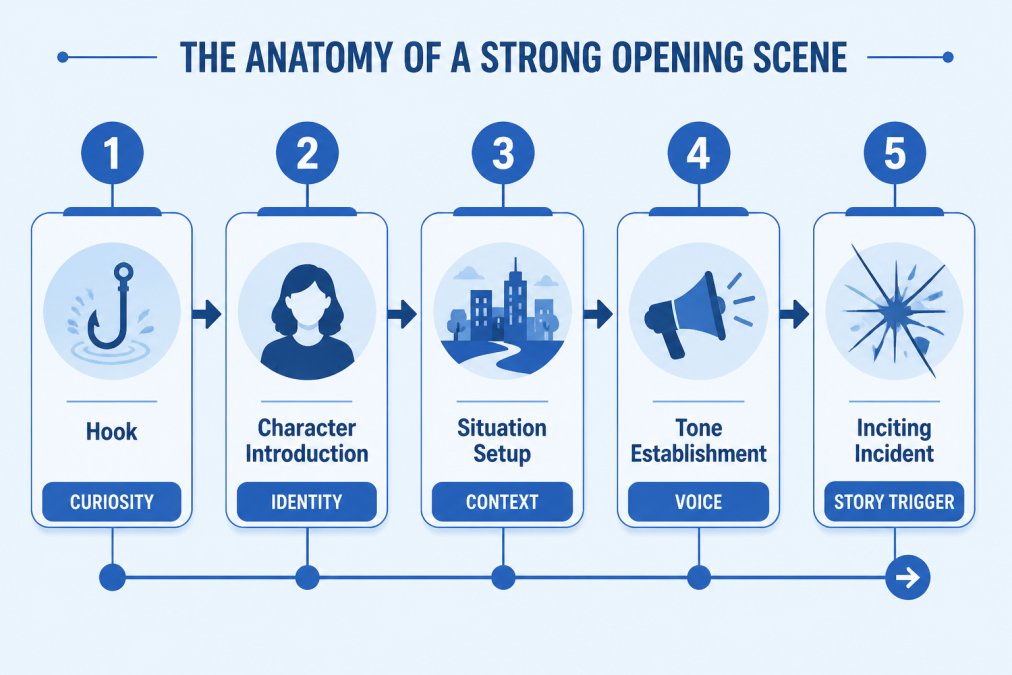
Every strong opening scene has recognisable parts that work together like a machine. Understanding these parts helps you build an opening that grabs readers from the first sentence.
A captivating opening scene needs five key elements: a hook that makes readers curious, character introduction that feels immediate, a situation that creates tension, tone that sets expectations, and an inciting incident that triggers the story forward. These don't all need to happen in the first paragraph, but they should all be present by the end of your opening scene.
The hook is your first sentence or two. It's the promise you make to the reader. This could be a striking image, a question, a piece of dialogue, or an action that feels urgent. The hook doesn't need to explain everything, it just needs to make readers want to know what happens next.
Character introduction comes next. Readers need to know who they're following. This doesn't mean listing physical details. Instead, show a character doing something, thinking something, or wanting something. Let their actions and voice reveal who they are.
Character or situation first?
This is where many writers stumble. Should you introduce your character first, or should you establish the situation?
The answer depends on your story. If your character's personality is central to your story, introduce them first through action or voice. If your situation is what drives the plot, establish the situation and then show how your character responds to it.
A character-driven story like The Catcher in the Rye opens with Holden Caulfield's voice and perspective. Readers meet him before they fully understand his situation. A plot-driven story like The Hunger Games establishes the situation, a deadly competition, and then shows how Katniss responds to it.
The key is this: whichever you choose, make it clear within your opening scene. Readers should know early whether they're following a character through a world, or watching how a character navigates a specific situation.
Finding the right length
How long should your opening scene be? The answer is: long enough to do its job, but not so long that you lose momentum.
Most opening scenes work best when they give you room to establish character, situation, and tone without overwhelming readers. Shorter scenes can work for fast-paced thrillers or stories that open with action. Longer scenes suit literary fiction where atmosphere and voice are everything.
The real question isn't word count, it's whether your opening scene accomplishes its purpose. If you've introduced your character, established your world, set the tone, and triggered the story forward, you're done. Stop there. Readers don't need more.
How to Write a Hook for a Novel That Grabs Readers
A hook is the first sentence or two of your opening scene. It's the moment that makes a reader decide to keep reading.
The best hooks do one of these things: they create curiosity, they establish immediate conflict, they reveal character through voice, or they promise something unusual. Not all hooks need to be action-packed. A quiet, intriguing line can be just as powerful as an explosion.
Here are proven hook patterns that work:
- The surprising statement: "My mother died on the day I was born." (Creates immediate curiosity and stakes.)
- The specific image: "The gun was still warm when I picked it up." (Drops readers into a moment of tension.)
- The character voice: "I am an invisible man, not because of any biochemical accident, but because of the peculiar circumstances of my existence." (Establishes voice and perspective immediately.)
- The unanswered question: "What would you do if you discovered your entire life was a lie?" (Engages readers by making them think.)
- The ordinary moment with tension underneath: "She poured her coffee the same way every morning, but today her hands were shaking." (Suggests something is wrong without explaining it.)
The strongest hooks often combine two of these patterns. They create curiosity and establish voice. They show conflict and reveal character. This layering is what makes readers lean in.
When you're drafting your hook, ask yourself: would a stranger care about this? If the answer is no, your hook needs more specificity. Generic openings ("It was a dark and stormy night") don't work because they could apply to any story. Specific, unusual openings ("The last time I saw my father, he was standing in the rain with a suitcase he'd packed for someone else") work because they belong to your story.
Module 4 - Creative Story Mastery →
Opening Scene Examples for Fiction Across Genres
Different genres need different opening approaches. Understanding what readers expect from your genre helps you structure an opening that satisfies them.
Literary fiction often opens with voice and atmosphere. Readers expect to spend time in a character's internal world before much happens externally. An opening might be a quiet moment that reveals everything about a character's loneliness or longing. The hook is often subtle, a detail, a thought, a memory, rather than explosive action.
Mystery and thriller need immediate questions. Readers want to know: what happened? Who did it? What's at stake? Your opening scene should drop them into a moment of tension or discovery. The hook might be a crime scene, a threat, or a secret revealed. Establish the central question within your first scene.
Romance opens by introducing the protagonist and hinting at the emotional conflict they'll face. Readers want to care about the character before the love interest appears. Show what your protagonist wants, what they're afraid of, or what they're struggling with. The hook might be a moment of vulnerability or a moment where they're about to make a choice that changes everything.
Science fiction and fantasy need to establish the world's rules quickly without stopping the story to explain them. Your opening scene should show readers what's different about this world through action and dialogue, not exposition. The hook might be something impossible or unfamiliar that makes readers curious about how this world works.
Young adult fiction often opens with a protagonist on the edge of change. Something is about to shift in their life. The hook might be the last moment before everything changes, or the first moment of change itself. Readers want to feel the character's voice and energy immediately.
The pattern across all genres is the same: establish what's unusual or at stake, show character through action or voice, and make readers curious about what happens next.
Common Opening Scene Mistakes to Avoid
Most weak opening scenes fail for predictable reasons. Knowing these mistakes helps you avoid them.
Starting with backstory: Many writers begin by explaining what happened before the story starts. They think readers need context. They don't. Readers will accept almost anything if you show them a compelling character in a compelling moment. Save backstory for later, when readers care enough to listen.
Opening with description: A long paragraph describing a landscape, a building, or a character's appearance stops momentum before it starts. Readers don't care what something looks like until they care about the character experiencing it. Start with a character, an action, or a moment of tension. Weave description in later.
Introducing too many characters: If your opening scene has five characters doing different things, readers won't know who to follow.
Balancing Action, Dialogue, and Exposition
Your opening scene needs a mix of action, dialogue, and exposition. Too much of any one element and your scene loses energy.
Setting Tone and Voice in Your First Scene
Tone and voice are how your story sounds. They're established in your opening scene and carry through the entire manuscript.
Your Next Step: Craft and Refine
You now understand how to structure a captivating opening scene. The next step is to apply this to your own work.
Frequently Asked Questions
What are the essential elements of a strong opening scene?
A strong opening scene needs a clear hook to grab attention, character presence or situation that matters to the story, established tone that signals what kind of tale this is, and a sense of stakes or tension. Balance showing the world through action and dialogue rather than explaining it through exposition. The scene should raise a question in the reader's mind, something that makes them want to turn the page to find the answer.
How do you balance action and exposition in an opening scene?
Show character through action and choice rather than description. If your character needs to know something, let them discover it by doing something, searching a room, overhearing a conversation, noticing a detail. Weave essential backstory into dialogue or internal reaction, but only when it serves the immediate scene. Avoid info-dumping; trust that readers will pick up context as they read. Every sentence should move the story forward or reveal something about the character.
What common opening scene mistakes should writers avoid?
Don't start with a character waking up, looking in a mirror, or reading a letter, these are passive moments that delay real action. Avoid heavy backstory or world-building explanation at the start; readers care about the character first. Don't begin with dialogue without context about who's speaking or why it matters. Skip the weather report or long description of a setting unless it's crucial to what happens next. Most importantly, don't start too early, begin at the moment something changes, not five pages before anything interesting occurs.
Should an opening scene start with a character or a situation?
Start with whichever one creates immediate tension or curiosity. If you begin with a character, they should be doing something that reveals who they are and what they want. If you begin with a situation, introduce a character quickly so readers have someone to care about. The strongest openings do both: a character facing a situation that forces them to make a choice or take action. Avoid starting with a passive character observing a situation; give them agency from the first line.