

Table of Contents
- What You'll Need Before Starting
- How to Structure a Manuscript: The Essential Framework
- Standard Manuscript Format Template: Font, Spacing and Layout
- How Long Should a Novel Manuscript Be?
- Best Practices for Manuscript Layout and Readability
- Manuscript Formatting Software and Tools
- Genre-Specific Formatting Variations
- Common Mistakes to Avoid
What You'll Need Before Starting
Before diving into manuscript structure, gather a few essentials: a clear understanding of your story's beginning, middle, and end, and a word processor like Microsoft Word or Google Docs. Most importantly, you need patience. Structuring a manuscript properly takes time, but it's time well spent. The difference between a document and a professional manuscript often comes down to how deliberately you've organised it.

At writeinspire, we've worked with writers, and the ones who succeed treat structure as a foundation, not an afterthought. Your manuscript structure determines how readers experience your story, pacing, clarity, and emotional impact all flow from how you've organised your material. Think of structure as the architecture of your narrative. Without it, even brilliant writing feels scattered.
How to Structure a Manuscript: The Essential Framework
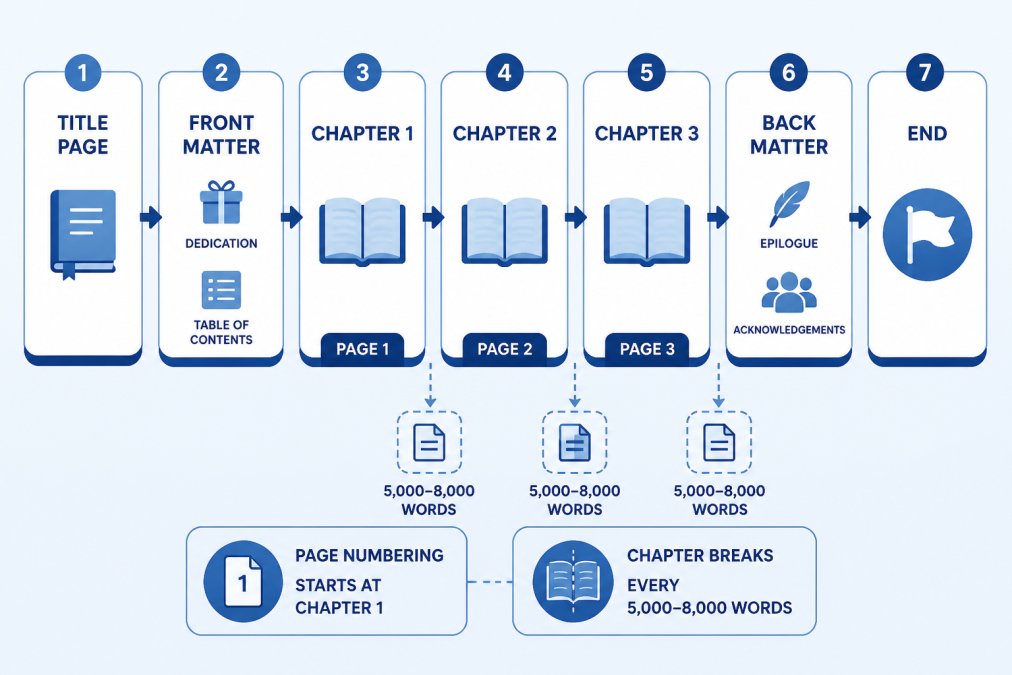
A well-structured manuscript follows a clear three-part architecture: front matter, main body, and back matter. Each section serves a specific purpose and follows conventions that readers and publishers expect.
Front matter and title page setup
Your front matter is the reader's first impression. It includes the title page, copyright information, table of contents (for non-fiction), and any introductory material like a dedication or acknowledgement section. The title page should contain your manuscript's title, your name as the author, and your contact information, centred on the page in the upper half with generous white space.
For fiction manuscripts, keep front matter minimal, a title page and perhaps a dedication is sufficient. Non-fiction manuscripts often include a table of contents to help readers navigate chapters. If you're writing academic work, include an abstract (150-250 words) after the title page but before the main text.
One common mistake is overthinking front matter design. Publishers have their own templates, so unless you're self-publishing, keep it simple and functional. The goal is clarity, not decoration.
Main body and chapter organisation
The main body is where your story or argument lives. Each chapter should begin on a new page, with the chapter heading positioned a third of the way down. Start your opening paragraph after a line break.
Chapter headings follow a simple pattern: "Chapter 1" or "Chapter One" (choose one style and stick with it), optionally followed by a chapter title. Consistency matters. If your first chapter reads "Chapter 1: The Beginning," every chapter should follow that format.
Within chapters, use paragraph breaks to signal shifts in time, perspective, or focus. A blank line between paragraphs is standard. Some writers use scene breaks, a line of asterisks or extra spacing, to indicate larger transitions within a chapter.
Chapter length varies by genre. Literary fiction often has shorter chapters (2,000-4,000 words), while epic fantasy or thrillers might run 5,000-8,000 words per chapter. The key is consistency within your manuscript. Readers develop a rhythm based on chapter length, so dramatic variations feel jarring.
Back matter and closing sections
Back matter includes everything after your final chapter: an epilogue (if applicable), author's notes, acknowledgements, bibliography or works cited (for non-fiction), and an appendix if you have supplementary material.
An epilogue is optional and should only be included if it adds genuine value, a final scene that wraps up loose threads or hints at future events. An author's note is brief, a few paragraphs explaining your process, inspiration, or context. Acknowledgements thank the people who helped you: editors, beta readers, mentors, family members.
For non-fiction, a bibliography or works cited section is essential if you've referenced other sources. Format it according to the relevant style guide (Chicago Manual of Style, APA, MLA, or Harvard). An appendix holds supplementary material, charts, data, extended examples, that supports your main text but would interrupt the narrative if included in the body.
Standard Manuscript Format Template: Font, Spacing and Layout
A standard manuscript format exists for good reason: it's readable, professional, and widely accepted by publishers and agents. Following these conventions signals that you understand the publishing industry.
Font and size requirements
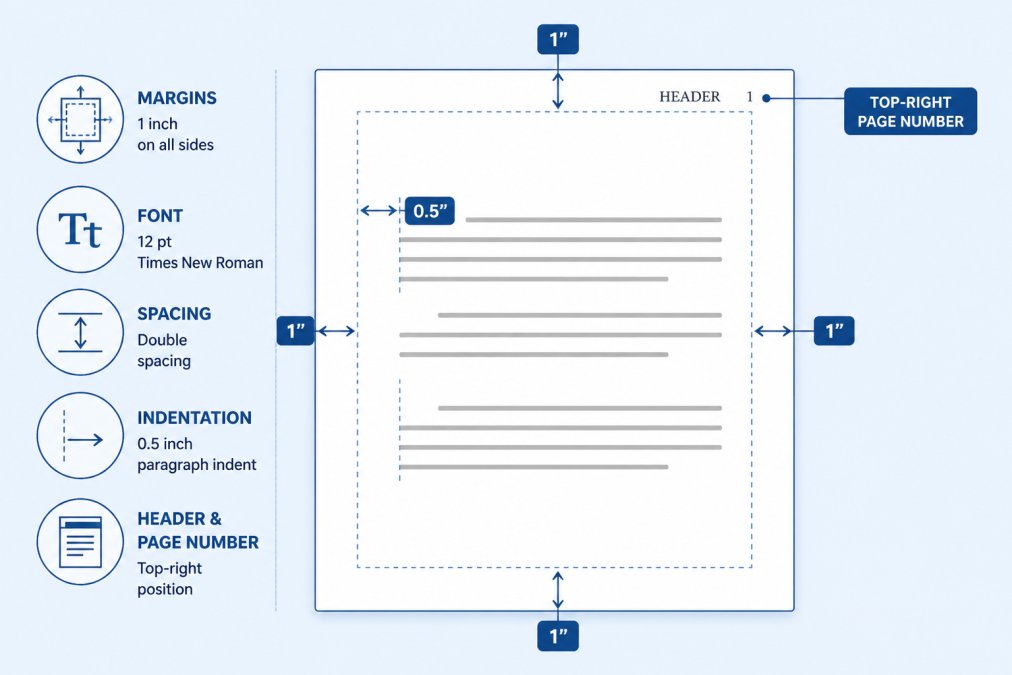
Use Times New Roman, 12-point font, throughout your manuscript. This is the industry standard. The font should be consistent, no mixing fonts within the body text. Headers and chapter titles can be slightly larger (14-16 point), but keep this consistent.
Why Times New Roman? It's a serif font, which many find easier to read in print, and it's universal, every publisher, agent, and reader has it installed. Using a decorative or unusual font signals inexperience and makes your manuscript harder to read during submission. Save creative typography for the final published book; your manuscript is a working document.
Avoid bold, italics, or underlining for emphasis within body text. Use italics only for thoughts, emphasis, or foreign words. Underlining is outdated and should be avoided entirely.
Margins, spacing and indentation
Set your margins to one inch on all sides. Double-spacing is mandatory for manuscript submission. This standard spacing provides room for editor notes and creates a professional appearance.
Paragraph indentation should be 1.27 cm at the beginning of each paragraph. Use your word processor's paragraph indentation settings, never multiple spaces. Most word processors allow you to set this automatically through formatting options.
Between chapters, leave extra space, typically 2-3 blank lines or a page break. This visual separation helps readers understand that a new chapter is beginning. Some writers use a scene break symbol (three asterisks centred on a line) to indicate a shift within a chapter, but this is optional.
Line spacing should be exactly double throughout, no single spacing, no 1.5 spacing. This applies to chapter headings, body text, and everything in between.
How Long Should a Novel Manuscript Be?
Manuscript length varies significantly by genre, and understanding genre conventions is essential when structuring a manuscript.
Literary fiction typically ranges from 80,000 to 100,000 words. Crime and mystery novels sit in a similar range: 70,000 to 90,000 words. Romance novels are often 70,000 to 100,000 words. Science fiction and fantasy often support longer manuscripts, typically 90,000 to 120,000 words or beyond.
Young adult fiction generally runs 50,000 to 80,000 words. Middle-grade fiction (ages 8-12) typically runs 20,000 to 50,000 words.
Non-fiction has different conventions. A self-help or business book usually runs 40,000 to 60,000 words. Memoir often runs 80,000 to 100,000 words.
These aren't hard rules, but they're industry expectations. A 150,000-word literary novel from a debut author is a harder sell than a 90,000-word one. Respect the conventions of your genre; they exist because they work.

Best Practices for Manuscript Layout and Readability
How to structure a manuscript for maximum readability involves more than just following formatting rules. It's about creating a reading experience that feels intentional and professional.
Page numbering and headers
Page numbering should begin with your first chapter, not your front matter. For the main body, use Arabic numerals (1, 2, 3) starting with Chapter 1.
Place the page number in the top-right corner or centred at the bottom of the page, and maintain this style throughout. Include a header with your last name and manuscript title on every page (except the title page). Format it simply: "LASTNAME / MANUSCRIPT TITLE" in the top-right corner, with the page number just below it.
Headers and page numbers serve a practical purpose: they make your manuscript easier to navigate and identify. Agents and publishers receive thousands of submissions; clear headers ensure yours doesn't get lost.
Chapter breaks and pacing
Chapter breaks are structural decisions that affect how readers experience your story. A chapter should feel like a complete unit with a beginning, middle, and end, even if it ends on a cliffhanger. The length of your chapters influences pacing. Shorter chapters (2,000-3,000 words) create a faster pace and work well for thrillers. Longer chapters (5,000-8,000 words) allow for deeper exploration and work better for literary fiction.
Consistency matters more than perfection. If your chapters average 4,000 words, occasional chapters of 3,500 or 4,500 words are fine. Jumping from 3,000 to 7,000 words repeatedly will feel unbalanced.
Scene breaks within chapters, marked by a line of asterisks or extra spacing, signal shifts in time, location, or perspective. Use these intentionally.
Tables, figures and captions
If your manuscript includes tables, figures, charts, or images, format them clearly and separately from body text. Each should have a caption that explains what it shows. Number your figures and tables sequentially: "Figure 1," "Table 1," etc.
Place figures and tables near the text that references them. Always reference them in your text before they appear: "As shown in Table 1..." Captions should be brief but descriptive.
Manuscript Formatting Software and Tools
Several tools can simplify the process of structuring a manuscript and maintaining consistent formatting. Microsoft Word is the industry standard, most agents and publishers expect submissions in .docx format. Word's built-in styles and formatting tools make it straightforward to apply consistent formatting throughout.
Google Docs is a free alternative that works well for collaborative writing and feedback. It's cloud-based and adequate for basic manuscript structure, though formatting options are more limited than Word.
Scrivener is specialised software designed for long-form writing. It's particularly useful for managing complex manuscripts with multiple chapters, research notes, and character profiles. It has a learning curve, but many serious writers find it invaluable.
For writers working with writeinspire's Creative Story Mastery program, you'll have access to templates and guidance on manuscript formatting specific to your genre.

Genre-Specific Formatting Variations
While the standard manuscript format applies across genres, some variations exist depending on what you're writing.
For screenplays and scripts, formatting is entirely different. Dialogue, action lines, and scene headings follow specific conventions. If you're writing a script, consult a screenplay formatting guide or use specialised software like Final Draft.
Poetry manuscripts have their own conventions. Line breaks, stanza spacing, and page breaks matter differently than in prose. A poetry manuscript should showcase your work's visual appearance on the page.
Graphic novels and illustrated works combine text and images. The manuscript structure depends on how you're presenting the work, as a script for an illustrator, or as a complete visual manuscript.
Memoir and personal essay collections might include photographs or documents. Format these clearly with captions and permissions noted.
Common Mistakes to Avoid
Even experienced writers stumble on manuscript structure. Here are the pitfalls that undermine otherwise strong work.
Inconsistent formatting is the most common mistake. You might use double spacing in Chapter 1 but accidentally switch to single spacing in Chapter 3. Use your word processor's formatting tools to apply styles consistently, it takes five minutes and saves hours of manual correction.
Mixing chapter numbering styles is another frequent error. Don't write "Chapter One" in your first chapter and "Chapter 2" in your second. Choose one style and stick with it throughout.
Overusing special formatting undermines readability. Bold, italics, and underlining should be used sparingly. If everything is emphasised, nothing stands out.
Neglecting white space is a subtle but important mistake. Walls of text are intimidating and hard to read. Paragraph breaks, chapter breaks, and scene breaks provide visual relief and help readers navigate your manuscript.
Ignoring genre conventions is a strategic mistake. If you're writing a 150,000-word literary novel when agents expect 90,000 words, you've made your manuscript harder to sell before anyone reads a word.
Not proofreading for formatting errors is careless. Before submitting, print your manuscript and read through it. Check that margins are consistent, spacing is uniform, page numbers appear correctly, and headers are present.
Finally, overthinking design is a trap. Your manuscript is a working document, not a finished book. Publishers will reformat it anyway. Focus on clear, professional, standard formatting. Save creativity for the story itself.
Finishing a manuscript is a genuine achievement, and how you structure it matters more than many writers realise. Professional formatting and clear structure show that you understand your craft and respect your readers. WriteInspire's coaching programs, including Creative Story Mastery and our writing consultation services, help writers move beyond structural uncertainty into confident completion. Your manuscript deserves to be read, make sure it's formatted to be taken seriously. Start with the framework outlined here, apply it consistently, and you'll have a manuscript that's ready for the next step, whether that's agent submission, self-publishing, or sharing with readers.
Frequently Asked Questions
What is the standard format for a manuscript submission?
Standard manuscript format requires Times New Roman 12-point font, double spacing throughout, one-inch margins on all sides, and left alignment. Include a title page with your name, contact details, and word count. Number pages in the header with your surname and title. This layout convention ensures readability and meets most submission guidelines from agents and publishers.
How long should a novel manuscript be to be publishable?
Most literary fiction manuscripts range from 70,000 to 100,000 words, though literary fiction can extend to 120,000 words. Genre fiction varies: fantasy and science fiction often run 90,000 to 120,000 words, while mystery and thrillers typically sit between 70,000 and 90,000 words. Young adult novels are usually 50,000 to 80,000 words. Check submission guidelines for your specific genre, as word count expectations differ between publishers and agents.
Do I need special software to format my manuscript correctly?
You can format a manuscript in Word or Google Docs using built-in tools like styles, spacing settings, and page numbering. However, dedicated manuscript formatting software like Scrivener or Atticus offers templates and automation that save time, especially for complex projects. For most writers, Word with careful attention to margins, fonts, and spacing is sufficient. Choose based on your comfort level and project complexity.
How do I structure the front matter of my manuscript?
Front matter typically includes a title page, copyright page, table of contents, and sometimes a dedication or acknowledgements page. The title page shows your manuscript title, your name, contact details, and word count. Copyright and publication information follow on the next page. A table of contents lists chapter titles and page numbers. Place these elements before chapter one, numbered with Roman numerals (i, ii, iii). This document structure sets the professional tone for your submission.
This article was written using GrandRanker