

Table of Contents
- What Makes Dialogue Compelling
- Examples of Good Fiction Dialogue
- Common Dialogue Mistakes to Avoid
- How to Write Dialogue Tags That Work
- Building Distinct Character Voices
- Using Subtext and What Is Left Unsaid
- Exercises for Writing Better Dialogue
- Dialogue Revision and Polish
- Frequently Asked Questions
Last Updated: September 29, 2026
What Makes Dialogue Compelling
Dialogue isn't about replicating real speech, it's about learning to write compelling dialogue that feels authentic while serving your story. The best dialogue reveals character, advances plot, and deepens reader understanding all at once.
Real conversation is cluttered with filler words, repetition, and tangents. Effective dialogue strips away the clutter while keeping the emotional truth intact. When you write compelling dialogue for fiction, you're making deliberate choices about what to include and what to leave out.
Dialogue that mirrors actual speech often feels flat on the page. Readers don't need every "um" and "like" to believe a character is real, they need consistency, purpose, and personality.
Every line your character speaks should hint at what they want, what they're hiding, or what they're trying to achieve. A character asking for directions reveals more than just their location problem, their tone, word choice, and what they don't say signal their emotional state and objectives.
Characters manage impressions, protect vulnerabilities, and push toward goals. The best dialogue shows this beneath the surface.
Examples of Good Fiction Dialogue
Strong dialogue sounds like the character, not the author. Weak dialogue sounds like exposition pretending to be conversation.
Strong dialogue implies conflict even in casual exchanges through subtext and specificity. Weak dialogue states everything explicitly.
The Subtext Example
Compare these two versions:
Weak: "I'm angry at you because you forgot my birthday."
Strong: "You remembered to text your mother, didn't you?"
The strong version shows anger through what's unsaid, using a question that carries accusation and forces a response. It's active, not passive.
Genre-Specific Dialogue Patterns
Dialogue shifts depending on your genre. Understanding these patterns helps you write authentically within your chosen form.
In thriller or mystery fiction, characters withhold details, lie, or reveal only what serves their agenda. Tension comes from what readers don't know.
Weak: "I didn't kill him. I was at home all night."
Strong: "Where was I? Home. Alone. Why does it matter?"
The strong version raises questions instead of answering them, suggesting evasion through defensive phrasing.
In romance fiction, dialogue reveals emotional vulnerability and attraction through the gap between what characters want to express and what they actually manage.
Weak: "I love you and I want to be with you."
Strong: "I shouldn't be here. This is a terrible idea." She didn't move. "Tell me to leave."
The strong version shows internal conflict, the character says one thing while their actions say another.
In literary fiction, dialogue mirrors the novel's themes and character's inner life. What characters don't say becomes as important as what they do.
Weak: "I've been thinking about leaving you for months."
Strong: "Do you remember that café we went to? The one on Fitzroy Street?" He stirred his coffee. "I went back last week. Alone."
The strong version suggests loss and distance without stating it directly.
Reading Dialogue Aloud to Test Authenticity
When you hear your words spoken, you notice awkward phrasing, dialogue tags that interrupt, lines that feel too formal or casual, pacing problems, and unnatural word order. Listen for where you naturally pause, where you emphasise words, and where the rhythm breaks, that's where revision happens.
Common Dialogue Mistakes to Avoid
Exposition dumps happen when characters tell each other information they already know just so the reader learns it. "As you know, we've been married for fifteen years" is exposition masquerading as dialogue. Real people don't recap shared history.
On-the-nose dialogue states the subtext directly. "I'm sad about losing my job" tells; a character staring at their phone and snapping at loved ones shows it.
Stilted pacing and unnatural speech patterns break immersion. Real speech has contractions, incomplete sentences, interruptions, and pauses. Common mistakes include every character sounding identical, dialogue that's too clean and grammatically perfect, lines that go on too long, conversations that resolve too neatly, and characters asking questions they'd never ask to advance the plot.
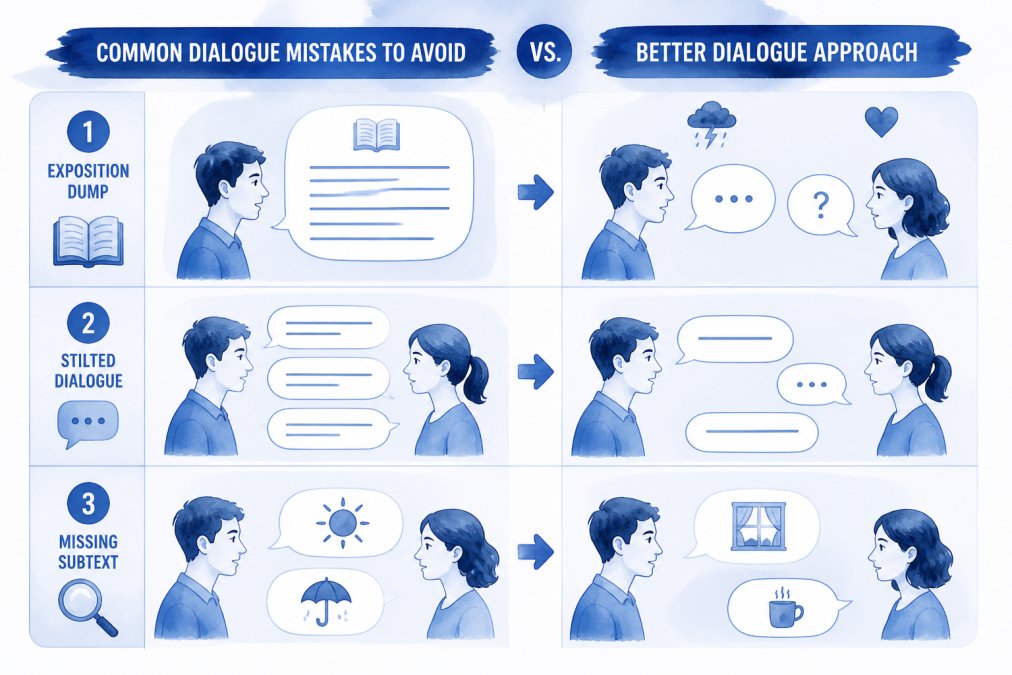
Don't use dialogue to deliver information that should come through action or narration. Show characters remembering through their actions and thoughts, not forced conversation.
Module 6 - Creative Story Mastery →
How to Write Dialogue Tags That Work
Dialogue tags are the "he said, she said" attributions that follow dialogue. Most writers overthink them or underuse them.
The strongest dialogue tags are invisible. "Said" and "asked" are your workhorses because readers' eyes skip right past them. Fancy alternatives draw attention to the tag instead of the words.
Use action beats instead of tags to do two jobs at once, attribute dialogue and show character emotion or physical state.
Instead of: "I can't do this anymore," she said, frustrated.
| Tag Type | When to Use | Effect |
|---|---|---|
| Said / Asked | Default for most dialogue | Invisible to reader |
| Action beats | Show emotion or movement | Vivid and efficient |
| Fancy tags | Rarely, for specific effect | Draws attention |
| No tag | Two-person scenes | Clean and fast |
Building Distinct Character Voices
Each character should sound like themselves. This is where dialogue becomes truly compelling.
Using Subtext and What Is Left Unsaid
Subtext is the unspoken meaning underneath the spoken words. A character says one thing but means another.
Character A: "That's a nice haircut."
Character B: "You hate it."
Exercises for Writing Better Dialogue
Practical techniques strengthen your dialogue craft faster than theory alone. The exercises below are designed to be repeated, each time you return to them, your instincts sharpen.
Exercise 1: Subtext Mapping
Write a short scene (200-300 words) where two characters discuss something mundane. Before you write, decide what one character is secretly anxious about, they must never mention it directly. Every line of dialogue must hint at the hidden anxiety without naming it. Use tone, word choice, what they avoid saying, and physical reactions. Read it aloud and ask: could a reader sense the anxiety without being told?
Exercise 2: Rewrite for Distinct Voice
This exercise teaches you to hear the difference between authorial voice and character voice.
Exercise 3: The Argument in Three Voices
This exercise shows how character voice shapes the entire emotional tone of a scene.
Exercise 4: Dialogue in Modern Formats
This exercise addresses a gap most dialogue guides miss: how to write text messages, emails, or social media exchanges within your narrative.
Example:
Text from Maya: where are you
Text from Maya: it's 8pm
Text from James: stuck at work
Text from Maya: again
Text from James: i know
Exercise 5: Dialogue Revision Sprint
This exercise teaches you to revise dialogue with intention.
Choose a scene with three or more lines of dialogue. Read it aloud and mark places where you stumble or a line feels too on-the-nose. For each marked line, ask: does this line advance plot, reveal character, build tension, or deepen a relationship? If not, cut it. Replace fancy dialogue tags with "said/asked" or an action beat. Read it aloud again.
Dialogue Revision and Polish
Read your dialogue aloud. Does it move too fast or drag? Does tension build? Cut exposition, unnecessary dialogue tags, and filler words unless they serve character voice.
Frequently Asked Questions
What is the difference between realistic dialogue and compelling dialogue?
Realistic dialogue mimics exactly how people speak, with filler words, repetition, and meandering sentences. Compelling dialogue captures the essence of authentic speech while serving your story's purpose. It reveals character, advances plot, and deepens reader understanding without the tedium of real conversation. The goal is not to replicate speech, but to craft dialogue that feels genuine while moving your narrative forward with intention.
How do I avoid common dialogue mistakes in my manuscript?
The most frequent mistakes are exposition dumps (characters stating information the reader needs rather than discovering it), on-the-nose dialogue (characters saying exactly what they mean with no subtext), and stilted pacing (dialogue that sounds unnatural or overly formal). Test your dialogue by reading it aloud. Listen for rhythm and authenticity. Ensure each character has a distinct voice through their word choices, contractions, and speech patterns. Every line should either reveal character, advance conflict, or deepen relationships, never explain plot.
What should I focus on when writing dialogue tags?
Use simple tags like 'said' or 'asked' most of the time. Readers skip over them. Avoid adverbs like 'said angrily' or unusual tags like 'interjected', they distract. Instead, use action beats: show what characters do while speaking. This reveals character, builds tension, and breaks up long stretches of dialogue. Action beats ground dialogue in scene and let body language convey emotion, making your prose more vivid and your story's pacing stronger.
How can I develop distinct character voices in dialogue?
Each character should speak differently based on their background, education, age, and emotional state. Use contractions naturally for some characters and sparingly for others. Give characters individual word choices, idioms, or speech patterns. Consider dialect or accent if authentic to the character, but use restraint. Show character relationships through dialogue: power dynamics, familiarity, and tension should be audible. Read your dialogue aloud to test whether each voice feels distinct and consistent throughout your manuscript.
Strong dialogue is learnable. It requires understanding the difference between realistic speech and effective storytelling, then practising the craft deliberately. When you write compelling dialogue for fiction, you're not trying to capture real conversation, you're creating the illusion of it while serving your story's deeper purposes. Start with character voice, layer in subtext, and revise ruthlessly. Your dialogue will transform from functional to unforgettable.