

Table of Contents
- Is Manuscript Coaching Worth the Investment? A Decision Framework
- Manuscript Coaching vs Editing: What You Are Actually Paying For
- The Book Coaching Process: From First Session to Finished Draft
- What Manuscript Coaching Costs and What You Get
- How to Choose a Book Coach: Questions That Reveal the Real Value
- Measuring Return on Investment: Outcomes, Timelines, and Progress
- Frequently Asked Questions
Last Updated: October 6, 2026
Is Manuscript Coaching Worth the Investment? A Decision Framework
Manuscript coaching is paid, structured guidance from an experienced writer who helps you plan, draft and finish a book-length work. Whether it is worth the investment depends less on the fee and more on your stage, your habits and what you actually need fixed. At writeinspire, we have spent over 30 years coaching writers, and the honest answer is that manuscript coaching pays off for some writers and wastes money for others. This guide gives you the framework to tell which group you are in. Below, we break down who benefits, who should walk away, what coaching costs against editing, and how to measure whether the money was well spent.
The first thing to get straight: coaching is not a magic door to publication. It is a working partnership. If you want someone to tell you your draft is brilliant, that is a different transaction, and it is not one we offer.
Who benefits most from manuscript coaching
Writers with a half-finished manuscript and no clear path forward gain the most. So do first-time authors who can commit regular hours each week, even small ones. The common thread is not talent. It is willingness to be challenged and to rewrite.
If you have a story you can feel in your bones but cannot get onto the page, coaching gives you structure and momentum. If you have started a book you believe in but cannot finish, a coach helps you diagnose why it stalls and rebuild it.
- You have a draft, partial or complete, that needs real shaping
- You can protect one or two focused hours a week
- You want honest feedback, not reassurance
- You are ready to make structural changes, not just polish sentences
Who should not hire a manuscript coach
If you want someone to write the book for you, coaching is the wrong service. If you are looking for a guarantee of publication, walk away. Nobody can promise that, and anyone who does is selling you something else.
Coaching also fails when the writer will not do the work between sessions. The sessions are not the product. The writing you do after them is.
- You want a ghostwriter, not a coach
- You want a promise of a bestseller or a publishing deal
- You cannot commit any regular writing time
- You want validation more than you want improvement
That sounds blunt, and it is meant to. The writers who get the most from coaching are the ones who arrive ready to be told what is not working.
Manuscript Coaching vs Editing: What You Are Actually Paying For
Manuscript coaching and editing are different services, and confusing them wastes money. Coaching develops the story and the writer across time. Editing improves a finished manuscript at the sentence and structural level. One builds the book. The other cleans it up.
If your draft has structural problems, paying an editor to polish the prose is money spent on the wrong layer. A coach helps you fix the bones first. Then an editor refines what is already sound.
| Service | What it does | When to use it | Who it suits |
|---|---|---|---|
| Manuscript coaching | Develops story, structure and craft over time | Drafting or revising | Writers who need guidance and accountability |
| Developmental editing | Assesses structure, pacing and character logic | Complete draft | Writers with a finished manuscript |
| Copyediting | Fixes grammar, style and consistency | Near-final draft | Writers ready to publish |
| Proofreading | Catches final typos and errors | Final pass | Writers at the last stage |
The distinction matters because it decides where your money goes first. Fix the structure before you pay for polish.
The Book Coaching Process: From First Session to Finished Draft
A book coaching process usually starts by clarifying what the story is really about, then building a structure strong enough to carry it. From there, sessions work through scenes, characters and pacing while you write between meetings. The aim is steady forward motion, not a burst of enthusiasm that fades.
The first session is diagnostic. We look at what you have, what the story is trying to do, and where it is drifting. You leave with a clear next step, not a vague pep talk.
What happens between sessions
Between sessions, you write. A coach may set custom exercises, deadlines and next-step targets tailored to your project. Ongoing reading between sessions means you are not waiting weeks for input, which keeps momentum alive.
That rhythm is the real value. You are never left alone with a stalled draft wondering what to do next.
What Manuscript Coaching Costs and What You Get
Manuscript coaching is priced in a few common ways, and knowing which model you are looking at tells you more about value than any single figure. Most coaches work on one of these structures:
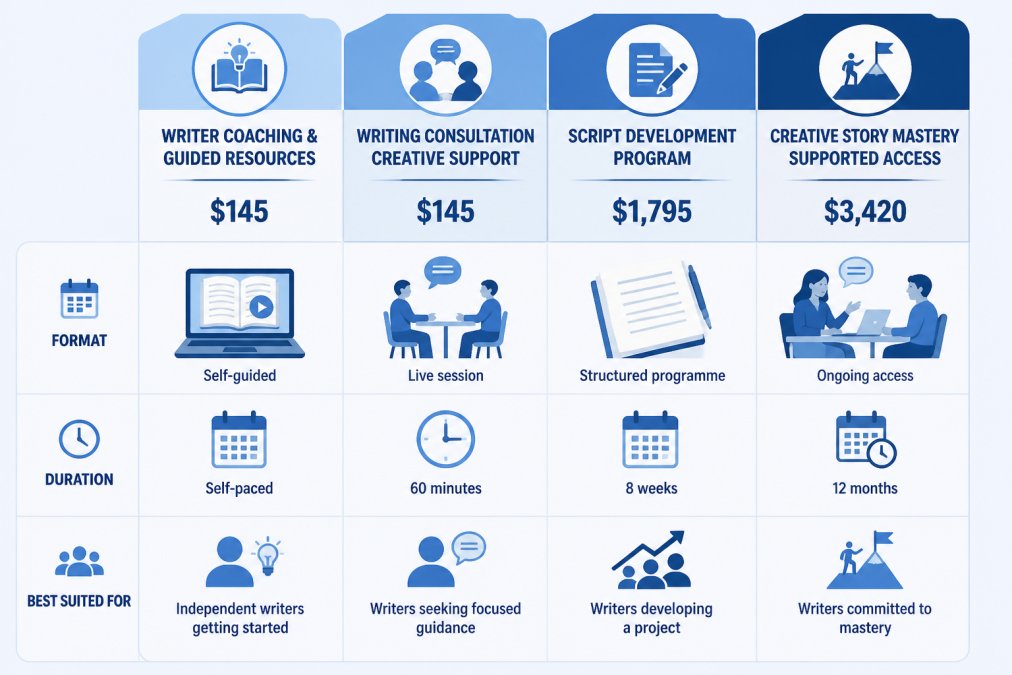
- Hourly or per-session, you pay as you go, which suits writers who want targeted help on a specific problem rather than a long partnership.
- Monthly retainer, a set number of sessions and email support each month, which suits writers who want steady accountability while drafting.
- Project or package fee, one agreed price for a defined outcome, such as a full structural review plus a set number of sessions, which suits writers who like a clear finish line.
- Programme or course with support, a structured curriculum plus coaching access, which suits writers who want to learn craft and be guided at the same time.
What sits inside those fees matters as much as the model. A fair coaching arrangement usually includes reading time between sessions, written or verbal feedback on pages, a plan for what you write next, and access to ask questions when you are stuck. If a fee covers only the live conversation and nothing in between, you are paying for a chat rather than a partnership.
It also helps to see coaching as one option among several, because the money question is really a comparison question:
| Route | What you get | What it suits |
|---|---|---|
| Manuscript coaching | Ongoing guidance, feedback and accountability while you write | Writers who need structure and a thinking partner |
| Developmental editing | A detailed assessment of a finished draft's structure and pacing | Writers with a complete manuscript |
| Writing course | Craft lessons you work through at your own pace | Writers who want to learn technique independently |
| Self-guided support | Books, podcasts, writing groups and your own discipline | Writers with strong habits and a clear plan |
A course can teach you how a story works, but it will not read your pages or notice that your second act sags. If you are weighing up a course, our Writing Coaching and short courses sit at different points on that spectrum, so you can pick the level of support that matches how you actually work.
Writer Coaching & Guided Resources →
Value for money is not about the lowest number. It is about how much finished, publishable work you end up with. A cheaper route that leaves you stuck is poor value. A structured arrangement that gets you to a real draft is not.
Before you commit, ask any coach to spell out exactly what is included, how long the arrangement runs, and what happens if you need to pause. A clear answer to those three questions is a good sign. A vague one is your cue to keep looking.
How to Choose a Book Coach: Questions That Reveal the Real Value
Choosing a book coach comes down to evidence, not enthusiasm. Ask what they have written, produced or published, and ask to see how they work. Vague answers are your signal to keep looking.
- What have you written, produced or published yourself?
- How do you give feedback, and how direct is it?
- What does a typical month of coaching look like?
- What happens if the draft is not working?
- Can you show me a clear plan for my project?
Red flags and realistic expectations
Promises of publication, bestseller status or "magic doors opening" are red flags. So is any coach who tells you your draft is perfect before reading it properly. Real coaching involves hard questions about your structure, characters and ending.
Expect to rewrite. Expect some sessions to sting a little. That discomfort is usually where the improvement lives.
Measuring Return on Investment: Outcomes, Timelines, and Progress
The return on manuscript coaching is measured in finished work, not feelings. But "did I finish?" is too blunt on its own.
Start with the outcome you actually want. Most writers are chasing one of four things:
- Finishing a first draft they have been circling for months
- Fixing structural problems before they pay for editing
- Lifting their craft so future books are easier to write
- Getting a manuscript into a state that is ready for publication
Pick the one that matters most, write it down, and treat it as the yardstick. Coaching that moves you steadily toward that goal is working. Coaching that leaves you busy but no closer to it is not.
Then track concrete markers, not moods. Useful signals include:
- Chapters or scenes completed each month
- Structural problems identified and resolved
- Rewrites completed, not just planned
- A draft that holds up when read cold
- Fewer repeat questions in later sessions, because you are learning the craft, not just borrowing answers
Set a realistic timeline. A first draft usually takes months, not weeks, and revision takes longer again.
Review honestly at intervals. Every few months, ask three questions: Am I closer to my stated goal? Am I a better writer than when I started? Would I spend the same again knowing what I know now?
Know what coaching cannot promise. It cannot guarantee publication, a bestseller, or that an agent will say yes.
That is the honest test. Coaching is worth it when it moves you from talking about the book to finishing it.
Frequently Asked Questions
What does a manuscript coach actually do?
A manuscript coach works alongside you on the craft and structure of your book, not just the surface errors. They help you clarify your story premise, develop narrative arc, strengthen characters, and build a revision plan you can execute. Unlike an editor who focuses on the existing text, a coach helps you make the rewrite decisions that shape the manuscript into something publish-ready. The work is collaborative and ongoing, with feedback designed to build your skills as well as improve the draft.
How is manuscript coaching different from hiring an editor?
Editing typically addresses what is already on the page: line edits, copyedits, proofreading, or structural suggestions. Manuscript coaching goes further by helping you build the book properly from the inside out. A coach might question character motivation, rearrange chapters, or help you rewrite scenes until they carry real tension. If your draft needs a proofread, hire an editor. If it needs reshaping and you want to learn how to do that work, coaching is the better fit.
How long does manuscript coaching take before I see results?
Timelines vary with the state of your draft and how much time you can commit. Some writers see meaningful structural improvements within a few weeks of focused sessions. A full manuscript development might run across several months. The Script Development Program, for example, runs for twelve months with monthly one-to-one sessions and ongoing reading between them. Progress depends on your writing time, so be honest about your weekly availability before you commit.
Can a manuscript coach help me finish a book I started years ago?
Yes. A half-finished manuscript sitting in a drawer is exactly the kind of project coaching addresses. The first step is usually a manuscript consult where you send your first ten pages or an overview of what exists. From there, a coach helps you diagnose what stalled the story and build a practical plan to move forward. The goal is consistent forward motion, not starting over from scratch unless the story genuinely needs it.