

Table of Contents
- Understand Your Inner Critic and What It's Telling You
- Imposter Syndrome for Writers: Why It Happens and How to Move Past It
- Writing Confidence Exercises to Build Your Creative Resilience
- How to Finish a First Draft Without Waiting for Permission
- Set Writing Goals and Build a Routine That Works for Your Life
- Consistency Over Perfection: The Real Path Forward
- Conclusion
Last Updated: August 13, 2026
Understand Your Inner Critic and What It's Telling You
Your inner critic isn't your enemy. It's a protective mechanism that evolved to keep you safe, and in writing, it often speaks loudest when you care most about the work. The problem isn't that you have self-doubt, it's that you haven't learned to distinguish between doubt that protects you and doubt that paralyses you.
Every writer hears that voice whispering that your sentences aren't good enough, that real writers don't struggle like this, that you're wasting your time. What most writers never realise is that this voice is trying to prevent failure. The trouble is, it prevents everything else too.
The inner critic gains power through silence. When you ignore it or fight it directly, it only gets louder. But when you turn toward it with curiosity instead of fear, something shifts. You start to notice what it's actually protecting: judgment? wasted time? the discovery that you're not as talented as you hoped?
Recognising the difference between healthy doubt and paralyzing doubt
Healthy doubt asks specific questions: "Is this character's motivation clear?" or "Does this scene earn its emotional weight?" It points to something fixable and motivates improvement.
Paralyzing doubt makes sweeping judgments: "This is terrible" or "You're not a real writer." It's vague, points nowhere, and stops you from working.
A practical test: can you write down what the doubt is claiming? If you can articulate it in a sentence or two, it's healthy doubt offering direction. If you spiral into feelings rather than specific concerns, that's paralyzing doubt, and it needs a different approach.
The goal isn't to silence your inner critic. It's to teach it when to speak and when to step back.
Imposter Syndrome for Writers: Why It Happens and How to Move Past It
Imposter syndrome for writers feels like a specific kind of fraud. You finish a chapter and think, "A real writer wouldn't have needed to rewrite this five times." You read someone else's book and discount compliments: "They're just being kind."
This isn't vanity. It's a cognitive distortion that affects most serious writers, especially those who recognise their own limitations. The irony is that imposter syndrome often strikes hardest when you're actually improving, because you're developing enough craft to see the gap between your current work and the work you admire.
Imposter syndrome thrives on comparison. You compare your rough draft to someone else's published book, a book that's been through professional editing, multiple rewrites, and years of refinement. You're comparing your process to their product, and of course you come up short. Every working writer knows this trap.
The gap between where you are and where you want to be
The gap is real, and you can see it clearly, which is exactly why imposter syndrome takes hold. But here's what changes the equation: recognising that the gap is information, not indictment. Every writer who matters has stood where you're standing and felt exactly what you're feeling. The difference is they kept working anyway, and the gap closed, not because they suddenly became talented, but because they completed enough drafts to learn what works.

The gap also tells you something valuable: you have good instincts. If you can see the difference between your work and work you admire, you're not fooling yourself about quality. That's the foundation of improvement.
When imposter syndrome whispers that you don't belong, the counter-argument isn't "Yes, I do." It's "I belong to the group of people who are learning, and that's exactly where I should be."
Writing Confidence Exercises to Build Your Creative Resilience
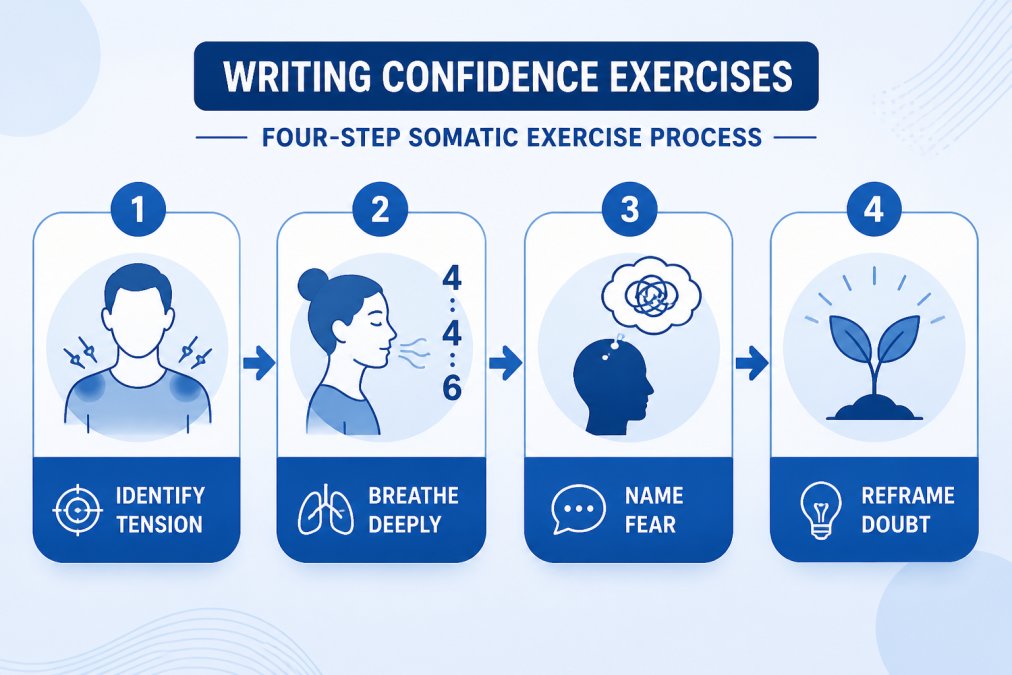
Creative anxiety lives in your body before it lives in your mind. Your shoulders tense. Your chest tightens. Your jaw clenches. Building creative resilience means teaching your body that writing is safe through concrete somatic techniques.
Somatic techniques to calm creative anxiety
The grounding breath. Before you start writing, spend two minutes breathing in for four counts, hold for four, exhale for six. The longer exhale activates your parasympathetic nervous system, the part that calms you down. Do this three times before opening your manuscript, and you'll notice your hands are steadier and your mind is clearer.
Progressive muscle release. Spend one minute systematically tensing and releasing each area: clench your fists for five seconds and release, shrug your shoulders up to your ears and drop them, clench your jaw and let it go slack. This teaches your body the difference between tension and relaxation.
The naming practice. When creative anxiety rises, name it specifically. Not "I'm nervous," but "I'm afraid this scene won't land" or "I'm worried I'm wasting time." Naming activates a different part of your brain than the amygdala, moving the experience from "threat" to "observable thought."
Reframing self-doubt as a sign you care about your work
Here's a counterintuitive truth: writers who don't doubt their work usually aren't very good. The doubt means you have standards. It means you can see the difference between what you've written and what you meant to write. That gap is where all improvement lives.
Instead of "I doubt myself," say "I care about this enough to notice where it falls short." The doubt isn't a character flaw, it's evidence of your investment in the work. When you doubt a scene, ask: "What specifically feels off?" When you doubt your ability, ask: "What skill would help me here?" The doubt becomes directional instead of paralyzing.
How to Finish a First Draft Without Waiting for Permission
The first draft doesn't need permission. It doesn't need to be good. It just needs to exist.
Most writers never finish because they're trying to write the final draft on the first attempt. They edit as they go, rewrite sentences three times before moving forward, wait until the opening feels perfect before continuing. This approach guarantees an unfinished manuscript.
The writers who finish are the ones who give themselves permission to write badly, not permission to be careless, but permission to be messy. Messy means you're exploring. Messy means you're discovering what the story needs as you write it.
Embracing the messy middle and imperfect pages
The messy middle is where most writers quit. You've finished the exciting opening. The ending is still far away. The middle feels slow and shapeless. This is when self-doubt strikes hardest, because you have enough perspective to see the work isn't working, but not enough distance to know how to fix it.
This is exactly where you need to keep going without judgment. The messy middle is where the story teaches you what it actually is. You can't see that yet, but if you stop now, you'll never get there.
Give yourself permission to write the worst possible version of each scene on purpose. Make the dialogue clunky. Make the pacing drag. Make the emotional beats obvious. This removes the pressure to get it right, which paradoxically makes it easier to move forward. You're not trying to write a good scene, you're trying to write a complete scene, and you can improve it later.
The imperfect pages are your working material, not your finished work. Holding this distinction is what allows writers to finish. Most writers discover their imperfect pages are actually better than they feared. Once you stop judging them in real time, you can see what's working.
Set Writing Goals and Build a Routine That Works for Your Life
Consistency beats intensity. A writer who writes for thirty minutes every day will finish a manuscript long before a writer who writes for five hours once a month. This isn't about talent, it's about showing up regularly, which trains your creative muscle and builds momentum.
The goal isn't to find huge blocks of time. It's to find sustainable time. If you have an hour a week, that's enough. If you have fifteen minutes a day, that's better. Frequency matters more than duration.
Setting writing goals means being specific about what "done" looks like. Not "I'll work on my manuscript," but "I'll write 500 words" or "I'll finish this scene." Specific goals give you something to aim for and a way to measure progress. Progress builds confidence and combats self-doubt.
A writing routine removes decision-making. You write at the same time, in the same place, with the same setup. Your brain learns that this is when writing happens, and it becomes easier to slip into focus. The routine also protects you from perfectionism. When you know you write for thirty minutes and then stop, you can't spend those thirty minutes editing. You write new material. This is how you build momentum and finish drafts.
Consistency Over Perfection: The Real Path Forward
Here's what separates writers who finish from writers who don't: finished writers have made peace with imperfection. They've decided that a messy completed manuscript is infinitely more valuable than a perfect manuscript that exists only in their head.
Perfectionism masquerades as high standards, but it's actually fear wearing a respectable disguise. It says, "I'm not publishing this until it's perfect," which really means, "I'm not publishing this until I'm certain it won't be criticised." But that certainty never comes. There's always another revision possible.
The cost of perfectionism is high: finished work, feedback that would improve your writing, and the chance to discover what you're capable of. Most importantly, it costs you the evidence that you can overcome self-doubt and complete something real.
Consistency, on the other hand, is forgiving. It doesn't require perfection. It just requires showing up. You write on days when you feel inspired and days when you don't. You write through self-doubt because the routine doesn't care about your doubt.
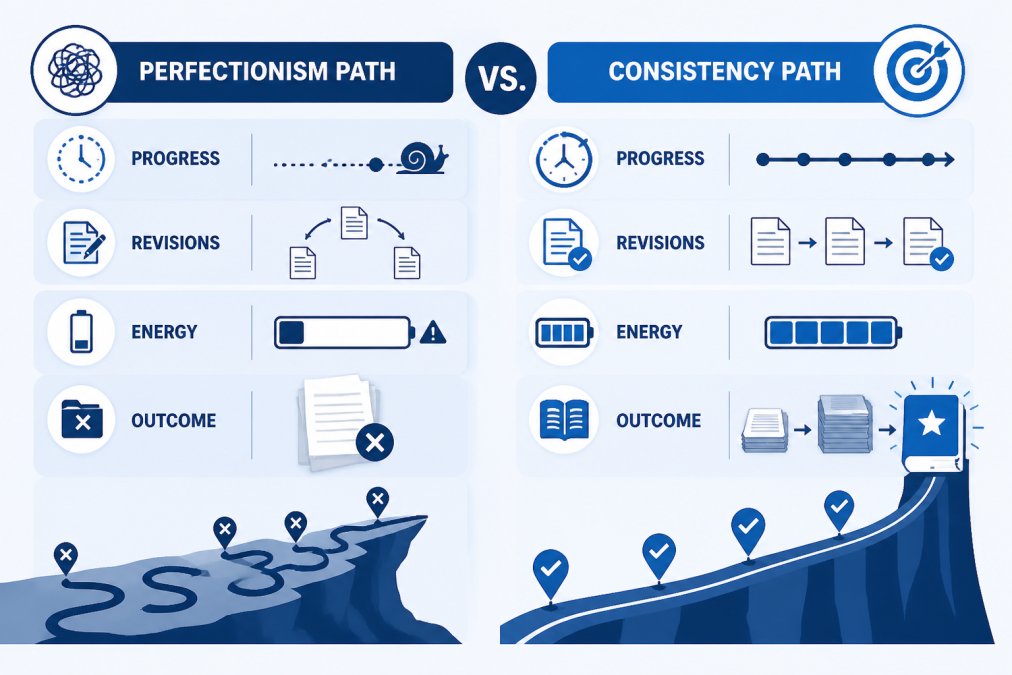
Consistency builds creative resilience in a way nothing else can. Every time you sit down and write despite self-doubt, you're gathering evidence that you can do this. After months of consistent writing, your doubt might still show up, but it shows up to a writer who has already proven they can finish. That changes everything.
The path forward isn't about becoming someone who doesn't doubt. It's about becoming someone who doubts and writes anyway. It's about building a routine that doesn't depend on confidence, because confidence is unreliable. A routine is reliable. A routine will carry you through the moments when self-doubt feels overwhelming.
Self-doubt in writing isn't a problem to solve, it's a companion to manage. The writers who finish manuscripts aren't the ones without doubt. They're the ones who learned to write despite it, who built routines that didn't depend on feeling ready, and who understood that consistency matters far more than perfection. At writeinspire, we work with writers who are serious about moving past doubt and into completion. Our creative writing coaching focuses on building the mindset, routine, and resilience you need to finish what you start. Whether you're working through a half-finished manuscript or starting your first draft, structured support makes the difference between abandoning your work and seeing it through to completion.
Frequently Asked Questions
How do I stop feeling like an imposter when writing?
Imposter syndrome for writers stems from comparing your rough draft to others' finished work. Start by separating the creative and editing phases. Give yourself permission to write badly in the first draft, that's the entire point. Track small wins: pages completed, chapters finished, consistency maintained. Join a writing community where you see other writers struggle too. Most published authors felt like impostors before their first book. Your doubt doesn't disqualify you; it means you care about quality.
Can self-doubt actually be a positive tool for writers?
Yes, when it's healthy doubt rather than paralyzing doubt. Healthy doubt pushes you to revise, to question weak dialogue, to deepen character motivation. Paralyzing doubt stops you from writing at all. The difference? Healthy doubt is specific ('this scene needs more tension') while paralyzing doubt is vague ('I'm not a real writer'). Use your doubt as a quality checkpoint during editing, not as a reason to avoid drafting. The best writers question their work, they just don't let that questioning prevent them from finishing.
What writing confidence exercises actually work?
Somatic techniques work because they interrupt the anxiety loop in your nervous system. Try this: when self-doubt rises, pause and notice where you feel it in your body. Place your hand there, breathe slowly for 30 seconds, then name the fear out loud. This simple act shifts you from reactive to reflective. Other effective exercises include timed free-writing (10 minutes, no stopping), reading your own old work to see how you've improved, and keeping a 'wins log' of completed pages. These aren't fluffy, they rewire how your brain responds to creative vulnerability.
How do I finish a first draft when self-doubt keeps stopping me?
The first draft is not the place to be perfect. Give yourself explicit permission to write badly. Set a word-count goal rather than a quality goal, 500 words per session, not 'perfect' words. Stop editing mid-draft; that's where perfectionism kills momentum. Many writers benefit from structured methods like the 90-Minute Draft approach, which builds confidence through quick, focused writing sessions. Your only job in the first draft is to get the story down. Editing comes later. Finishing a draft, even a messy one, proves to your inner critic that you can actually do this.
This article was written using GrandRanker