

Table of Contents
- What Is Writing Coaching for Independent Authors?
- Benefits of Hiring a Book Coach
- Developmental Editing vs Writing Coaching: What's the Difference?
- How to Find a Book Mentor and Choose the Right Coach
- Writing Coach Rates in Australia and ROI
- Working with a Coach: What to Expect
- Conclusion
Last Updated: August 9, 2026
What Is Writing Coaching for Independent Authors?
Writing coaching for independent authors is personalised guidance to help you develop your manuscript, strengthen your craft, and navigate publishing without relying on traditional publishing houses. Unlike a freelance editor who fixes your work after it's written, a writing coach works alongside you during the creative process, helping you clarify your story, build discipline, and make decisions that shape your manuscript from the ground up.
At writeinspire, we understand that independent authors face a unique challenge: you're managing everything yourself. There's no publisher holding your hand, no acquisition editor shaping your vision, no marketing department behind you. A writing coach fills that gap by offering accountability, structural guidance, and rigorous feedback that transforms a half-finished manuscript into something publishable.
The coaching relationship is collaborative. Your coach asks hard questions: Does your story arc work? Are your characters consistent? Is your pacing serving the narrative? They don't rewrite your work; they help you see it clearly and make stronger choices. Many writers discover the real bottleneck isn't talent, it's clarity.
Benefits of Hiring a Book Coach
Working with a book coach offers concrete advantages beyond what you'd get from a writing group or online course. The most obvious benefit is accountability. When you have a scheduled session with a coach, you show up with pages and meet deadlines instead of letting your manuscript sit untouched for months.
A coach also provides expert feedback tailored to your specific manuscript and goals. They identify patterns in your writing that you've become blind to, when dialogue feels flat, when pacing drags, when a character's motivation doesn't track. They know what separates a publishable manuscript from one that isn't ready.
Beyond the manuscript itself, a coach helps you develop as a writer. You learn story structure, how to build tension, and how to create characters readers care about. Many authors finish their first book without understanding these fundamentals. A coach accelerates that learning curve dramatically.
There's also the psychological dimension. Writing is isolating, and doubt creeps in. A coach normalises those feelings and helps you push through them, reminding you why you started writing in the first place.
Developmental Editing vs Writing Coaching: What's the Difference?
Many writers use the terms interchangeably, but developmental editing vs writing coaching serve different purposes at different stages of your manuscript.
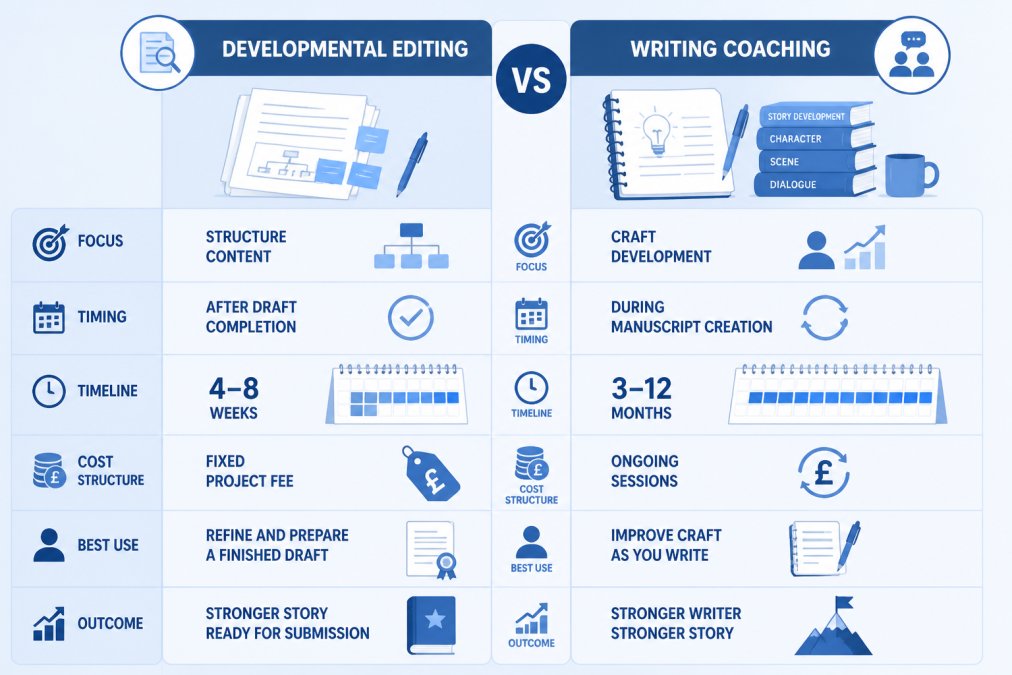
Developmental editing is a service. You submit a completed draft, an editor reads it, and produces a detailed report identifying structural issues, plot holes, character inconsistencies, and pacing problems. It's a transaction: you pay for analysis and implement changes. The relationship ends.
Writing coaching is a process. You work with a coach over weeks or months while you're still writing. You bring pages regularly, and the coach helps you think through problems before you write them into the manuscript. The relationship is ongoing and adaptive.
If your manuscript is finished and you need an expert assessment, developmental editing is efficient. If you're mid-project and feeling lost, or if you've never finished a manuscript before, coaching is the better investment. Coaching prevents problems; editing fixes them after they're already baked into 80,000 words.
Many writers benefit from both: coaching during creation, then editing after completion.
How to Find a Book Mentor and Choose the Right Coach
Finding a book mentor or writing coach requires more care than hiring a plumber. The relationship matters too much for a quick search. A bad fit wastes your money and time; a good fit accelerates your progress dramatically.
Start by clarifying what you need. Are you writing fiction or nonfiction? A novel or memoir? Different genres have different structural rules. A coach who specialises in romance might not suit a literary fiction project.
Look at the coach's background. Have they published work themselves? Do they have a track record coaching other authors? What's their philosophy about writing? Read their website and social media to get a sense of how they think about writing.
Ask for references. A legitimate coach will provide names of authors they've worked with. Talk to those authors and ask specific questions: Did the coach help you finish your manuscript? Did you learn skills for your next project? Would you work with them again?
Vetting Coaches and Avoiding Scams
Not every person calling themselves a writing coach is qualified. Here's how to spot red flags.
Beware of coaches who promise guaranteed publication or bestseller status. No one can guarantee that. A coach who promises results is either lying or setting you up for disappointment.
Watch out for coaches who charge enormous upfront fees for packages you can't cancel. Legitimate coaches typically charge monthly or per-session rates. Ask about refund policies and what happens if the fit isn't working after three months.
Be suspicious of coaches who haven't published themselves or don't have verifiable client work. They should have some credential, published work, editorial background, or a portfolio of author testimonials.
Check whether they have any connection to vanity publishing schemes. Some coaches funnel authors into expensive self-publishing services where the coach gets a cut. A good coach helps you make the best decision for your manuscript, whether that's traditional publishing, self-publishing, or querying agents.
Questions to Ask Before Committing
Before you sign up with a coach, ask these questions directly.
Ask: "How do you typically structure coaching sessions?" Do they have a set format, or do they adapt to each client's needs?
Ask: "How often do we meet, and what's the time commitment?" Make sure the cadence works for your life. Many writers have only an hour or two per week.
Ask: "What's your approach to feedback?" Do they focus on big-picture issues or line-level editing? Do they give you answers, or do they ask questions to help you find your own answers?
Ask: "How do you measure progress?" What does success look like in your coaching relationship? Having a shared definition prevents misalignment later.
Ask: "What genres or types of writing do you specialise in?" A coach who says "I work with everything" might lack depth.
Ask: "Can I do a trial session before committing?" You need to feel comfortable with this person, because you'll be sharing your work and doubts with them regularly.
Writing Coach Rates and ROI
Understanding writing coach rates helps you budget and evaluate value. Rates vary significantly based on the coach's experience, location, and format.
Writing coaches typically charge per hour or package rates. Some offer group coaching or workshops at lower costs. Online coaches sometimes cost less than in-person coaches, though experience and reputation matter more than delivery method.
WriteInspire offers [writing coaching with guided resources(/products/co-authoring-lead-your-story-from-spark-to-finished-manuscript) | writeinspire.com.au] for $145.00, reflecting 30+ years of experience and a structured approach to manuscript development.
The question isn't whether coaching is expensive, it's whether the ROI justifies the cost. If you've been working on a manuscript for three years without finishing it, and a coach helps you finish it in six months, that's valuable. If you've queried agents 50 times without success, and a coach helps you revise your manuscript until agents start requesting full manuscripts, that's worthwhile. If you self-publish a book that generates income because it's well-crafted, the coaching investment pays for itself.
The harder ROI to quantify is the learning. You're not just paying for help with one manuscript; you're learning a process you can apply to your next project.
Working with a Coach: What to Expect
The coaching relationship follows a general arc, though specifics vary by coach and project.
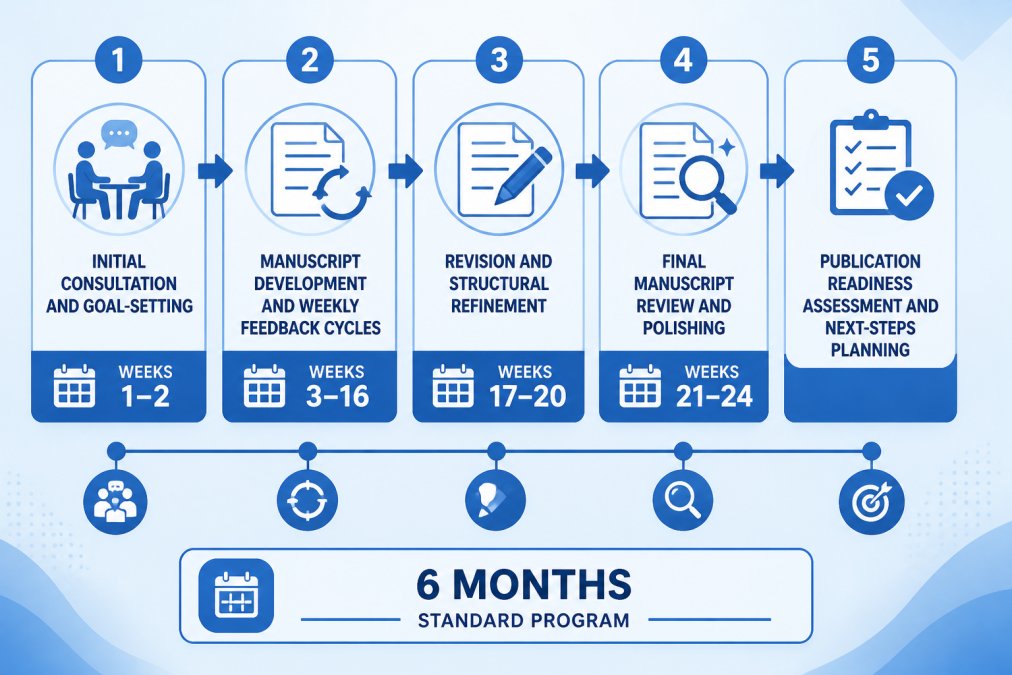
Most coaching relationships start with an initial consultation. You and your coach discuss your project, goals, timeline, and concerns. They ask about your writing history and current draft status. This conversation establishes baseline expectations.
Then comes the working phase. You submit pages on a regular schedule, typically weekly or fortnightly. Your coach reads them before your session and comes prepared with feedback. You discuss what's working, what needs revision, and what you should focus on next. You leave with clear next steps.
This cycle repeats. You revise, write new pages, submit, get feedback, and discuss. The manuscript evolves through multiple passes. Your coach helps you see patterns in your own writing. Over time, you start catching those issues yourself.
As you near the end of your manuscript, the focus shifts to bigger-picture questions. Does the ending land? Does the character arc resolve satisfyingly? Is there a scene that doesn't serve the story? A coach helps you strengthen these crucial elements.
Overcoming Writer's Block and Mindset Issues
Writer's block isn't usually about technique. It's about fear, that your work isn't good enough, that you're wasting time, that you'll finish and face rejection. A writing coach addresses the mindset issues underneath the block.
Perfectionism is a common block. You can't move forward because you're rewriting every sentence as you go. A coach helps you separate drafting from editing. Write the messy first draft. Edit later. Permission to write badly is often the breakthrough people need.
Comparison is another block. You read published books and think your work will never match them. A coach reminds you that published books went through multiple rounds of professional editing. Your first draft shouldn't match a published book.
Imposter syndrome is real for writers. A coach validates your work and points out progress you've made. They remind you that finishing a manuscript is genuinely hard.
Building Accountability and Writing Routine
One of the most underrated benefits of coaching is accountability. When you know you're meeting your coach on Thursday with ten new pages, you write those pages. Consistency matters more than volume. Many writers finish manuscripts on an hour or two per week, consistently applied.
A coach helps you identify realistic targets and hold you to them. They also help you troubleshoot when life gets in the way. You miss a deadline. A good coach doesn't judge; they help you adjust the plan. Maybe you dial back to fewer words per week for a month. The point is you're still moving forward.
Over time, the routine becomes a habit. You stop needing external accountability because you've internalised the discipline.
Writing coaching for independent authors is a practical investment in finishing your manuscript and developing your craft. The indie author path requires self-direction, and a coach provides both structure and support. If you've been struggling to finish, or if you're unsure whether your manuscript is ready, a coach can be the difference between abandoning your project and seeing it through to publication. WriteInspire's approach to manuscript development and creative writing coaching combines rigorous feedback with mentorship designed specifically for independent writers who want professional results. Start with a consultation to see if coaching fits your goals and timeline.
Frequently Asked Questions
What does a book writing coach actually do?
A writing coach works one-on-one with you to develop your manuscript, refine your craft, and overcome obstacles that prevent completion. Unlike an editor who fixes grammar and structure after the fact, a coach guides you through the creative process itself, helping you find your story's core, develop strong characters, build compelling plot arcs, and maintain momentum when motivation fades. They provide constructive feedback on your work, help you set realistic writing goals, and serve as an accountability partner. Writing coaching is about building your skills and confidence as a writer, not just fixing your finished manuscript.
How is writing coaching different from just joining a writers' group or taking an online course?
Writers' groups offer peer feedback and community, which is valuable, but they lack personalised guidance tailored to your specific manuscript and goals. Online courses teach craft principles but don't provide direct feedback on your work or accountability for progress. Writing coaching combines structured learning with one-on-one attention, your coach knows your project intimately, understands your challenges, and adapts their guidance to your needs. They hold you accountable, help you troubleshoot problems as they arise, and provide expert editorial input on your developing manuscript. It's the difference between learning about swimming and having a coach in the water with you.
Is writing coaching worth the investment for independent authors?
For independent authors serious about completing a publishable manuscript, coaching typically delivers strong return on investment. Most writers who work with a coach finish their manuscript faster and produce higher-quality work than those working alone. Beyond the finished book, you gain skills that apply to every project you write afterwards. The real cost of not getting coaching is often years of struggling alone, false starts, abandoned drafts, and manuscripts that never reach readers. If you're committed to your writing and want professional results without vanity publishing, coaching accelerates your timeline and improves your outcomes significantly.
How can a coach help me overcome writer's block and self-doubt?
Writer's block and imposter syndrome are common, but they're often rooted in specific issues a coach can identify and address. These might include unclear story direction, perfectionism, fear of judgment, or simply a lack of writing routine. A coach helps you diagnose the real problem, not just the symptom. They teach you strategies to restart momentum, help you separate the creative draft from the critical edit, and build your confidence through regular feedback and progress tracking. Beyond technique, a good coach provides encouragement and perspective, reminding you that doubt is normal and that your story matters. Accountability and professional guidance make the difference between feeling stuck and moving forward.
Can writing coaching work with limited time commitment, like one or two hours per week?
Yes. Effective coaching doesn't require huge blocks of time. Many coaches work with writers who have just a few hours weekly to dedicate to their manuscript. What matters is consistency and focus, working regularly, even in small sessions, produces better results than sporadic marathon writing sessions. A coach helps you make the most of whatever time you have by eliminating wasted effort, setting clear priorities for each session, and maintaining momentum between meetings. They also help you protect your writing time and build a sustainable routine that fits your life. The key is commitment and structure, not the number of hours available.
What's the difference between hiring a writing coach and just paying a freelance editor to fix my manuscript?
A freelance editor corrects problems in a finished (or near-finished) manuscript, grammar, structure, clarity. A writing coach works with you during the creative process to prevent those problems and help you develop stronger work from the start. Editing is about fixing; coaching is about building skill and confidence. If you have a half-finished manuscript or haven't started yet, coaching gets you to a better place before you need an editor. Many writers benefit from both: coaching during development, then editing for final polish. Coaching also teaches you to self-edit better, which saves money on professional editing later.
How do I know if a writing coach is actually qualified and not just selling false promises?
Look for coaches with demonstrated publishing experience, either their own published work or a track record of helping authors complete and publish manuscripts. Ask for references from past clients and examples of manuscripts they've helped develop. Qualified coaches are transparent about their background, methodology, and realistic timelines. They won't promise your book will become a bestseller or guarantee publication; they'll explain what coaching can and cannot do. Check whether they have formal training in editorial craft or creative writing. Be wary of coaches who focus only on selling their service rather than discussing your specific needs and goals. A good coach will discuss your project in detail before you commit, answering your questions honestly and setting clear expectations.
I've had a half-finished manuscript sitting unfinished for years. Is this the kind of thing coaching actually helps with?
Yes, absolutely. Abandoned manuscripts are one of the most common reasons writers seek coaching. Your coach will help you understand why the project stalled, whether it's a structural problem with the story, unclear direction, lost motivation, or simply life getting in the way. They'll work with you to either revive the manuscript by fixing what isn't working, or help you decide if it's worth finishing or if you should move on to a new project. Many writers find that fresh eyes and expert guidance unlock a manuscript that felt hopeless. The key is being honest about whether the story still excites you and whether the problems are fixable. A coach helps you make that assessment and take action either way.
This article was written using GrandRanker