

Table of Contents
- Why Plot Structure Matters in Short Fiction
- The Three-Act Structure: Foundation for Short Story Plot
- The Snowflake Method: Building Complexity Layer by Layer
- Short Story Plot Templates That Work
- Pacing and Scene Structure: The Engine of Your Story
- Short Story Word Count Guidelines and Structure Fit
- Common Short Story Structure Mistakes to Avoid
- Bringing It Together: Structuring Your Short Story
- Frequently Asked Questions
Last Updated: September 23, 2026
Why Plot Structure Matters in Short Fiction
Plot structure transforms a spark of an idea into a story that grips readers. Without it, even the most compelling character or vivid setting falls flat.
Short stories demand tighter plotting than novels. With 5,000 to 7,500 words to hook readers, develop stakes, and deliver a payoff, every scene must earn its place and every beat must move the narrative forward.
Learning the 5 best plot structuring techniques for short stories gives you a toolkit for different kinds of stories. The key is knowing which structure serves your specific story, then executing it with intention.
The Three-Act Structure: Foundation for Short Story Plot
The three-act structure, setup, confrontation, and resolution, is the backbone of storytelling and foundation for every other technique you'll learn.
Setup establishes your world and introduces your protagonist. In short fiction, use 500 to 800 words, just enough context for readers to care what happens next, without lengthy worldbuilding or backstory dumps.
Confrontation is where the real story lives. Your character encounters an obstacle, choice, or revelation that forces them to act. This section should consume roughly 60% of your word count.
Resolution wraps the narrative arc. Your character faces the climax, makes a choice, and experiences the consequences. This needs to be earned, not rushed.
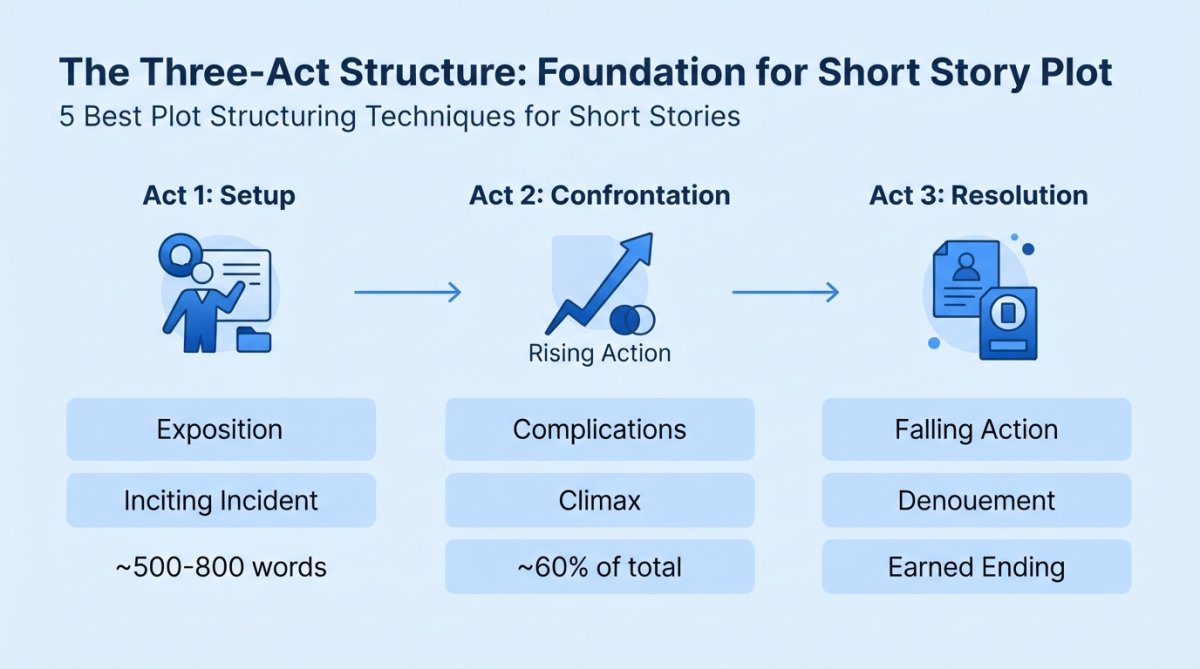
This structure scales flexibly: a 2,000-word flash fiction story and a 7,500-word short story both use the same framework, just with different proportions.
Setup, Confrontation, and Resolution
Setup introduces the protagonist's world and the inciting incident, the moment something disrupts the ordinary. The ratio of setup to total word count matters more than exact word counts.
Confrontation is where your character grapples with the problem. Each scene should raise stakes or deepen conflict. By the midpoint, readers should understand what your character wants and why they can't simply have it.
Resolution means the narrative tension releases. Your character makes a choice and lives with the consequences. In short fiction, this might be a single scene or final paragraph.
The three-act structure works for mysteries, romance, science fiction, and literary fiction alike. It's not a formula. It's a rhythm readers have learned to expect, and meeting that expectation creates satisfaction.
The Snowflake Method: Building Complexity Layer by Layer
The Snowflake Method builds your story from a single sentence outward, adding detail and complexity with each pass.
Start with one sentence that captures what your story is fundamentally about.
Expand to a paragraph describing the three acts, then a page outlining your protagonist's arc, then scene-by-scene breakdowns. Each layer adds specificity without rigid constraints.
For short fiction, the key principle is start simple, add complexity deliberately. This prevents overcomplicating your plot before you've drafted.
The method also forces you to articulate your story's central tension early. Before you write a single scene, you know what your protagonist wants, what stands in their way, and what they'll learn. That clarity translates into tighter prose and more purposeful scenes.
Short Story Plot Templates That Work
Templates aren't meant to constrain you. They're meant to show you what works and why. When you understand the architecture of a successful twist ending or a hero's journey, you can adapt it to your own story.
The Hero's Journey in Miniature
The hero's journey, call to adventure, refusal, meeting the mentor, crossing the threshold, tests, ordeal, reward, return, seems too sprawling for short fiction. But condensed, it's remarkably effective.
Your protagonist receives a call (inciting incident). They hesitate or refuse. A mentor figure or circumstance pushes them forward. They cross into a new world or situation. They face tests that reveal their character. The ordeal arrives, the moment of highest stakes. They survive, transformed. They return changed.
In a 5,000-word story, this entire arc can unfold in tight, purposeful scenes. The key is cutting anything that doesn't serve the transformation. No lengthy training montages. No side quests. Just the essential beats that show your character learning and changing.
The Twist Ending Framework
A twist ending works when readers have all the information they need to understand the twist, but they've been misdirected about what it means. The setup plants clues. The confrontation develops what seems like the obvious trajectory. The resolution reveals what was hiding in plain sight.
The mistake many writers make is withholding information to force surprise. That's cheap. Effective twist endings give readers the pieces, they just arrange them in a way that obscures the final picture until the reveal.
Think of it as misdirection, not deception.
Pacing and Scene Structure: The Engine of Your Story
Pacing is the rhythm of your narrative. It's controlled by scene length, dialogue density, paragraph breaks, and sentence structure. Tight pacing doesn't mean fast. It means purposeful.
Short Story Word Count Guidelines and Structure Fit
Word count shapes structure. A 1,000-word flash fiction piece uses different proportions than a 7,500-word short story. Understanding those proportions helps you allocate your words wisely.
| Word Count Range | Typical Scene Count | Setup Duration | Confrontation % | Resolution Speed |
|---|---|---|---|---|
| Under 1,500 | 1-2 | Immediate | 70-80% | Fast |
| 1,500-5,000 | 3-5 | 15-20% | 60-70% | Earned |
| 5,000-7,500 | 4-7 | 15-20% | 55-65% | Deliberate |
Common Short Story Structure Mistakes to Avoid
Understanding what works means knowing what doesn't. These mistakes appear constantly in unpublished manuscripts, and they're all preventable once you see them.
Overcomplicating the Plot
Beginning writers often feel that more plot equals a better story. Multiple subplots, secondary conflicts, twists layered on twists. In a short story, this becomes noise. Readers lose track of what actually matters.
Weak Inciting Incident
The inciting incident is the moment that forces your story to begin. It's when the ordinary becomes extraordinary. A weak inciting incident, something the protagonist could easily ignore or solve, fails to generate momentum.
Rushed or Unearned Resolution
Many writers run out of energy by the time they reach the ending. The resolution feels tacked on, as if they've suddenly decided to wrap things up. Readers feel the shift, and it undermines everything that came before.
Bringing It Together: Structuring Your Short Story
Start with your core idea. Write it in one sentence. What is this story fundamentally about?
Frequently Asked Questions
What are the 5 essential elements of a short story plot?
The five essential elements are exposition (introducing characters and setting), inciting incident (the event that starts the story), rising action (complications and tension building), climax (the turning point where stakes peak), and resolution (how the story concludes). Short stories compress these elements tightly, often combining exposition with the inciting incident to grab readers immediately. Each element serves the central conflict and propels the narrative forward without wasted space.
How do you choose the right plot structuring technique for a short story?
Choose based on your story's length, complexity, and emotional core. The three-act structure works for most traditional short stories (1,500-5,000 words). The Snowflake Method suits stories with layered conflict or character revelation. Plot templates like the Hero's Journey work best for adventure or transformation arcs, while the twist-ending framework demands careful foreshadowing and economy of detail. Consider whether your story emphasises action, character change, or revelation, that choice determines which structure serves you best.
What are common short story structure mistakes to avoid?
The biggest mistakes are overcomplicating the plot with too many subplots, weakening the inciting incident so readers don't feel the stakes, and rushing or leaving the resolution unearned. Many writers also bury their story's real conflict under unnecessary exposition, fail to pace scene and summary effectively, or end abruptly without letting emotional consequences land. Short stories demand ruthless focus, every scene must earn its place and move the narrative or reveal character.
How does short story word count affect plot structure?
Word count dictates how compressed your structure must be. Flash fiction (under 1,500 words) often skips exposition entirely, starting mid-action with minimal character setup. Standard short stories (1,500-7,500 words) accommodate a full three-act structure with clear turning points. Longer short stories (7,500-20,000 words) allow subplots and richer character development. Know your target length before outlining, it shapes how many scenes you can afford, how much tension you can build, and whether your climax has room to breathe.
Can a short story work without traditional plot structure?
Yes, but with intention. Character-driven stories, slice-of-life narratives, and experimental fiction can succeed through voice, atmosphere, or emotional resonance rather than traditional plot beats. However, even these need narrative momentum, a shift in perception, a small revelation, or a moment of change. Readers expect some movement, even if it's internal. Skipping structure entirely often reads as unfinished rather than innovative. If you abandon traditional structure, replace it with something deliberate: a thematic arc, a tonal journey, or a carefully orchestrated discovery.
The difference between a story that works and one that doesn't often comes down to structure. You can have compelling characters and beautiful prose, but without a clear narrative arc, readers won't stay engaged. By mastering these five techniques and understanding how to apply them to your specific story, you give yourself the foundation to write short fiction that resonates. Start with the three-act structure. Build from there. Trust the process.