

Table of Contents
- Why Manuscript Outlining Templates Matter for Beginners
- 1. The Three-Act Structure Template
- 2. The Hero's Journey Framework
- 3. The Snowflake Method for Growing Your Story
- Chapter-by-Chapter Book Outline Examples
- Best Software for Manuscript Outlining
- How to Outline a Book Step by Step
- Troubleshooting Stalled Outlines and Common Mistakes
- Frequently Asked Questions
Last Updated: September 3, 2026
Why Manuscript Outlining Templates Matter for Beginners
Here's the truth: most writers who abandon their manuscripts do so not because they lack talent, but because they lose direction halfway through. A blank page is paralyzing. A clear structure is liberating.
Manuscript outlining templates give you a roadmap before you write a single scene. They answer the questions every writer faces: What happens next? Why does it matter? How do these pieces fit together? Writers who finish their work almost always start with a template that matches their story and their brain.
The best templates reduce decision fatigue, catch plot holes before you've written thousands of words, and give you permission to start messy, because the outline is where the real thinking happens.
Below are several approaches that work. Some are narrative frameworks (like the Hero's Journey), some are mechanical (like the Snowflake Method), and some work in a notebook, spreadsheet, or software. Pick the one that matches how your brain works.

1. The Three-Act Structure Template
The three-act structure is the skeleton of most stories that work. Act One sets up the world and the problem. Act Two complicates it with repeated failed attempts. Act Three forces a final confrontation and resolution. It works because it mirrors how we naturally process stories: understand what's at stake, watch someone struggle, see how it resolves.

For a manuscript outline using this structure, you'd map:
- Act One (25% of your manuscript): Introduce your protagonist, their ordinary world, and the inciting incident that disrupts it
- Act Two (50% of your manuscript): Escalate the stakes, introduce obstacles and allies, show your character's failed attempts to solve the problem
- Act Three (25% of your manuscript): Bring the protagonist to a point of no return, force a climactic choice, and show the consequences
Many writers start here because it's intuitive and proven. The risk: it can feel formulaic if you're writing experimental fiction or work that deliberately subverts expectations.
2. The Hero's Journey Framework
The Hero's Journey, mapped by mythologist Joseph Campbell, includes 12 distinct stages: the call to adventure, refusal of the call, meeting with a mentor, crossing the threshold, tests and allies, approach to the inmost cave, the ordeal, the reward, the road back, resurrection, and return with the elixir.
This framework works brilliantly for epic fantasy, adventure, and coming-of-age narratives. Some writers find it too prescriptive; others find it liberating.
For a manuscript outline using the Hero's Journey, you'd map each of the 12 stages and identify:
- What happens in this stage
- How it changes your protagonist
- What question or tension it raises for the next stage
It works best for writers who like detailed planning and is deeply embedded in popular culture, readers absorb its rhythm and sense when a stage is missing. If you're drawn to this framework but want guidance on how to apply it to your specific story, Creative Story Mastery explores narrative frameworks in depth and helps writers build outlines that work.
3. The Snowflake Method for Growing Your Story
The Snowflake Method, developed by fiction writer Randy Ingermanson, starts with a single sentence and expands it recursively, like a snowflake growing outward from its centre.
Here's how it works:
- Write a one-sentence summary of your entire story
- Expand that to a one-paragraph summary (3-5 sentences)
- Write a one-page summary (expand the paragraph to roughly 250 words)
- Develop character summaries for your main characters
- Expand your one-page summary to a four-page outline
- Write a one-page summary for each character's arc
- Expand to a full chapter-by-chapter outline
This method appeals to writers who like to start small and build outward. You discover what your story is really about by articulating the core conflict in a single sentence before expanding it. It's slower than jumping straight to a full outline, but the time you spend forces clarity and prevents you from writing yourself into corners.
Chapter-by-Chapter Book Outline Examples
Once you've chosen a framework, break your story into chapters. A chapter-by-chapter outline includes the chapter number, POV character, primary story beat, key scenes, how it changes the protagonist, and a one-sentence summary of purpose. This prevents chapters that don't advance the plot and makes drafting faster, you're executing a plan, not deciding what happens next.
Chapter-by-chapter outlines reveal pacing problems before you write a word. If chapters 15-25 are all setup with no turning points, you'll see it immediately and can fix it in the outline rather than rewriting thousands of words. Your outline doesn't need to be beautiful or complete, it needs to be useful.
Best Software for Manuscript Outlining
You don't need software to outline. A notebook, pen, or spreadsheet works. But the right tool can make the process faster and keep your outline accessible while drafting.
Common options include:
Scrivener includes outlining, character tracking, and research folders. Powerful but has a learning curve.
Notion lets you build custom outlines and character databases. Free for personal use and works across devices.
Microsoft Word or Google Docs are simple and sufficient for basic outlines using heading styles.
Spreadsheets (Google Sheets or Excel) work well for tracking chapter number, word count, POV character, and key scenes.
Pick a tool you'll actually use. Switching between tools kills momentum.
How to Outline a Book Step by Step
Here's a practical process for creating a manuscript outline, regardless of which framework you choose:
Step 1: Define your story problem and protagonist's drive (30 minutes)
Write one sentence answering each: What is the core conflict? What does your protagonist want and need? What stands in their way? This forces you to articulate your story's spine before outlining details.
Step 2: Map your story's major turning points (45 minutes)
Identify 4-6 moments that shift direction: the inciting incident, point of no return, midpoint, climax, and resolution. You don't need every scene yet, just where the story pivots.
Step 3: Outline your story's structure using your chosen framework (1-2 hours)
Map your turning points into your chosen structure. Decide: Does this moment belong in Act One or Act Two? Is this a threshold crossing or a test?
Step 4: Break your story into chapters (1-2 hours)
Estimate your final word count and divide by target chapter length (typically 3,000-5,000 words). Assign your turning points to chapters, then fill gaps with scenes that build toward or away from them.
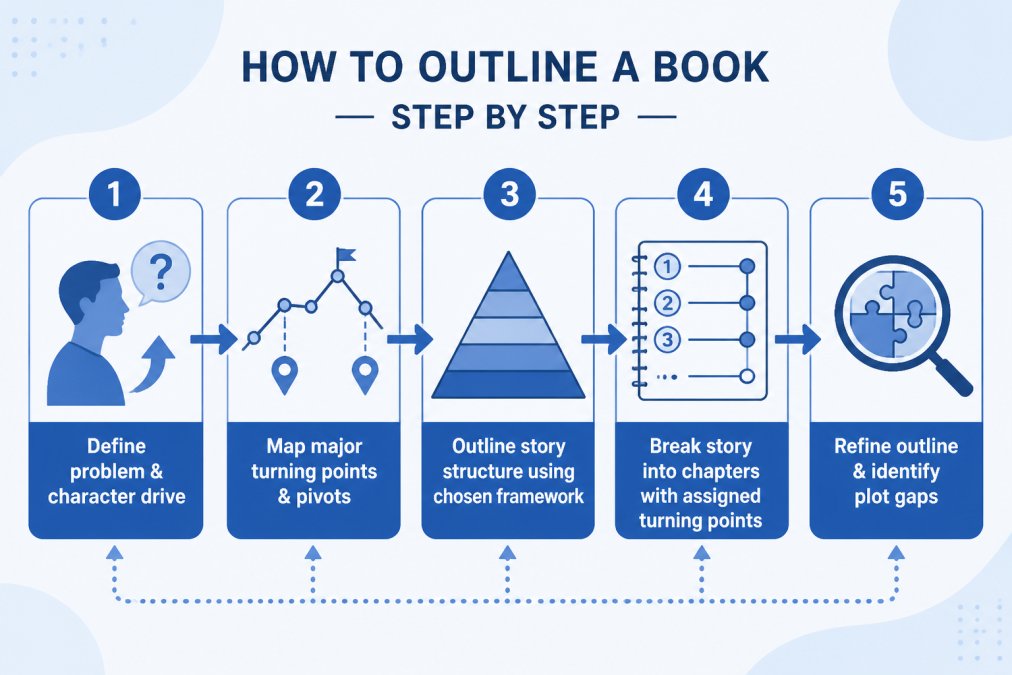
Step 5: Identify plot holes and conflicts (30-45 minutes)
Read through your outline as a reader. Does each chapter move the story forward? Are there scenes that don't serve the plot? Are there logical gaps? Does pacing feel right? Mark problems so you can address them before drafting.
Step 6: Refine and expand (ongoing)
Your outline will evolve as you write. The goal is a clear direction and enough detail to prevent getting lost. Your outline is a living document, not a contract.
Troubleshooting Stalled Outlines and Common Mistakes
The outline is too detailed. Outlining every scene, every piece of dialogue, every thought removes the joy of discovery. Your outline should guide you, not script you.
The outline is too vague. "Chapter 5: Stuff happens" creates blank-page panic. Your outline should be specific enough that you know what needs to happen, even if you don't know exactly how.
You've outlined a story you don't actually want to write. You spend weeks building a plot, then realise you're not excited about it. Abandon that outline. Your instinct is telling you something. Start again with a story that genuinely excites you.
Your outline doesn't match your story's actual shape. You discover your story is longer, shorter, or structurally different. Adjust the outline to match what you're discovering. Your outline serves your story, not the reverse.
You're outlining instead of writing. Some writers use outlining as productive procrastination. Set a deadline: outline for no more than a week, then start drafting. You'll learn more about your story by writing it than by outlining it. If you find yourself stuck in the outlining phase, Writing Consultation Creative Support can help you move from planning to drafting with confidence. If your outline isn't working, it's feedback. Adjust it, simplify it, or start fresh. The only outline that matters is the one that gets you to draft.
Outlining is where your story becomes real. The right template gives you permission to think clearly before you write, catch problems early, and move faster when drafting. Whether you're drawn to the Hero's Journey, the Snowflake Method, or the three-act structure, the framework matters less than your commitment to using it. Your story is worth telling. The outline is your first step toward proving it.
Frequently Asked Questions
What are the most common mistakes beginners make when outlining a manuscript?
Beginners often over-detail their outlines, trying to write scenes instead of mapping story structure. Others skip the outline entirely, diving straight into drafting and hitting walls halfway through. The biggest mistake is treating the outline as final, it's a working tool that evolves. Many also confuse plot with character arc, forgetting that your protagonist must change. Start loose, focus on story beats and turning points, and give yourself permission to revise the outline as your manuscript develops.
How much detail should be included in a beginner's outline?
A beginner's outline should capture the essential story structure without overwhelming you with detail. Aim for one sentence per scene or chapter, noting the inciting incident, rising action, climax, and resolution. Include character goals, obstacles, and how each scene moves the plot forward. Avoid writing full paragraphs, that's what drafting is for. Your outline is a roadmap, not the journey itself. As you gain experience, you'll discover whether you prefer minimal structure or chapter-by-chapter breakdowns.
Should I use a digital tool or a manual template for my manuscript outline?
Both work equally well, it depends on how you think. Digital tools like spreadsheets or dedicated outlining software let you reorganise scenes quickly and track character arcs across chapters. Manual templates (pen and paper, or printed worksheets) help some writers think more creatively without screen distractions. Many beginners find a hybrid approach works best: sketch ideas on paper, then transfer them into a digital format for organisation. The best tool is the one you'll actually use consistently.
How do I choose the right outlining template for my genre?
Different genres follow different story patterns. Romance typically requires a clear meet-cute, escalating tension, and emotional resolution. Mystery demands clues planted early, a turning point that shifts suspicion, and a satisfying reveal. Literary fiction often prioritises character development over plot mechanics. Start by reading three books in your genre and mapping their structure, where does the inciting incident occur? When does the protagonist face their biggest challenge? Your outline should mirror the pacing and emphasis your readers expect. Genre conventions exist because they work.
What is the best way to outline a novel for beginners?
The best approach combines simplicity with flexibility. Begin by identifying your story problem, the central conflict your protagonist must resolve. Map the major turning points: inciting incident, midpoint reversal, and climax. Then work backwards and forwards to fill in scenes that build tension toward those beats. Use chapter-by-chapter breakdowns once you understand the overall narrative arc. Remember, your outline is a living document. As you draft, you'll discover new story possibilities, that's normal. Allow your outline to evolve with your manuscript.
This article was written using GrandRanker