

Table of Contents
- Quick Comparison: Top Creative Writing Courses
- Creative Story Mastery: Comprehensive Storytelling from Spark to Finished Manuscript
- Creative Writing Coaching for Beginners: Where to Start Your Craft
- The 90-Minute Draft Method: Short Courses for Writers Who Struggle with Time
- Script Development Program: 12-Month Manuscript Development Services
- Write A Play in 30 Days: Focused Creative Writing Exercises
- How to Choose the Right Creative Writing Course for Your Goals
- Frequently Asked Questions
Last Updated: September 1, 2026
Quick Comparison: Top Creative Writing Courses
Finding the right creative writing course depends on where you are in your journey as a writer. Some courses focus on building foundational skills, whilst others guide you through completing a full manuscript. The best creative writing courses for Australian authors balance structured craft instruction with genuine feedback that helps you finish what you start.
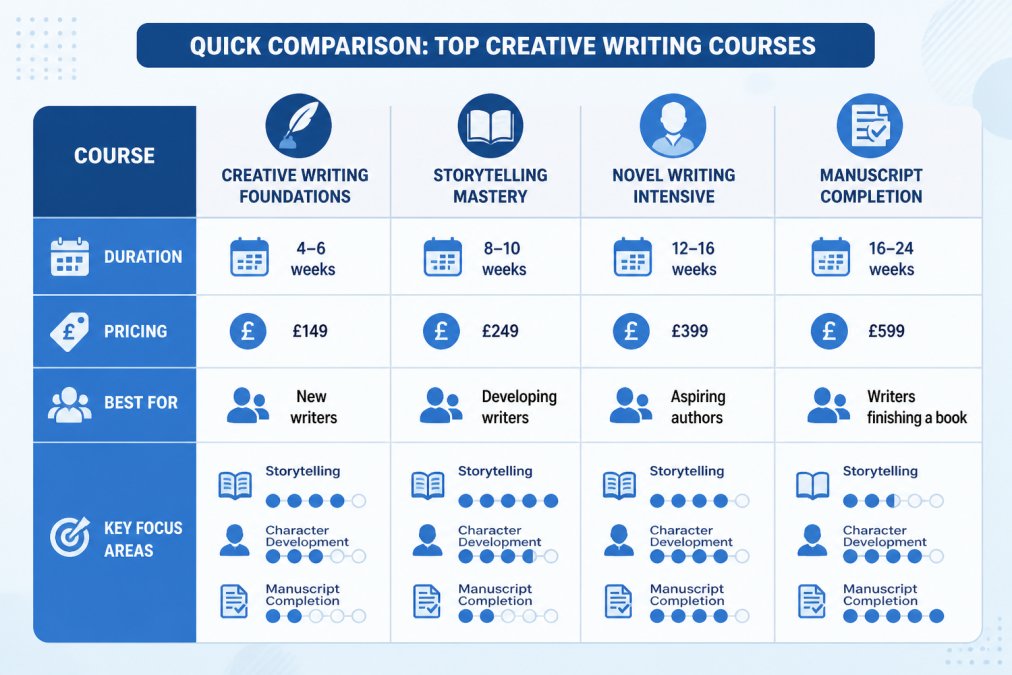
| Course | Duration | Best For | Key Focus | Price |
|---|---|---|---|---|
| Creative Story Mastery - Supported | Self-paced modules | Writers wanting guided support | Storytelling foundations to finished manuscript | $3,420 |
| Creative Story Mastery - Go It Alone | Self-paced modules | Independent learners | Complete story craft curriculum | $2,565 |
| Script Development Program | 12 months | Playwrights and screenwriters | Monthly one-on-one dramaturg support | $1,795 |
| The 90-Minute Draft Method | Single session | Time-pressed writers | Rapid drafting without perfectionism | $49.95 |
| Write A Play in 30 Days | 30 days | Beginners to playwriting | Daily structured exercises | $59.95 |
The choice comes down to your situation: Do you need accountability or independence? Are you starting from scratch or refining an existing draft? How much time can you realistically commit each week?

Creative Story Mastery: Comprehensive Storytelling from Spark to Finished Manuscript
Creative Story Mastery is a complete storytelling curriculum built to take writers from discovering a story idea through to a polished, submission-ready manuscript. This isn't a quick course, it's a rigorous craft education designed for writers serious about mastering the fundamentals.
The program moves through eight core modules: finding a compelling story, developing your narrative structure, creating believable characters, building scenes with tension, controlling action and momentum, writing authentic dialogue, refining language, and finally, preparing your work for the marketplace. Each module builds on the previous one, so by the end you've moved from a spark of inspiration to a complete story.
WriteInspire offers two versions. The Supported Access includes ongoing guidance as you work through the material, which suits writers who benefit from external accountability and feedback. The Go It Alone version gives you full access to the curriculum at a lower price point, ideal if you're self-directed and prefer to set your own pace without structured check-ins.
What makes this different from a typical online course is the depth. This isn't a collection of video lectures you watch passively. Each module includes detailed workbooks with exercises, reflections, and space for your own writing. You're building a manuscript as you go, not just learning theory.
The real value emerges when you reach the character development module. Most writers know characters matter, but Creative Story Mastery walks you through the specific questions that reveal who your characters really are, their goals, their contradictions, what they're willing to sacrifice. By the time you finish, your characters drive the plot rather than the other way around.
Creative Writing Coaching for Beginners: Where to Start Your Craft
If you've never finished a manuscript and worry you might not have what it takes, this is where many writers actually begin. The fear of wasting time on something unfinished is real. What separates writers who finish from those who don't isn't talent, it's usually structure and someone who believes the work matters.
Writer Coaching & Guided Resources from WriteInspire starts with a fundamental question: what is your story actually about? Not the plot summary, but the emotional core. What makes this story yours to tell?
This service works because it's not vanity publishing dressed up as coaching. There's no promise that your first draft will be perfect or that you'll automatically find a publisher. Instead, you get a working partner who helps you build the manuscript properly, shape it with genuine craft, and keep momentum going until it's real.
The coaching approach means you're not alone in the blank-page struggle. Your coach works with you to clarify the story premise, develop a narrative arc that holds tension, strengthen characters so readers care about what happens to them, and ensure every scene serves the larger story. You write the manuscript, but you're writing it with someone who understands how stories actually work.
What makes this different from hiring a freelance editor is timing. An editor works on a finished draft. A coach works alongside you from the beginning, helping you make better choices as you write rather than trying to fix problems after the fact. This saves months of revision.
The 90-Minute Draft Method: Short Courses for Writers Who Struggle with Time
Time is the real barrier for most writers. Not talent. Not ideas. Time.
The 90-Minute Draft Method solves this by compressing the entire writing process into a single focused session. You move from a blank page to a workable draft using a specific sequence: define the story problem, establish character drive, map the scene turns, write action beats, add dialogue, sharpen language, and land a strong hook.
This isn't about producing polished prose. It's about generating momentum and making decisions fast. The method works because it removes perfectionism from the equation. You're drafting, not editing. You're moving forward, not second-guessing every sentence.
The structure matters. You spend the first ten minutes clarifying what the story is really about and what changes. The next fifteen minutes building your character, what they want, what stands in their way, what's at stake. Then you map the scene beats that will create tension. By minute 25, you're actually writing, and you don't stop to edit until the draft is done.
What makes the 90-minute format work is constraint. Unlimited time paradoxically slows you down because you can always revise. A hard deadline forces commitment. You finish because you have to, not because it's perfect.
Many writers use this method weekly to build a manuscript chapter by chapter. One 90-minute session per week equals roughly 2,000-3,000 words of usable draft material. Over a year, that's a complete novel.
Script Development Program: 12-Month Manuscript Development Services
For writers serious about completing a script or manuscript with professional guidance, the Script Development Program offers what most courses don't: consistent one-to-one support over a full year.

This is a 12-month partnership with Darren Brealey, who brings over 30 years of writing and producing experience. You get monthly Zoom sessions where your script is read, discussed, and shaped with real depth. Between sessions, ongoing feedback keeps you moving instead of waiting weeks for input. Custom exercises and deadlines are tailored to your specific project.
The program includes access to the full Creative Story Mastery library, so you have both the structured curriculum and the personalised dramaturg support. This combination addresses the two things most writers need: a clear framework for craft, and someone who believes the work is worth finishing.
What distinguishes this from generic manuscript coaching is the production experience. Brealey has worked in London, Singapore, Malaysia, and Australia, he understands how stories work across different markets and mediums. That perspective shapes the feedback you receive.
The program is flexible around your life. Sessions are scheduled at times that work for you, which matters for writers juggling work, family, and creative time. The goal is consistent progress, not rigid deadlines that add stress.
Write A Play in 30 Days: Focused Creative Writing Exercises
If playwriting intimidates you or you're unsure whether you actually want to write a play, this workbook gives you thirty days to find out.
Write A Play in 30 Days isn't a course with video lessons. It's a structured workbook that guides you through one page per day, building a complete stage play concept from first idea to final page. Each day follows the same rhythm: a five-minute warm-up with prompts, 25-60 minutes of actual writing, and five to ten minutes of reflection where you capture what you've learned and note new story ideas.
The structure mirrors the Creative Story Mastery modules, so you're learning the same craft principles but compressed into a month-long sprint. You discover story ideas, develop conflict and structure, build characters with genuine motivation, strengthen scenes, control action, sharpen dialogue, and refine language, all within the playwriting context.
The genius of the daily format is that it removes the pressure of producing something perfect. You're building creative consistency. Some days the writing flows. Some days it doesn't. You keep going regardless, and by day 30 you have a solid play outline and a clearer understanding of your creative process.
Many writers use this as a stepping stone. Complete the 30-day workbook, then decide whether you want to develop the play further through the Script Development Program or move on to a different project.
How to Choose the Right Creative Writing Course for Your Goals
Choosing a creative writing course depends on answering three honest questions: Where are you in your writing journey? How much time can you actually commit? What's your primary goal, learning craft, finishing a manuscript, or both?
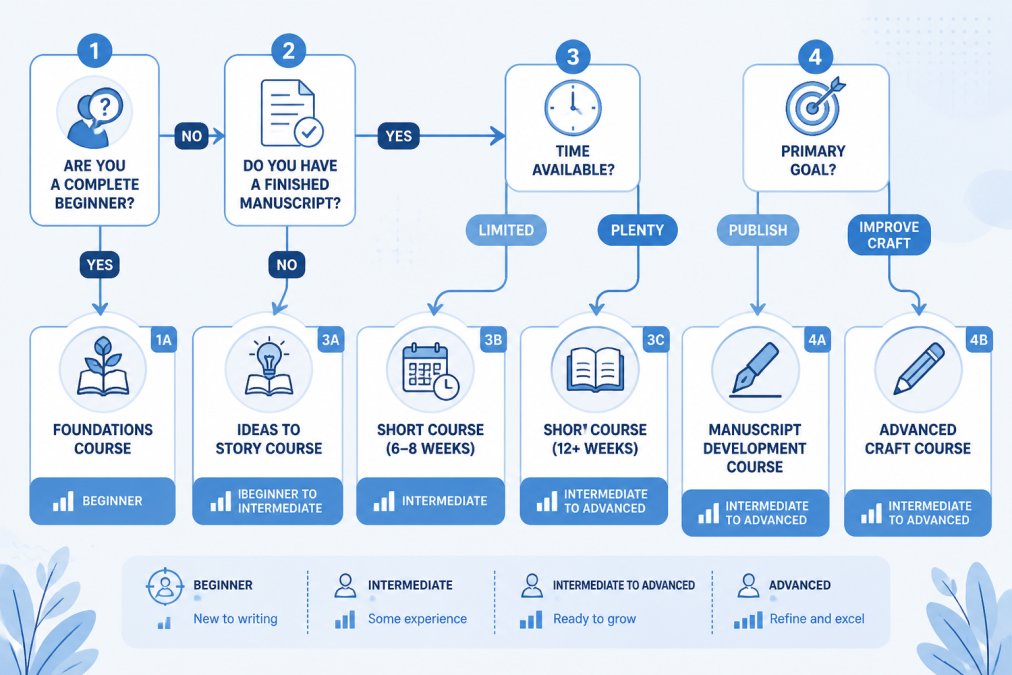
If you're starting from scratch and have limited time: The 90-Minute Draft Method or Write A Play in 30 Days suit you. Both work within tight schedules and produce tangible output quickly. They're also low-cost entry points to test whether structured creative writing coaching actually helps.
If you have a half-finished manuscript sitting in a drawer: Creative Story Mastery with Supported Access gives you both the craft framework and someone checking in on your progress. The accountability often makes the difference between finishing and abandoning the project again.
If you're committed to mastering storytelling comprehensively: Creative Story Mastery Go It Alone works if you're genuinely self-directed. You get the full curriculum without the overhead of check-ins, at a lower price. This suits writers who already have discipline and just need the structured knowledge.
If you need personalised feedback and one-to-one support: The Script Development Program or Writer Coaching & Guided Resources are worth the investment. You're not just learning craft, you're building a manuscript with someone who reads your work and helps you solve specific problems as they arise.
The common mistake is choosing based on price alone. A cheaper course that doesn't match your situation wastes time and money. A more expensive program that includes the accountability and feedback you actually need pays for itself by helping you finish.
WriteInspire's approach differs from vanity publishing because the focus is on craft and completion, not on selling you a publishing package. You're investing in learning to write better and finishing your work, not in the promise of automatic publication.
Choosing a creative writing course is an investment in your craft and your ability to finish what you start. The best creative writing courses for Australian authors combine rigorous instruction with genuine support that keeps you moving when motivation fades. WriteInspire's programs, from the comprehensive Creative Story Mastery curriculum to the one-to-one Script Development Program, are built on over 30 years of experience helping writers master storytelling fundamentals and complete manuscripts that reflect their best work. Start with a course that matches your current situation, not the one that sounds most impressive. The right fit is the one you'll actually finish.
Frequently Asked Questions
What's the difference between creative writing courses and joining a writers' group?
Writers' groups offer community and peer feedback, which is valuable for motivation and perspective. Creative writing courses provide structured curriculum, craft instruction, and professional guidance in storytelling fundamentals, character development, and narrative structure. A course teaches you the techniques; a group gives you accountability and companionship. Many authors benefit from both, but a course accelerates your skill development in specific areas like plot structure, dialogue, and scene work.
How long does a creative writing course typically take?
Creative writing course duration varies widely. Short courses like the 90-Minute Draft Method fit into a single session for writers with limited time. Longer structured programs like Creative Story Mastery span several months of self-paced study with printed modules. Intensive manuscript development services run for 12 months with ongoing one-to-one support. Choose based on your schedule: if you have only an hour or two weekly, short courses work; if you're serious about finishing a full manuscript, longer programs with regular feedback deliver better results.
Will a creative writing course actually help me finish my manuscript?
A well-designed course addresses the specific reasons manuscripts stall: unclear story structure, weak character motivation, pacing problems, and lack of accountability. Courses that include manuscript development services, where an instructor reads your work between sessions and gives targeted feedback, have higher completion rates. The key is choosing a course that matches your stage: beginners need craft fundamentals; writers with half-finished drafts benefit more from one-to-one coaching and deadline structures that keep momentum going.
Are creative writing courses better than hiring a freelance editor?
An editor polishes a finished manuscript; a course teaches you to write better from the start. Editors fix problems; courses prevent them by teaching narrative structure, character depth, and scene craft. Many authors do both: take a course to learn the craft and develop their manuscript, then hire an editor for the final polish. If your manuscript is half-finished or you're still learning storytelling fundamentals, a course with manuscript development services offers more value than editing alone.
Can I really learn creative writing online, or do I need in-person workshops?
Online creative writing courses work well for self-directed learners and writers with time constraints. Structured programmes with printed modules, video instruction, and written feedback deliver solid craft training. In-person workshops offer immediate interaction and real-time feedback, which some writers find motivating. The best choice depends on your learning style and schedule. Online courses with one-to-one support sessions (like monthly Zoom calls with an instructor) combine flexibility with personal attention.
This article was written using GrandRanker