

Table of Contents
- What Professional Writing Coaching Actually Does
- Writing Coach vs Developmental Editor: Understanding the Difference
- The Real Impact: Benefits That Show Up in Your Manuscript
- How to Choose a Writing Coach That Matches Your Goals
- Manuscript Development Support: What Coaching Can and Cannot Do
- Common Red Flags and What Coaching Actually Costs
- Is Professional Writing Coaching Right for You?
What Professional Writing Coaching Actually Does
Professional writing coaching is fundamentally different from what most writers imagine. It's not about someone sitting over your shoulder fixing your grammar or telling you whether your manuscript is "good enough." Instead, it's a structured process focused on building your capacity to write at a higher level yourself.

At writeinspire, we've spent over 30 years watching what separates writers who finish manuscripts from those who don't. The difference isn't talent. It's almost always process. A writing coach works with you to develop the habits, frameworks, and discipline that make consistent progress possible.
Think of it this way: an editor tells you what's wrong. A coach teaches you how to recognise what's wrong yourself, and more importantly, how to avoid creating those problems in the first place. This distinction matters enormously. When you work with a writing coach on professional writing coaching, you're investing in skills that carry forward to every project you'll ever write.
The coaching engagement typically involves regular sessions where you discuss your manuscript development, share sections of work in progress, and tackle specific challenges, whether that's overcoming writer's block, structuring a complex narrative, or simply maintaining the writing discipline needed to finish a full-length manuscript. The coach asks questions designed to clarify your thinking, identifies patterns in your writing, and helps you develop a customised curriculum tailored to your specific goals and weaknesses.
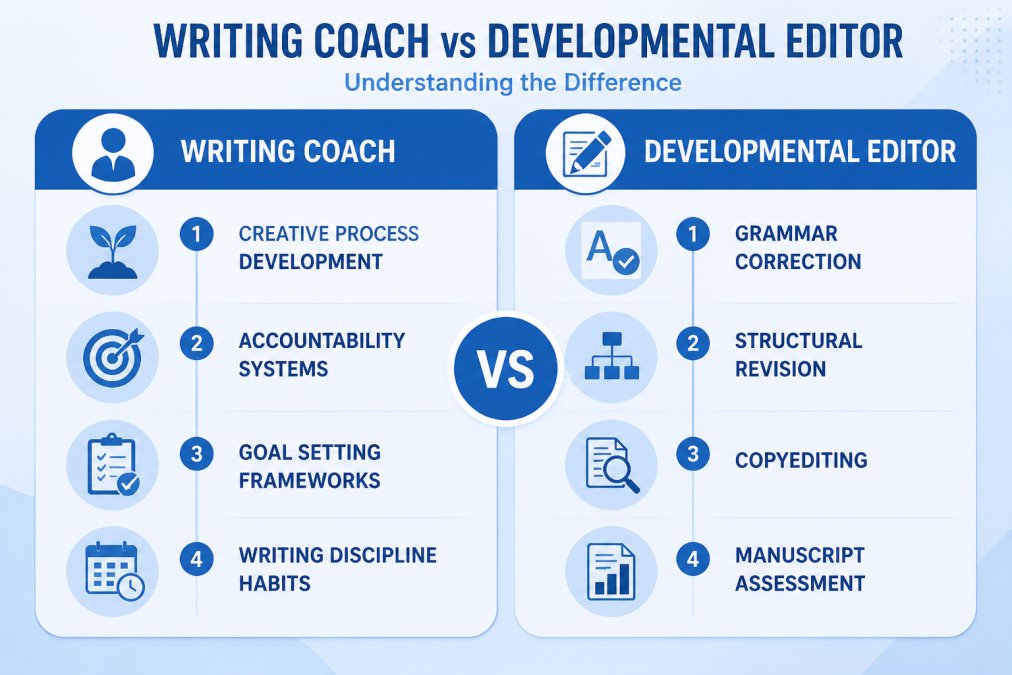
Writing Coach vs Developmental Editor: Understanding the Difference
Here's where confusion typically starts: many writers use these terms interchangeably, but they describe fundamentally different services. A developmental editor assesses your finished or near-finished manuscript and provides detailed feedback on structure, pacing, character development, and narrative arc. You get a report. You revise based on that feedback. The engagement often ends there.
A writing coach works with you throughout the creative process. Rather than waiting until you have a completed draft, coaching begins when you have an idea, a half-finished manuscript, or even just a sense that you want to write something but don't know where to start. The coach's role is to guide your development as a writer, not just to evaluate your finished work.
The practical difference shows up immediately. With a developmental editor, you're paying for expertise in assessing manuscripts. With a writing coach working on professional writing coaching, you're paying for ongoing support that builds your skill in manuscript development. One is transactional. The other is relational and developmental.
This also changes what you get from the investment. An editor's feedback is typically one-directional: here's what I see, here's what needs fixing. A coach's approach is collaborative. You discuss your creative intentions, your challenges, your goals for the manuscript. The coach helps you problem-solve in real time rather than delivering a verdict after the fact.

Many writers benefit from both at different stages. You might work with a coach to develop your manuscript, then hire an editor for a final professional assessment before submission. But understanding the distinction helps you choose the right support at the right time. Professional writing coaching works best when you need guidance on the creative process itself. An editor works best when you need an expert assessment of a substantially complete manuscript.
The Real Impact: Benefits That Show Up in Your Manuscript
The most obvious benefit of working with a writing coach is finishing what you start. Writers who engage in professional writing coaching report higher completion rates on manuscripts. This isn't because the coach writes for you, they don't. It's because accountability and structured goal setting fundamentally change your behaviour.
When you have a session scheduled with a coach, you show up with pages written. When you know you'll be discussing your progress, you prioritise writing time. When someone asks you directly about your manuscript development goals, you clarify what actually matters to you versus what you think should matter. These shifts seem small, but they compound into genuine momentum.
Beyond finishing, coaching improves the actual quality of your work. Writers develop a stronger sense of their own writing voice through coaching. You learn to recognise your patterns, both the strengths worth leaning into and the habits that undermine your storytelling. A coach helps you see your work with fresh eyes, identifying where your narrative arc is strongest and where it sags.
The collaborative feedback you receive in coaching is also different in character. Rather than waiting months for an editor's report, you're getting real-time discussion of your creative choices. You can explore why a particular scene isn't working, test different approaches, and understand the reasoning behind suggestions. This builds your editorial instinct. Over time, you become better at spotting your own issues before they reach a reader.
Many writers also experience a shift in their professional development and career trajectory through coaching. You're not just writing in isolation, you're learning how the publishing industry actually works, what agents and publishers look for, how to position your manuscript, and what realistic expectations are for your genre. This contextual knowledge changes how you approach your work.
How to Choose a Writing Coach That Matches Your Goals
Choosing a writing coach requires more than finding someone with impressive credentials. You need someone whose approach aligns with your goals, whose experience matches your project type, and whose coaching engagement model fits your circumstances.
Start by clarifying what you actually need. Are you trying to finish a manuscript that's been sitting unfinished for years? Are you developing a new skill in a particular genre? Do you need accountability, or do you need technical guidance on story structure? Your specific challenge should drive your choice of coach.
Look for evidence of published work. A coach doesn't need to be a bestselling author, but they should have demonstrable experience in the publishing industry. Ask what they've published, what genres they specialise in, and whether they've worked with writers at your experience level. Someone who's successfully guided dozens of writers through manuscript development in your genre is worth more than someone with only their own writing credentials.
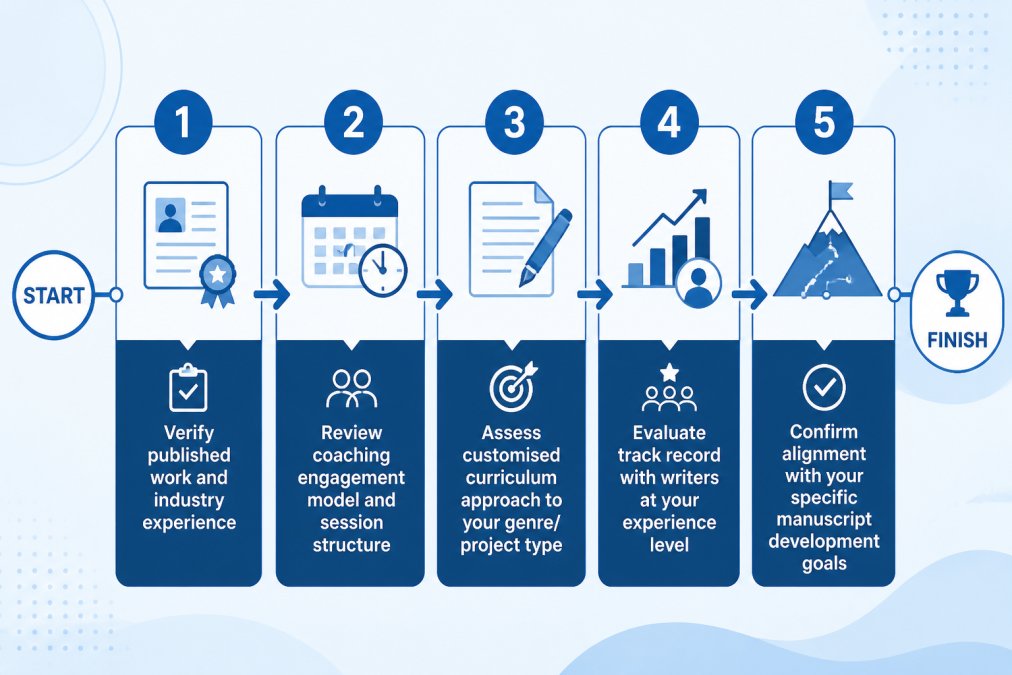
Evaluate how they structure their coaching engagement. Do they offer ongoing sessions or fixed packages? How often do you meet? What's included between sessions? Some coaches provide detailed written feedback; others focus on discussion-based sessions. Some work with you on a single manuscript; others help you develop as a writer across multiple projects. The structure should match your needs and budget.
Ask directly about their approach to professional writing coaching. Do they focus on craft fundamentals? Story structure? Writing discipline and habits? Character development? Different coaches emphasise different areas. A coach who specialises in helping writers overcome procrastination might not be the best fit if you're struggling with narrative structure. Alignment matters.
Check whether they offer a consultation before committing. A good coach will want to understand your project, your goals, and your expectations before you start paying. This conversation should clarify whether you're a good match. If a coach won't take time to discuss fit, that's a red flag.
Manuscript Development Support: What Coaching Can and Cannot Do
Professional writing coaching excels at certain things and has real limitations. Understanding both helps you approach coaching with realistic expectations.
Coaching can help you develop a stronger writing voice, build writing discipline, overcome procrastination and writer's block, understand story structure and narrative arc, create a customised curriculum for your specific weaknesses, and maintain accountability through the long process of manuscript development. If you're struggling to finish, to recognise your own patterns, or to understand how to improve your craft, coaching addresses those challenges directly.
What coaching typically cannot do: it won't rewrite your manuscript for you. A coach isn't a ghostwriter. They won't turn a fundamentally flawed concept into a publishable book if the core idea doesn't work. They can't guarantee your manuscript will get published or that an agent will take you on. They can't replace professional editing, coaching develops your skills; editing assesses your finished work.
This distinction is important. Some writers hope coaching will somehow bypass the hard work of actually improving their craft. It won't. What it does is make that hard work more focused and productive. You're not flailing in the dark trying random approaches. You're working with someone who's seen what works and can guide you toward it.
The realistic timeline also matters. Professional writing coaching isn't a quick fix. Meaningful improvement in your writing typically takes months, not weeks. If you're expecting to work with a coach for three sessions and emerge with a publishable manuscript, you'll be disappointed. The writers who see the biggest gains from coaching are those who commit to an ongoing engagement, usually at least three to six months, often longer.
Common Red Flags and What Coaching Actually Costs
Before you commit to professional writing coaching, watch for warning signs that suggest a coach might not be worth your investment.
Red flags include coaches who guarantee publication or agent representation. No one can promise that. Coaches who focus primarily on criticism rather than skill-building. Coaches who won't clearly explain their approach or methodology. Coaches with no evidence of published work or industry experience. Coaches who pressure you into long-term contracts without a trial period. Coaches who claim to work with all genres equally well, specialists are usually better than generalists.
Also be cautious of coaches who position themselves as vanity publishers or who suggest self-publishing as the primary path forward. There's nothing wrong with self-publishing, but a coach's role is to develop your skills, not to sell you publishing services.
Regarding cost: professional writing coaching varies significantly. One-off consultations might run from $145 for a single session. At writeinspire, we offer Writing Coaching & Guided Resources starting at $145 per session, alongside more comprehensive programs like the Creative Story Mastery for writers committed to developing their craft through structured, supported learning.
The key question isn't whether coaching is expensive, it's whether it's worth the investment for your specific situation. If you've been trying to finish a manuscript for years without success, or if you're serious about developing your writing skills, coaching often pays for itself by enabling you to actually complete work and move forward. If you're casually curious about writing but not genuinely committed, cheaper alternatives like writing courses or workshops might suit you better.
Is Professional Writing Coaching Right for You?
Professional writing coaching works best for writers in specific situations. You're a good candidate if you have a manuscript you genuinely want to finish but haven't been able to complete alone. You're a good candidate if you've been writing for years but feel stuck, not improving, not finishing, not moving toward publication. You're a good candidate if you're serious about developing your craft and willing to invest time and money in that development.
You might not need coaching if you're looking for a quick grammar check or a basic assessment of whether your manuscript is publishable. An editor serves that purpose better. You might not need coaching if you're not genuinely committed to finishing, coaching requires your active participation and effort.
The writers who see the biggest benefit from professional writing coaching are those who understand it as an investment in their development as a writer, not as a service that will magically fix their manuscript. You're paying for guidance, accountability, and expertise that helps you do better work yourself.
If you're ready to commit to finishing your manuscript and developing your skills, coaching can genuinely accelerate your progress. The accountability alone, knowing you have a session scheduled and you'll be discussing your work, changes how most writers approach their projects. Add to that expert guidance on craft, story structure, and the realities of the publishing landscape, and you have a combination that produces results.
The question isn't really whether professional writing coaching is effective. It's whether you're ready to use it effectively. Writers who show up consistently, engage honestly with feedback, and commit to the process see genuine improvement in their work and real progress toward finishing their manuscripts. If that describes you, coaching is worth exploring. Start with a consultation to discuss your specific manuscript development goals and find a coach whose approach aligns with where you want to go.
Frequently Asked Questions
What's the difference between a writing coach and a developmental editor?
A writing coach focuses on your creative process, writing discipline, and goal setting, helping you build skills and accountability across multiple projects. A developmental editor assesses a finished manuscript and provides editorial guidance on structure and narrative arc. Coaching develops you as a writer; editing fixes a specific manuscript. Many writers use both at different stages.
How do I know if I'm ready for professional writing coaching?
You're ready if you've started writing but struggle with consistency, procrastination, or finishing projects. Coaching works best when you have a manuscript in progress or a clear writing goal. If you doubt your abilities entirely, coaching builds confidence through constructive criticism and mentorship. If you've been writing for years but never finished anything, coaching often addresses the accountability and performance improvement gaps that writers' groups miss.
Can professional writing coaching help me overcome writer's block?
Yes. Coaching addresses the root causes of writer's block, perfectionism, unclear story structure, fear of judgement, through structured guidance and skill acquisition. A coach helps you develop writing habits and a customised curriculum that works for your creative process. Many writers find that regular coaching sessions create accountability and momentum that breaks through long-term blocks.
How much does professional writing coaching typically cost?
Coaching ranges from short consultation sessions to ongoing support programs. One-on-one consultations start at $145, while comprehensive manuscript development and coaching programs can range from several hundred to thousands of dollars depending on duration and intensity. Consider this an investment in your career trajectory and publication readiness, not just a single manuscript fix.
This article was written using GrandRanker