

Table of Contents
- What Creative Story Mastery Really Means
- Finding Your Story: The First Step
- Story Structure Templates That Actually Work
- Character Arc Development: Examples and Practice
- Manuscript Development Techniques for Every Writer
- Creative Writing Course Duration: What to Expect
- Moving From Draft to Finished Manuscript
- Conclusion: Your Path to Storytelling Mastery
Last Updated: August 30, 2026
What Creative Story Mastery Really Means
Creative story mastery is the ability to craft narratives that resonate deeply with readers by combining solid structural understanding with authentic character development and emotional momentum. It's not about following rigid formulas, it's about understanding the principles that make stories work, then bending them to serve your unique voice.

Real mastery means knowing why certain narrative choices land with readers and which ones fall flat. It means understanding story beats not as checklist items but as natural turning points where your characters' choices drive the plot forward.
At writeinspire, we've worked with writers who thought they'd never finish a manuscript. The shift from stuck to productive almost always came down to one thing: they stopped treating their story as something to figure out as they wrote, and started treating it as something they could plan and shape with intention.
Finding Your Story: The First Step
Before you worry about narrative structure or character arcs, you need to know what story you're actually telling. Finding your story means identifying the core tension or question your narrative explores. Is it about a character overcoming an external threat? A relationship fracturing under pressure? An internal conflict that forces someone to choose between two impossible paths?

Many writers confuse the plot (what happens) with the story (what it means). A plot is a sequence of events. A story is what those events reveal about human nature, desire, or conflict.
One practical approach: write down the central question your narrative answers. Not the plot summary, the question. "What happens when someone discovers a secret that changes everything?" "How far will a person go to protect someone they love?" That question becomes your north star. Every scene, every character decision, every plot twist should either deepen that question or move toward answering it.
Story Structure Templates That Actually Work
Story structure exists for a reason: it mirrors how human brains process narrative. Understanding this isn't limiting, it's liberating. When you know how structure works, you can use it intentionally instead of stumbling through your draft hoping something clicks.
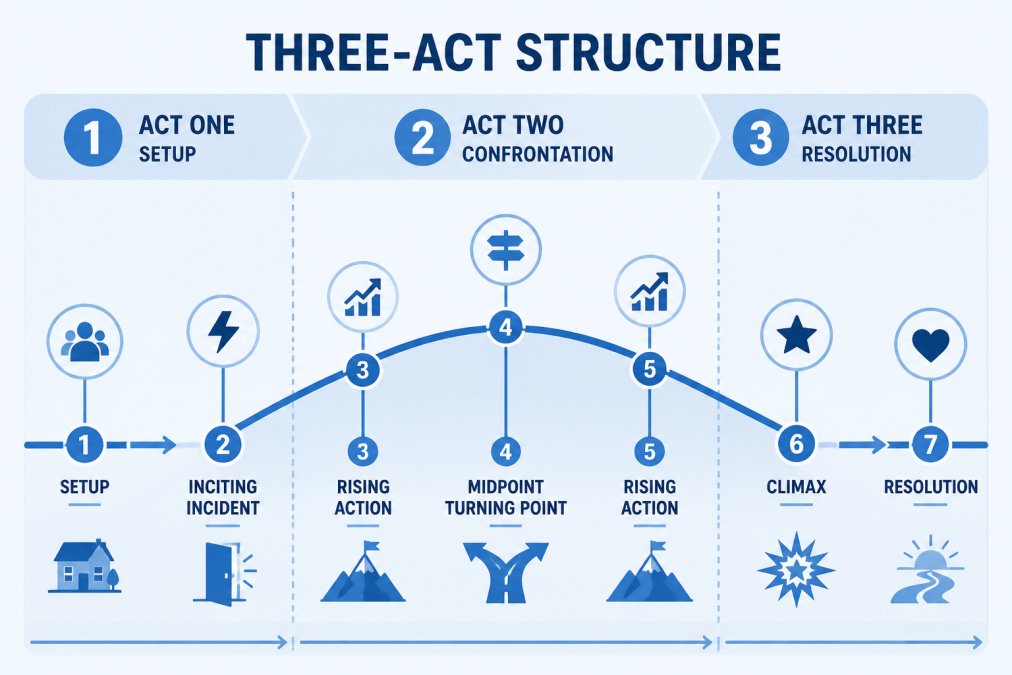
The three-act structure remains the most durable template. Act One establishes your protagonist, their world, and the inciting incident that disrupts that world. Act Two follows the character through escalating complications and obstacles. Act Three brings the conflict to a climax and resolution.
Within that framework, story beats mark the turning points where the narrative shifts direction. The inciting incident forces the protagonist into action. The midpoint raises the stakes or reveals new information. The dark moment tests whether they can succeed. These beats aren't arbitrary, they're moments where character choice and external pressure collide.
The mistake many writers make is treating these beats as rigid requirements rather than natural story moments. A beat happens when the plot demands it, not on a predetermined page number. The structure serves the story, not the other way around.
Character Arc Development: Examples and Practice
Characters drive stories. Plot is what happens; character arc is who your protagonist becomes because of what happens. Without a clear character arc, even an exciting plot feels hollow.
A character arc tracks the internal change your protagonist undergoes. It's not about external circumstances, it's about how their beliefs, fears, or values shift across the narrative. A character might start believing they're unworthy of love and end it understanding their own worth. Another might begin confident and reckless, only to learn humility through failure.
Building an arc requires understanding your character's starting point: their core wound, their false belief, their defensive strategy. What do they believe about themselves that limits them? What would it take to challenge that belief? The plot should systematically dismantle their defences and force them to confront what they've been avoiding.
Practice this with a character you're developing. Write down: What does this character believe about themselves that's holding them back? What would prove that belief wrong? What event or relationship forces them to question it? How do they resist change? What finally makes them accept a new way of seeing themselves? That progression is your character arc.
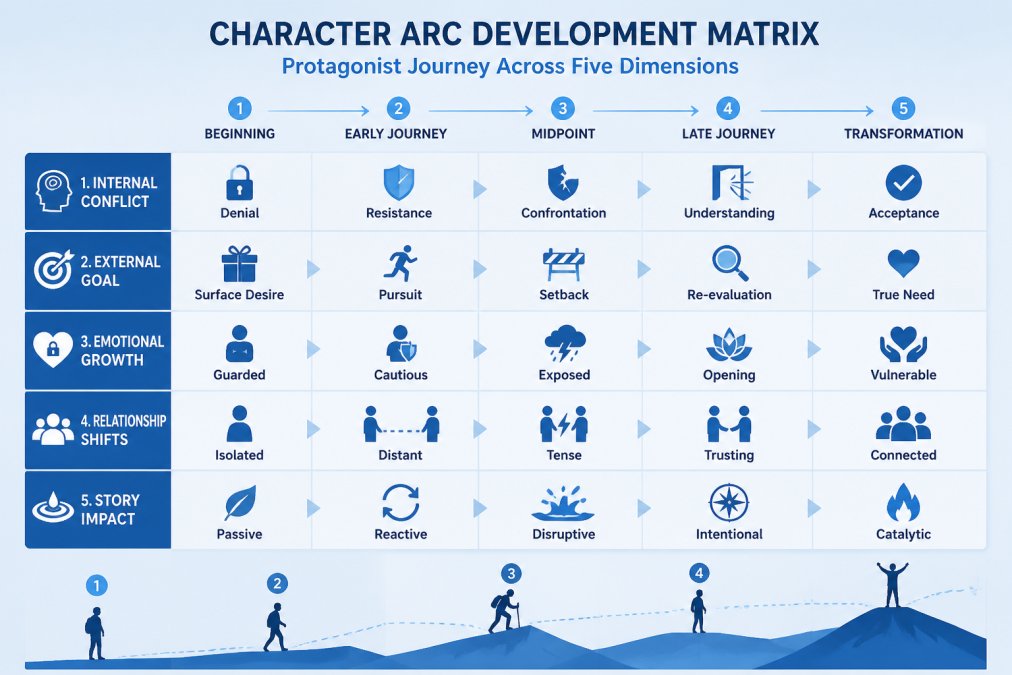
The best character arcs aren't sudden transformations. They're gradual shifts where each scene moves the character incrementally closer to understanding something new about themselves.
Manuscript Development Techniques for Every Writer
Turning an idea into a finished manuscript requires technique and repeatable methods that move you from blank page to completed draft.
The first technique is structured outlining. This doesn't mean plotting every detail, it means knowing your major turning points and the emotional arc connecting them. A solid outline gives you permission to write freely within a framework.
The second technique is drafting in blocks. Rather than writing linearly from beginning to end, write the scenes you're most excited about first. Write the climax. Write the scene that's been haunting your imagination. Then build the connective tissue around those moments.
The third technique is revision with purpose. Most writers treat revision as fixing mistakes. Real revision is reshaping. It's adding scenes that deepen character development, cutting sections that slow pacing, reordering sequences to build emotional momentum.
A practical workflow: First draft focuses on getting the story down. Second draft focuses on structure and pacing. Third draft focuses on character and dialogue. Fourth draft focuses on prose. This phased approach prevents you from trying to perfect everything at once.
Creative Writing Course Duration: What to Expect
If you're considering formal training in creative writing, understanding the time commitment helps you choose the right program.
Short courses, typically six to eight hours spread over a few weeks, work well for writers wanting to focus on a specific skill: dialogue, character development, or manuscript editing. They're intensive but time-limited.
Longer programs, three to six months, allow deeper exploration of storytelling principles and more substantial feedback on your work. Most writers see meaningful progress in this timeframe because consistency matters more than intensity.
Full-length courses spanning six to twelve months give you the most comprehensive training.
The real question isn't how long a course lasts, it's how much time you can dedicate to writing during and after the course. At writeinspire, the Creative Story Mastery program is structured to fit writers with varying schedules. Whether you choose supported coaching or go-it-alone access, the program adapts to your pace while keeping you moving forward.
Moving From Draft to Finished Manuscript
The gap between a completed draft and a publishable manuscript is where most writers struggle. A draft is raw material. A finished manuscript is a craft object, intentional, shaped, and ready to face readers.
The first step is distance. Set your draft aside for at least two weeks. You need to read it with fresh eyes, and you can't do that while emotionally enmeshed in the writing.
The second step is comprehensive revision. Read through the entire manuscript once without making changes, just noting patterns. Where does energy flag? Which characters feel underdeveloped? Where does the plot meander?
The third step is targeted revision. Address major issues first: structural problems, pacing, character consistency. Then move to scene-level work. Then sentence-level work.
The fourth step is feedback. Share your revised manuscript with readers you trust, ideally other writers who understand your genre. Listen for patterns in feedback rather than trying to incorporate every suggestion.
The final step is copyediting and proofreading. This is where you catch grammatical errors, inconsistencies, and awkward phrasing.
| Revision Phase | Focus | Time Estimate | Outcome |
|---|---|---|---|
| Distance & Reset | Let the draft rest | 2-4 weeks | Fresh perspective |
| Comprehensive Read | Identify major issues | 1 week | Map of problems |
| Structural Revision | Fix pacing, plot, character arcs | 2-4 weeks | Cohesive narrative |
| Scene-Level Revision | Strengthen individual scenes | 2-3 weeks | Engaging sequences |
| Feedback Integration | Incorporate reader responses | 1-2 weeks | Outside perspective applied |
| Copyediting | Grammar, consistency, clarity | 1-2 weeks | Polished prose |
Conclusion: Your Path to Storytelling Mastery
Creative story mastery isn't something you achieve and then stop working toward. It's a deepening practice. The writers who finish manuscripts and go on to write better ones aren't naturally gifted, they're disciplined about understanding craft and honest about their weaknesses.
The path forward starts with choosing a structure that matches your life. If you're serious about finishing a manuscript, you need more than good intentions. You need a framework, feedback, and accountability. WriteInspire's Creative Story Mastery program offers exactly that, structured modules on finding your story, building narrative arcs, and developing characters, paired with ongoing coaching support. Whether you choose supported access with regular feedback or go-it-alone access to work through the modules at your own pace, you're working within a proven framework designed by writers who've helped hundreds of people move from stuck to finished.

Start where you are. If you have an idea but no structure, begin with finding your story. If you have a draft but no direction for revision, start with the manuscript development techniques. If you're ready for comprehensive training, commit to a course that matches your schedule and learning style. The writers who succeed aren't waiting for inspiration, they're building the craft, one deliberate choice at a time.
The challenge facing most writers isn't talent, it's finishing. Writeinspire removes that barrier by providing structured guidance, practical frameworks, and experienced coaching focused on getting your manuscript from idea to completion. With over 30 years of experience in manuscript development, writeinspire works with writers to create, edit, format and publish their works. Join the conversation, leave a comment, start a discussion, and bring something creative and positive. Access Creative Story Mastery today and start the manuscript you've been meaning to write.
Frequently Asked Questions
How do I start off a creative story if I'm not sure what to write about?
Begin by capturing moments that genuinely interest you, a conversation you overheard, a 'what if' question, or a character who won't leave your head. Write freely without judgment for 15 minutes. The story often emerges from what feels alive to you, not what you think should work. Creative story mastery starts with permission to explore without pressure. Many writers find their real story only after they've written their way through the false start.
What's the difference between creative writing and storytelling?
Creative writing is the craft, how you use language, imagery, and technique. Storytelling is the architecture, the narrative structure, emotional beats, and how you guide a reader through a complete journey. You can write beautifully without telling a story, and you can tell a gripping story with simple prose. Creative story mastery demands both: the technical skill and the ability to shape experience into meaning for someone else.
Can creative writing be taught, or is it something you're born with?
Storytelling craft absolutely can be taught. Every technique, from pacing to dialogue to character motivation, can be learned and practised. Talent exists, but it means nothing without rigorous practice and feedback. Writers who finish manuscripts and publish work share one thing: they treated writing like a skill to develop, not a gift to wait for. Coaching accelerates this by showing you what to practise and how to spot what isn't working.
How long does a creative writing course typically take to complete?
Most structured creative writing courses run 8-12 weeks for foundational work, though comprehensive manuscript development programmes can span 6-12 months depending on depth and your pace. What matters more than duration is consistency, writing 3-4 hours weekly over 12 weeks beats sporadic marathon sessions. Your commitment and how much you revise between lessons shape the real timeline far more than the course calendar itself.
This article was written using GrandRanker