

Table of Contents
- Quick Comparison: Creative Writing Courses Side by Side
- 1. WriteInspire: Structured Coaching for Manuscript Development
- 2. Australian Writers' Centre: Flexible Online and In-Person Workshops
- 3. Faber Writing Academy: Novel Completion with Industry Connections
- 4. University and TAFE Options: Formal Qualifications
- How to Choose a Writing Course That Fits Your Goals
- Creative Writing Short Courses vs. Long Programs
- Online Creative Writing Workshops: What to Expect
Last Updated: August 12, 2026
Quick Comparison: Creative Writing Courses Side by Side
Finding the right creative writing course depends on what you're trying to achieve. Are you looking to finish a manuscript? Master storytelling techniques? Get industry connections? The landscape has expanded dramatically, and not all courses suit the same writer.
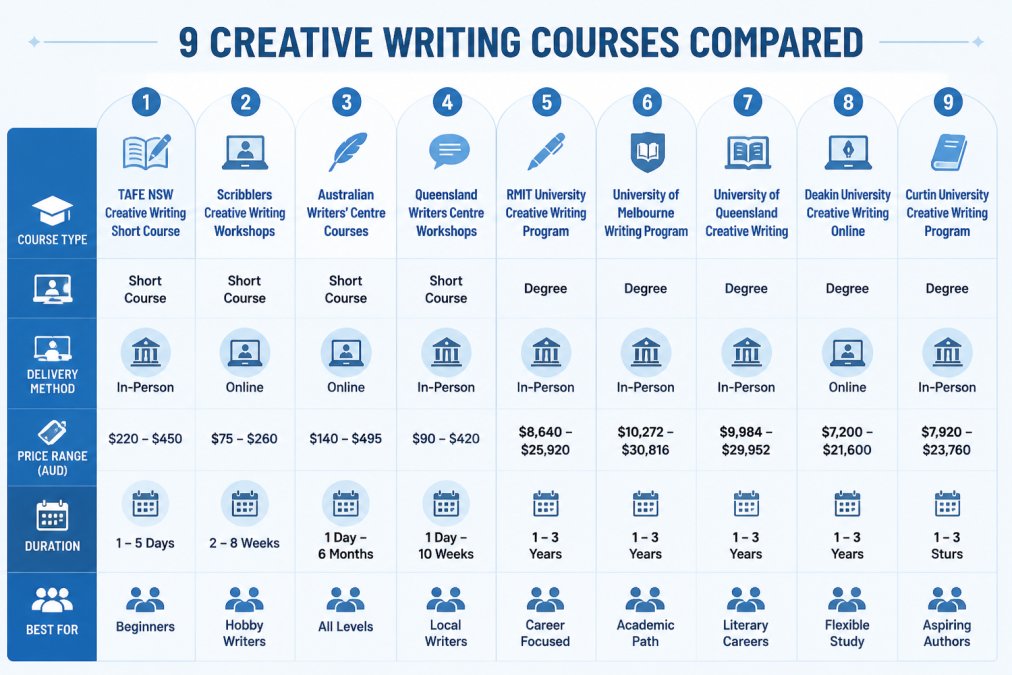
What matters most is matching your current situation, skill level, available time, budget, and what you want to produce with a program designed for writers like you.
| Course | Format | Duration | Best For | Key Strength |
|---|---|---|---|---|
| WriteInspire | Coaching & guided resources | Flexible | Manuscript completion | Rigorous 30+ years methodology |
| Australian Writers' Centre | Online & in-person workshops | Flexible | Flexible learners | Industry-specific Australian focus |
| Faber Writing Academy | Structured novel courses | Varies | Committed novelists | Publishing industry connections |
| University of Sydney (CCE) | Short courses & workshops | 1-4 days | Skill builders | Practical fundamentals |
| RMIT Bachelor of Arts | Full degree | 3 years | Career changers | Comprehensive qualification |
| Queensland Writers Centre | Self-paced online | Varies | Budget-conscious writers | Affordable entry point |
| TAFE NSW | Vocational & degree programs | Varies | Career-focused writers | Recognised qualification |
| Varuna | Small-group intensive courses | Varies | Committed writers | Intimate peer community |
| Story Studios Australia | Casual & structured courses | Varies | Community-focused writers | Ongoing engagement & meetups |
1. WriteInspire: Structured Coaching for Manuscript Development
WriteInspire treats manuscript development as a craft to master, not a product to rush. With over 30 years of creative writing coaching experience, the platform focuses on rigorous guidance rather than vanity publishing, which matters if you've invested years in a manuscript and want it to actually be good.

The core strength is structured storytelling methodology refined across decades. Whether you're working through Creative Story Mastery (supported access for $3,420.00 or go-it-alone access for $2,340.00) or using Writing Coaching & Guided Resources ($145.00), you're getting proven process. The platform offers tailored support for new storytellers finding their voice and established authors breaking through creative walls.
What sets WriteInspire apart: the coaching focuses on actual craft, narrative structure, character development, voice, rather than publishing tips or marketing. If you've been writing for years but never finished anything, this addresses the real problem: most writers lack a clear process for moving from idea to completed manuscript.
The platform works particularly well for independent creatives who want professional results without traditional publishing gatekeeping.
2. Australian Writers' Centre: Flexible Online and In-Person Workshops
The Australian Writers' Centre offers genuine flexibility with self-paced online courses and live in-person workshops. This matters if your life doesn't fit a rigid schedule.
Courses span fiction, non-fiction, memoir, poetry, and short story writing. The Australian focus means instructors understand the local publishing landscape, relevant agents, and how the market actually works here. Many programs include personalised feedback on your writing samples, where real learning happens. Instructors are accomplished writers themselves, so you're learning from people who've actually done what you're trying to do.
The range lets you start with foundational courses and progress to longer programs if you want deeper engagement. Some run for weeks, others for months.
3. Faber Writing Academy: Novel Completion with Industry Connections
Faber Writing Academy focuses explicitly on helping you complete a novel, with industry partnerships including Allen & Unwin that create real opportunities beyond just finishing your manuscript.
The structure is rigorous. You work through targeted writing exercises, participate in group discussions, and engage with selected readings. Small-group experiences mean you're learning alongside other committed novelists. That peer dynamic matters, you get feedback from instructors and perspective from writers at similar project stages.
What makes this worth the investment: industry connections. Writers who complete the program get opportunities to be showcased in anthologies and have their work circulated within publishing circles. That's real exposure most creative writing courses don't offer.
The tradeoff is commitment. This isn't a casual evening class. You're signing up for intensive, structured work over several months. But if you're the kind of writer who finishes projects when given structure and accountability, this model works.
4. University and TAFE Options: Formal Qualifications
If you want a recognised qualification alongside creative development, formal education through universities and TAFE provides that pathway. The University of Sydney's Centre for Continuing Education offers short courses in poetry, fiction, and non-fiction covering voice, characterisation, structure, and editing.
RMIT's Bachelor of Arts in Creative Writing is a full three-year degree using an intensive studio model. You're writing constantly and getting feedback from working writers. The qualification carries weight if you want to teach creative writing or pursue writing-related careers.
TAFE NSW offers vocational pathways, including the Bachelor of Creative Practice, emphasising practical skills and career readiness. If you're considering writing as a career change, formal qualification opens different doors than self-directed learning.
University and TAFE options share a common advantage: structured learning environments with peer communities. You're in a cohort of other writers, creating accountability and ongoing creative dialogue. That community aspect is harder to replicate in online-only courses.
The downside is time commitment. A three-year degree is significant. But if you're early in your writing journey wanting comprehensive foundational training, the depth of study is genuinely valuable.
How to Choose a Writing Course That Fits Your Goals
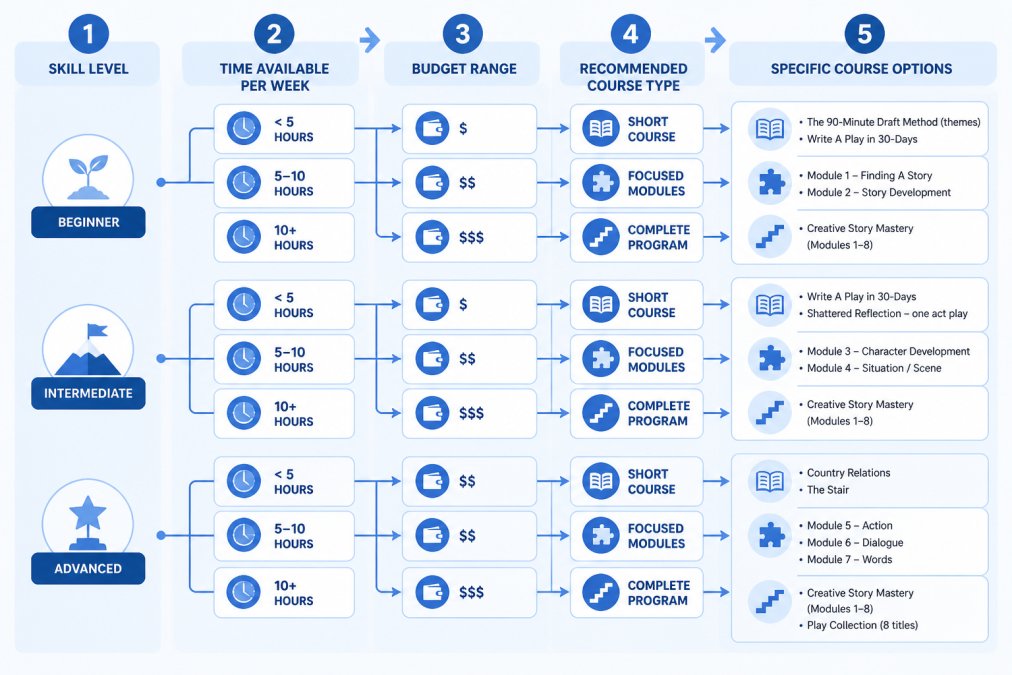
Choosing the right course isn't about finding the "best" one, it's about matching your specific situation to a program designed for writers like you. Three key factors determine fit: your current skill level, how much time you can realistically dedicate, and your budget.
Skill Level and Starting Point
Your current experience shapes which course makes sense. If you've never written seriously, jumping into a competitive small-group intensive creates frustration. You need foundational work first: understanding narrative structure, character development, and your own voice.
For complete beginners, short courses or self-paced online modules work well. Queensland Writers Centre's short courses let you explore different genres without heavy investment. University of Sydney's one-day workshops are similarly low-pressure entry points.
If you've been writing for years but never finished anything, your problem usually isn't skill, it's process. WriteInspire's coaching approach and The 90-Minute Draft Method (ambition) for $49.95 shine here. You don't need to learn how to write; you need a system that gets you to completion.
For advanced writers already producing work, small-group intensives like Varuna or Faber make sense. You're refining craft and getting peer feedback that pushes your work further.
Time Commitment and Learning Style
How much time can you actually dedicate? Honesty matters here. If you tell yourself you'll do a two-hour weekly workshop but work 50-hour weeks with family commitments, you won't show up consistently.
Self-paced online learning works for writers with unpredictable schedules. Queensland Writers Centre courses give lifetime access. You move through modules when you have time, not on someone else's timetable.
Live workshops and cohort-based courses require consistent weekly attendance. If you can commit, the accountability is valuable. But only choose this if you can actually show up.
Intensive multi-day or week-long programs work for writers who can carve out dedicated time. Varuna offers residential experiences where you live on-site for several days, fully immersed in writing and community. That intensity produces real progress if you can arrange it.
Budget and Value for Money
Creative writing courses range from short modules to three-year degrees. Price doesn't correlate with quality; it reflects format, duration, and what you're paying for.
Short courses give skill-building and exploration at low risk. Mid-range programs typically offer structured multi-week courses with ongoing feedback. Formal qualifications represent years of study and comprehensive training, making sense if you want a writing career, not just to finish one manuscript.
Creative Writing Short Courses vs. Long Programs
Short courses, typically one day to four weeks, are skill-focused and topic-specific. You take a weekend workshop on poetry, a three-day intensive on character development, or a four-week module on narrative structure. The advantage is low commitment and low cost.
Short courses work well for writers with a foundation wanting to sharpen specific skills. They also suit explorers unsure which genre resonates yet.
The limitation: short courses don't produce finished manuscripts. They give you tools and techniques, but completing full-length work requires sustained engagement over months.
Long programs, typically three months to three years, are designed for completion and depth. You move through structured curriculum, build on previous learning, and develop a finished manuscript or substantial body of work. Community is stronger because you're with the same cohort over time.
Long programs make sense if you have a specific project to complete or you're considering writing as a career path.
A hybrid approach works for many writers: start with short courses to explore and build foundational skills, then commit to a longer program once you know your focus.
Online Creative Writing Workshops: What to Expect
Online creative writing workshops have become the default delivery method. They remove geographical barriers and offer flexibility. But online learning differs from in-person workshops.
Most online workshops fall into two categories: live synchronous sessions where everyone joins at the same time, or asynchronous self-paced modules you work through independently. Live sessions create real-time interaction and community. Asynchronous modules let you learn on your own schedule but remove real-time community.
Expect less immediate feedback in online environments than in-person workshops. When everyone's typing rather than talking, conversation is slower. Some writers prefer the thinking time written feedback allows.
The practical side matters: you need reliable internet, a quiet space, and self-discipline. Online courses require more self-motivation than in-person workshops.
Community building happens differently online. You're not grabbing coffee with classmates after class. But many online programs create Discord servers, discussion forums, or peer feedback groups that build genuine connection over time.
The best online workshops combine live sessions with asynchronous work. You might have a live workshop on Tuesday evening discussing a writing exercise, then work through modules independently and share your work in a forum for peer feedback.
Choosing a creative writing course is ultimately about matching your current reality to a program designed for writers like you. WriteInspire's coaching approach works for writers struggling to finish something and needing rigorous methodology. The Australian Writers' Centre suits writers valuing flexibility and Australian market knowledge. Faber Writing Academy appeals to novelists ready to commit to completion with industry connections. University and TAFE options serve writers seeking formal qualifications and comprehensive training.
The key is honest self-assessment: Where are you now? What's your actual time commitment? What do you want to produce? Answer those questions first, then match them to a program. The right course isn't the most expensive or prestigious, it's the one that fits your life and goals. Start with WriteInspire's Writing Consultation Creative Support ($145.00) if you want personalised guidance on which approach suits your manuscript or creative goals. A single consultation can clarify your direction before you commit to a longer program.

Frequently Asked Questions
What's the difference between a short creative writing course and a full degree program?
Short courses (typically 3 hours to 12 weeks) focus on specific skills like character development or storytelling techniques, and suit people with limited time or those testing the waters. Degree programs span 2-3 years and provide comprehensive training, industry connections, and a formal qualification. Short courses offer flexibility and quick wins; degrees offer depth and credentials. Your choice depends on whether you want to build a single skill or commit to formal study.
Are online creative writing workshops as effective as in-person courses?
Yes, when designed well. Online workshops offer flexibility, access to instructors across the country, and self-paced learning. In-person courses build stronger peer connections and allow real-time feedback. The best choice depends on your learning style and schedule. Many writers benefit from a mix: online courses for foundational skills, in-person workshops for intensive feedback and community.
How do I know if a creative writing course will actually help me finish my manuscript?
Look for courses that offer structural feedback, regular check-ins, and accountability. Courses with small class sizes, experienced mentors, and a focus on project completion (not just theory) tend to deliver results. Read reviews from past students, ask whether the course includes manuscript critique, and check if the instructor has published work themselves. Courses centred on rigorous coaching rather than vanity publishing tend to produce stronger outcomes.
Can I study creative writing part-time while working full-time?
Absolutely. Most online courses and short workshops are designed for working writers. Look for self-paced options or evening classes. WriteInspire's coaching and the 90-Minute Draft Method, for example, are built for writers with limited time. The key is finding a course that respects your schedule and doesn't require large blocks of uninterrupted time.
What's the best creative writing course for beginners with no prior experience?
Beginner-friendly options include Queensland Writers Centre (affordable, self-paced), The University of Sydney's Centre for Continuing Education (practical skills focus), and WriteInspire's Creative Story Mastery (structured guidance from experienced coaches). Look for courses that cover fundamentals like voice, character, and structure, and offer plenty of writing exercises. Starting with a short course helps you build confidence before committing to longer programs.
This article was written using GrandRanker