

Table of Contents
- How We Reviewed Popular Creative Writing Courses
- Creative Writing Short Courses for Beginners: A Starting Point
- Structured Coaching vs. Self-Paced Online Learning
- Manuscript Development Services vs Courses: What's the Difference?
- Avoiding Vanity Publishing Traps in Course Marketing
- Creative Story Mastery Review: A Closer Look
- What to Look for Before You Enrol
- The Verdict: Which Creative Writing Course Fits You?
- Frequently Asked Questions
Last Updated: September 9, 2026
Reviews of popular creative writing courses usually end in a cynical rant or a glossy ad. Both miss the point. Creative writing courses range from six-hour workshops to year-long manuscript mentoring, and the right choice depends on what you are trying to finish. At writeinspire, we have spent over 30 years coaching storytellers. Below, we compare short courses, structured coaching, and manuscript services across cost, feedback depth, and outcomes.
How We Reviewed Popular Creative Writing Courses
We evaluated courses against five criteria: depth of feedback, curriculum structure, instructor access, publishing support, and total cost. A workshop that gives two pages of notes on a chapter is a different investment from a self-paced program with no human contact.
Most reviews fail by treating every option as interchangeable. A beginner-friendly short course builds writing practice and narrative voice, but it will not get a half-finished manuscript out of a drawer.
Creative Writing Short Courses for Beginners: A Starting Point
Creative writing short courses for beginners are the lowest-risk way to test whether structured learning suits you. These range from single-session introductions to six-hour programs that cover story structure, character development, and writing prompts in a compressed format.
The strength is momentum: a short course forces you to produce work on a deadline and often introduces peer feedback. The limitation is depth, six hours cannot cover manuscript development or editing, and most short courses do not include post-course support.
Structured Coaching vs. Self-Paced Online Learning
The choice between structured coaching and self-paced online learning is often framed as a budget question, but the real difference lies in feedback and accountability. Let's look at the practical mechanics of each.
What Self-Paced Learning Really Delivers
Self-paced online courses are built around content delivery. You receive pre-recorded video lessons, written modules, and exercises to work through on your own schedule. The strength is flexibility.
The feedback loop is where these courses typically fall short. Most offer automated quizzes or peer-review forums where you post work and hope someone reads it. You might learn the theory of showing versus telling, but you won't discover where your scenes lose tension unless you can already spot it.
This format works well for confident writers who know their weaknesses and need craft material to study. The risk is mistaking consuming content for building a writing practice.
What Structured Coaching Changes
Structured coaching inverts the model. Instead of starting with content, it starts with your work. A coach reads your pages, identifies the technique holding you back, and guides you through targeted exercises. The curriculum adapts to what your manuscript needs next.
This matters most when you hit a creative block. In a self-paced course, a block means you stop; in coaching, a block is a diagnostic moment where a coach helps you see whether the problem is character motivation, structural flaw, or missing research.
Accountability is the other major factor. The gap between knowing what to do and doing it is where manuscripts die. A coach checks in on your progress and helps clear obstacles, not about discipline, but about having a thinking partner invested in your project.
A Framework for Choosing
Ask yourself: when you sit down to write, do you know what you are trying to achieve in that session? If yes, you might only need craft resources. If often no, you need help setting direction.
Consider the difference between learning about dialogue and having someone show you where your dialogue loses tension across a full chapter. The first is information. The second is transformation. For writers circling the same project for years, coaching addresses the direction problem self-paced courses ignore.
A practical middle ground exists: use a self-paced course for foundational craft, then book a single coaching session for feedback on a chapter. This hybrid approach controls costs while providing the personalised insight that moves a manuscript forward.
Whichever path you lean toward, look for a program with direct feedback on your writing. Content is easy to replicate; the conversation about your specific pages is where real growth happens.
Manuscript Development Services vs Courses: What's the Difference?
Courses teach you how to write. Manuscript development services act on the pages you have already produced. This is the clearest distinction in the market, and the one most writers get wrong.
A course, even a good one, works through a curriculum in sequence. A manuscript development service, by contrast, is a diagnostic process: it examines your existing draft, identifies structural problems, and gives you a roadmap to fix them.
If you have a half-finished manuscript that has sat in a drawer for years, another course is not what you need. You need someone to read what exists and tell you what works, what does not, and what to do next.
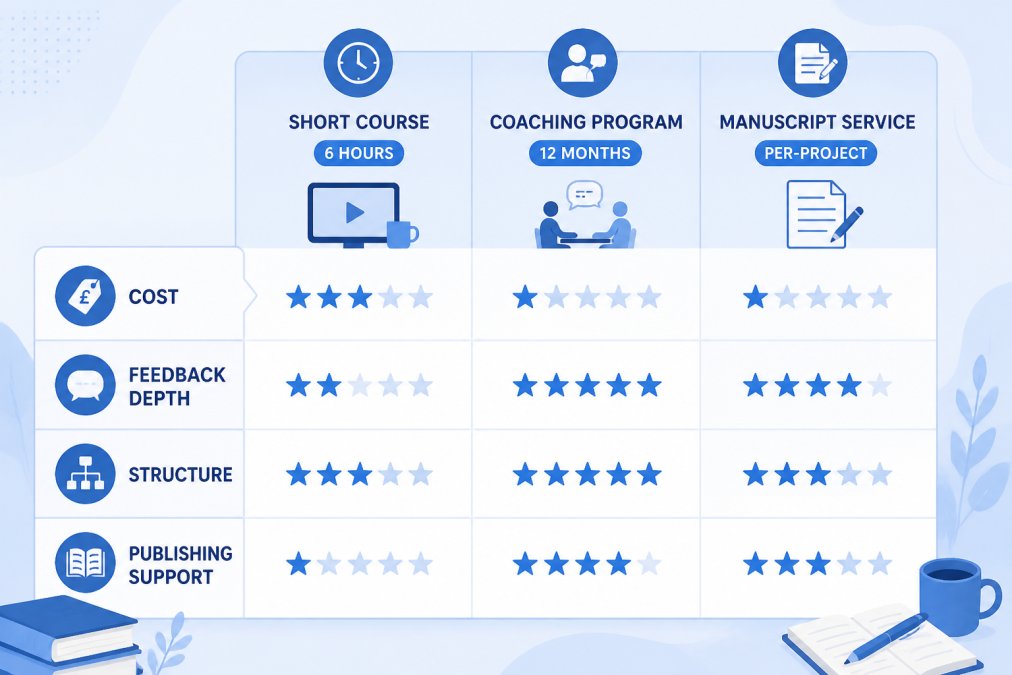
| Option | Best For | Feedback Depth | Structure | Publishing Support |
|---|---|---|---|---|
| Short course | Testing the waters | Group-based | Fixed curriculum | None |
| Self-paced online | Confident self-starters | None or automated | Fixed curriculum | None |
| Structured coaching | Finishing a full manuscript | Personal and detailed | Adapted to your project | Often included |
| Manuscript service | Fixing an existing draft | Diagnostic on your pages | Project-based | Varies |
Avoiding Vanity Publishing Traps in Course Marketing
The publishing industry has a persistent shadow: vanity publishing. These operations charge writers to produce books that no legitimate publisher or literary agent would touch, often dressed up as "hybrid publishing" or "author services." Many writing courses feed into this trap.
A legitimate creative writing course teaches craft. A vanity operation sells the dream of seeing your name on a cover and skips the hard work of making the book good enough to earn it.
The Australian publishing landscape has clear guidance on this distinction, and reputable resources like the Australian Society of Authors' advice on publishing contracts explain what legitimate publishing arrangements look like. Before you pay for any program that mentions publishing, check how it handles the submission process and whether it connects you to real industry professionals.
Creative Story Mastery Review: A Closer Look
Creative Story Mastery is a structured coaching program for writers who want to take a story from a spark to a finished, polished manuscript. Unlike a short course, it works through eight modules covering the full arc of storytelling, from finding a story worth telling to navigating the publishing process.

The program is available in two formats. The Supported option costs $3,420.00 and includes direct coaching support throughout. The Go It Alone option costs $2,565.00 and provides the same curriculum with less personal guidance. Both include printed module books shipped progressively.
What distinguishes this approach is the sequencing. Each module targets a specific craft element: story development, character development, situation and scene, action, dialogue, and the precise use of language. It is a scaffolded curriculum where each stage builds on the last, finishing with a module on the storyteller's marketplace.
For writers who have never finished a full-length work, this structure addresses the most common failure point: losing momentum halfway through. Knowing that module three focuses on character development means you are never left wondering what to work on next.
What to Look for Before You Enrol
Before you commit to any creative writing course, look beyond the marketing page and examine the actual structure of the program. Here is a practical framework for evaluating your options, with a focus on what happens after the course ends.
Look for the Feedback Loop
A course can promise all the craft knowledge in the world, but if no one reads your work, you will not improve as quickly. Ask directly: who reads my pages, and how much feedback do I get?
Some courses offer written comments on a single piece of work; others provide ongoing marginal notes on every chapter you submit. The depth of this feedback is the single biggest predictor of whether you will grow as a writer. Group feedback is valuable, but it is not a substitute for expert commentary that can point to the exact sentence where your tension drops.
Examine the Curriculum for Craft, Not Just Inspiration
Many courses are built around writing prompts and exercises designed to get you producing words. These can be fun and motivating, but they often avoid the harder work of revision and structural editing. Look for a curriculum that names specific craft elements: story structure, scene construction, character motivation, dialogue pacing, and narrative voice.
A course that teaches you how to start a story is different from one that teaches you how to finish a draft. The best programs sequence modules so each skill builds on the last.
Ask About the End of the Course
This is the question most reviews miss: what happens after the final module? A course can be excellent for ten weeks and then leave you completely on your own.
Ask: Is there an alumni community where I can continue to share work? Are there opportunities to submit my manuscript for professional feedback? Does the program connect me to literary agents or publishers?
Post-course support is where the real value of a program often shows up. A course that ends with a finished manuscript but no guidance on what to do next leaves you unsure of how to navigate the publishing world.
Understand the Business Side
Writing is an art, but publishing is an industry. A good course acknowledges this and prepares you for it. Look for modules that cover the submission process, query letters, and publishing contracts.
Be wary of any program that guarantees publication as part of the package. Real publishing decisions are made by literary agents and editors based on manuscript quality. Instead, look for a program that teaches you how to navigate the industry yourself.
Consider Accessibility and Inclusivity
Every writer learns differently. If you are neurodivergent or have specific learning needs, consider how the course structure supports you. Does it offer written materials alongside video content? Are there options for asynchronous participation? Is the feedback format clear and constructive?
A course that is flexible in delivery and supportive in feedback style will serve you better than one that demands a single mode of participation. The best programs recognise that creative writers come from diverse backgrounds and learning styles.
A Final Check on the People Behind the Program
Who is actually teaching the course? Look for instructors with published work, editorial experience, or a track record of helping writers complete manuscripts. A program backed by decades of practical coaching is a different proposition from a content pack assembled by a marketing team.
Ask for samples of student work or testimonials that describe specific outcomes. Did students finish their manuscripts? Did they go on to publish? These concrete results tell you more than any promise of 'unleashing your creativity' ever will.
The Verdict: Which Creative Writing Course Fits You?
Match the course type to your specific problem, and you will rarely waste money. If you have never written seriously, a short course is the right starting point. If you understand craft fundamentals but struggle with consistency, a self-paced online course may give you the structure you need.
If you have been writing for years without finishing anything, or you have a half-finished manuscript collecting dust, the gap is not knowledge. It is accountability and personalised feedback. A structured coaching program that reads your work and guides you module by module is the option most likely to produce a completed manuscript.
That is the gap writeinspire exists to fill. With over 30 years of experience in creative writing coaching, we focus on rigorous manuscript development rather than vanity publishing. Our Creative Story Mastery program walks you through finding your story, developing characters, crafting scenes, and preparing your work for the marketplace, with the option of direct coaching support throughout.
The writing community is full of people who talk about the novel they will write one day. Structured coaching is for the ones who decide that day is now. Whatever path you choose, choose one that includes honest feedback, a real curriculum, and a clear road to a finished manuscript. As the Australia Council for the Arts notes on developing creative practice, sustained support and feedback are central to artistic growth.
Frequently Asked Questions
What is the best creative writing course in Australia?
The best course depends on your goal. For beginners wanting to test the waters, a short course offers a low-pressure introduction. For writers with a half-finished manuscript, a structured coaching program like Creative Story Mastery provides deeper manuscript development. Look for courses that offer direct feedback on your work, not just pre-recorded lectures, and check whether the provider has real publishing experience.
Are creative writing courses worth the investment for new authors?
They are worth it when they teach you the full craft: story structure, character development, and the editing process. A good course also helps you build writing discipline and understand the publishing industry. They are not worth it if they promise publication or use pressure tactics. Look for programs that develop your skills and give you honest feedback, rather than ones that guarantee results.
How do I distinguish between reputable writing programs and vanity services?
Reputable programs focus on teaching you the craft, not on selling you additional paid services. They are transparent about their curriculum and the qualifications of their instructors. Avoid programs that guarantee publication, ask for large upfront fees without explaining what you get, or pressure you to sign quickly. A legitimate course will help you improve your manuscript, not just tell you it is ready to publish.
What are the benefits of structured manuscript development over generic courses?
Generic courses often cover broad topics without giving you specific feedback on your own work. Structured manuscript development, like the kind offered through coaching programs, guides you through each stage of your book, from initial concept to final draft. You receive personalised feedback that addresses your specific weaknesses, which is how writers actually improve. This approach is more effective for finishing a full manuscript.
The hardest part of writing is rarely the writing itself. It is finishing, and finishing well. writeinspire pairs you with experienced coaching that reads your pages, strengthens your craft, and carries you from first spark to polished manuscript. If you are ready to stop planning and start completing, get started with writeinspire and bring your story into the world.