

Table of Contents
- What Is a Structured Manuscript Development Program?
- How Structured Manuscript Development Programs Work
- Questions to Ask a Potential Writing Coach Before You Start
- What to Expect from Structural Editing for Fiction
- Mentorship, Feedback, and the Peer Review Process
- What to Ignore: Common Bad Advice About Manuscript Programs
- Conclusion: Choosing the Right Path for Your Manuscript
- Frequently Asked Questions
Last Updated: September 8, 2026
Every manuscript begins as a tangle of possibility. Structured manuscript development programs for writers untangle that knot with intention, turning a promising draft into one that stands a genuine chance with publishers and readers. At writeinspire, we have spent over 30 years coaching writers, and the most common misunderstanding is treating development as a final polish rather than a foundational rebuild.
A structured manuscript development program is a guided, staged process that takes a draft through assessment, structural editing, feedback, and refinement until it is submission-ready. This is not hiring someone to tidy your prose at the end. Development happens before line edits, before formatting, before you ever worry about a query letter.

The distinction matters because most writers arrive with the wrong expectation. They think their draft needs a gentle touch when it actually needs a structural conversation. Below, we walk through how these programs work, what questions to ask before committing, and how to separate useful guidance from the noise that wastes your time and money.
What Is a Structured Manuscript Development Program?
A structured manuscript development program is a formalised, stage-by-stage framework for improving a full-length manuscript, typically involving manuscript assessment, structural editing, and guided revision over weeks or months. It differs from a one-off critique or quick proofread because it treats the manuscript as a living document that evolves through distinct passes.

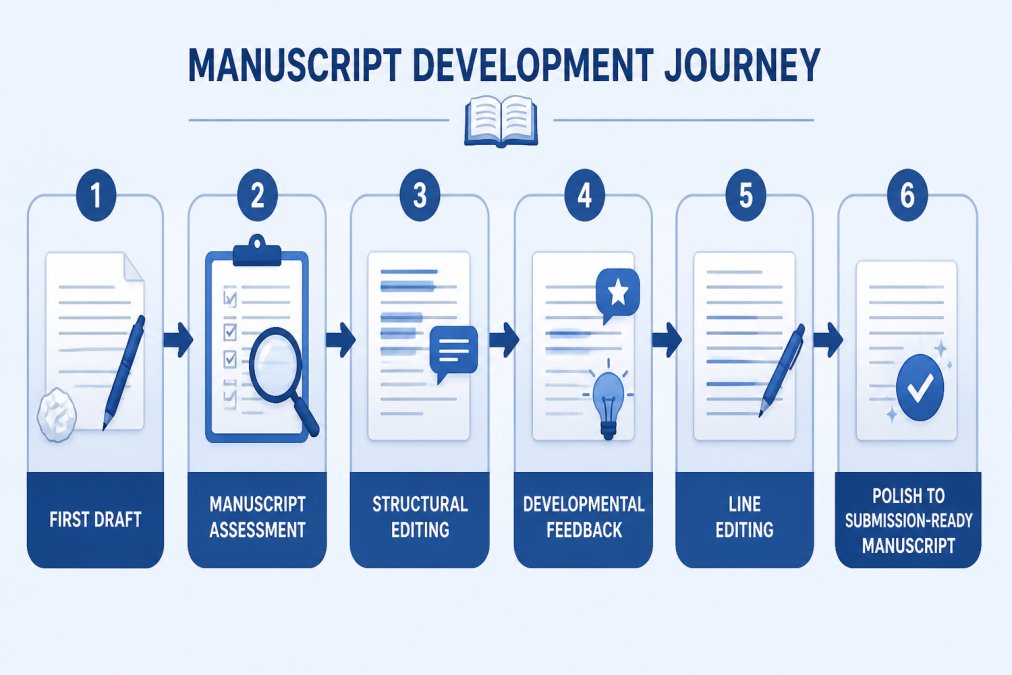
The core value is accountability married to expertise. You enter a working relationship where a coach or editor tracks your revision strategy across the whole arc of the book. For emerging authors, this structure often makes the difference between abandoned drafts and a finished, publishable work.
Most programs share common DNA: an initial assessment, a development phase focused on narrative arc and characterisation, a structural edit, then progressively finer passes. The best ones adapt the sequence to your manuscript's weaknesses rather than forcing every book through an identical template.
Manuscript Development vs Copy Editing: What's the Difference?
Manuscript development focuses on the big bones of your story: plot structure, pacing, character motivation, narrative arc, and voice development. Copy editing, by contrast, works at sentence level, correcting grammar, punctuation, and consistency. You need development before copy editing, never the reverse.
Think of it as architecture versus interior decorating. Structural editing decides whether the load-bearing walls hold up and whether the rooms flow logically. Copy editing chooses the paint colours and arranges the furniture. A beautifully painted room in a collapsing house is still a collapsing house. Many writers pay for copy editing far too early, polishing sentences that will later be cut when a structural problem surfaces.
How Structured Manuscript Development Programs Work
A structured program unfolds in identifiable stages, each with a specific goal and deliverable. You are paying for a process with clear milestones, not vague encouragement. Knowing the sequence helps you evaluate whether a program is genuinely structured or merely a series of expensive conversations.
The full arc usually spans several months, depending on the manuscript's condition and your available writing time. Writers with demanding jobs and family commitments can still make progress, but the timeline stretches. A typical program spaces sessions to match your pace rather than demanding unrealistic daily output.
Stage 1: Manuscript Assessment and Goal Setting
The first stage is diagnosis. A manuscript assessment services professional reads your full draft and produces a detailed report covering strengths, weaknesses, and specific recommendations for revision. This becomes the roadmap for everything that follows.
During this stage, you and your coach agree on clear goals. Is the manuscript destined for traditional submission to a literary agency? Are you planning to self-publish? Is this a novel, a memoir, a play? Each destination shapes the revision strategy. A commercial genre manuscript needs different pacing and market awareness than a literary work for a small press.
Honest goal setting here prevents heartbreak later. A coach should tell you what is achievable, what will take longer than you hoped, and whether the manuscript's fundamental concept is strong enough to justify the investment. If a program skips this stage or rushes it, treat that as a warning sign.
Stage 2: The Structural Edit, Where the Real Work Happens
Once the assessment is complete, the structural edit begins. The editor examines the manuscript's architecture: plot logic, character arcs, pacing, point of view consistency, and whether each scene earns its place. Unlike a line edit, which works sentence by sentence, a structural edit looks at the whole forest, not the individual trees.
A thorough structural edit produces a revision plan, not just a list of problems. This plan might suggest merging two characters, cutting a subplot that distracts from the central theme, or moving the inciting incident earlier so the reader's interest is captured within the first chapter. The plan should be specific enough that you know exactly what to tackle first.
Stage 3: Guided Revision and Feedback Loops
This is where the program's structure proves its worth. Rather than sending you off to revise alone for six months, a structured program builds in checkpoints. You revise a portion, submit it, and receive targeted feedback before moving on. This iterative loop prevents you from compounding small errors into large structural problems.
A common pattern is a two-to-three-week revision cycle per section. You work on the first three chapters, submit them, discuss the results, and apply those lessons to the next batch. This is far more effective than trying to fix the entire manuscript in one heroic push.
Stage 4: Progressive Refinement and Submission Readiness
As structural issues resolve, the program shifts focus. The next passes address scene-level pacing, dialogue tightening, and narrative voice consistency. Only after these are settled does the work move to line editing and copy editing. A structured program will not let you skip ahead to polish while structural problems remain.
The final stage prepares the manuscript for its intended path. For traditional publication, this includes formatting to industry submission standards and preparing a synopsis. For self-publishing, it means preparing the file for conversion and understanding the layout conventions for your chosen platform.
How to Tell a Structured Program from a Series of Conversations
The difference comes down to deliverables. A structured program has a written plan, a timeline, and defined milestones. You should be able to see, at any given moment, what stage you are in and what the next deliverable is. If a coach cannot articulate this, or the plan changes dramatically every session, you are likely paying for unstructured advice.
Ask for a sample revision plan before you commit. Most reputable coaches will share a redacted example of a plan they have produced for another writer. This gives you a concrete sense of the level of detail you can expect. If they cannot provide one, treat that as a significant warning sign.
:::tip A structured program should feel like a project with clear milestones, not an open-ended conversation. If you cannot name the stage you are in, the program is not structured enough.
Questions to Ask a Potential Writing Coach Before You Start
Choosing a coach is the most consequential decision in the entire process, and the questions to ask a potential writing coach deserve serious thought before you hand over any money. Many writers focus on price and availability when they should be probing experience, approach, and fit.
Start with the practical and work toward the philosophical. Ask what they have published and where. Ask how many manuscripts they have guided to completion. Ask whether they have worked with writers at your specific stage. Ask how they handle a manuscript they believe is fundamentally flawed, because the honest answer tells you whether they will waste your time with flattery or tell you the hard truth.
The single most revealing question is this: what does your revision process actually look like, step by step? A vague answer means a vague program. A coach who can articulate their method, timeline, and expectations for you demonstrates the structure you are paying for.
Many writers worry about whether they have enough time. A good coach will tell you honestly whether an hour or two each week is enough to maintain momentum, and many programs are designed around small, consistent blocks rather than heroic weekend marathons.
What to Expect from Structural Editing for Fiction
Structural editing for fiction is the deepest and most demanding stage of manuscript development. It examines how your plot holds together, whether your characterisation is consistent and compelling, and whether your narrative arc delivers the emotional payoff your premise promises.
Expect your editor to challenge decisions you thought were settled. A structural edit may reveal that your protagonist's motivation is unclear, that your midpoint sags, or that your subplot is working against your main storyline. These are not small fixes. Addressing them often means rewriting substantial portions of the manuscript, which is why this work must happen before any line-level polish.
The process is collaborative rather than prescriptive. A skilled structural editor does not rewrite your book for you; they ask questions, point out problems, and help you find your own solutions. This preserves your authorial voice while strengthening the underlying craft. If an editor is rewriting your sentences or imposing their style, you are receiving a ghostwriter, not structural editing.
Mentorship, Feedback, and the Peer Review Process
Beyond one-on-one coaching, many structured programs incorporate mentorship and peer review. This is where the writing workshop model proves its value. Fellow writers reading your work catch assumptions you cannot see, and reading their work sharpens your own critical faculties.

The peer review process works best when moderated by an experienced mentor who can distinguish between subjective taste and genuine craft problems. Unmoderated critique groups often collapse into politeness or brutality, neither of which serves the manuscript. A skilled facilitator channels feedback toward actionable revision rather than personal preference.
Mentorship adds a layer that peer groups cannot replicate. A mentor who has navigated the publishing industry can speak to market expectations, submission strategies, and the realities of what editors and agents look for. This practical knowledge, grounded in real experience, is often the difference between a manuscript that is merely good and one that is publishable.
The Three Main Program Formats: Which One Fits Your Draft?
Not all mentorship and feedback structures are the same. Understanding the three dominant formats helps you choose the right one for your current stage.
The Workshop Model, This is the traditional format used by university creative writing departments and community writing centres. A group of eight to twelve writers reads each other's work in advance, then meets weekly to discuss. The mentor's role is to guide the conversation and ensure feedback remains constructive. This model excels at exposing you to diverse perspectives and building a writing community. It works best when you have a complete draft and are open to broad feedback on story, character, and pacing.
The One-on-One Mentorship, This is a direct relationship between you and an experienced writer or editor. Sessions are typically fortnightly or monthly, with written feedback between meetings. This format allows the mentor to track your revision progress closely and tailor advice to your specific manuscript. It is ideal for writers who have already received broad feedback and need focused, consistent guidance through the revision process. It is also the most flexible format for writers with demanding schedules.
The Hybrid Program, This combines elements of both. You might have a one-on-one mentor for structural guidance, but also participate in a small peer group for accountability and additional perspective. This is the model used by many long-form manuscript development programs, including the one we run at writeinspire. The hybrid approach works well for writers who want the depth of individual attention but also value the community and motivation that comes from a group.
How to Evaluate the Feedback You Receive
Not all feedback is created equal, and learning to evaluate it is a skill in itself. A useful framework is to categorise feedback into three types: structural observations, craft suggestions, and subjective preferences.
Structural observations point to issues with plot logic, character motivation, or pacing. These are almost always worth taking seriously, as they reflect how a reader experiences your story's architecture. Craft suggestions address technique, such as dialogue attribution, scene transitions, or exposition handling. These are worth considering but may not always align with your intended style. Subjective preferences are statements like "I didn't like this character" or "this chapter felt slow to me." These are valuable data points, but they are not commands. A good mentor will help you distinguish between these categories and decide which feedback to act on.
The Role of Accountability in a Structured Program
One of the most underappreciated benefits of a structured program is simple accountability. Writing is solitary, and revision is where many manuscripts go to die. A structured program with regular check-ins and deadlines creates external pressure to keep moving forward. This is not about fear; it is about momentum. Knowing that you have a session next week where you need to show progress is often enough to get you to the desk on the days when motivation is low.
Most practitioners find that the accountability structure matters more than the specific feedback received. A program that keeps you writing steadily for six months will produce a better manuscript than a brilliant editor who only meets with you once. When evaluating a program, ask about the rhythm of check-ins and what happens if you fall behind. A good program will have a plan for getting you back on track.
:::takeaway The best feedback structure is the one you will actually stick with. A workshop that meets weekly, a mentor you check in with fortnightly, or a hybrid program with monthly milestones all work, as long as they keep you revising consistently.
What to Ignore: Common Bad Advice About Manuscript Programs
A considerable amount of bad advice circulates about manuscript development, and following it can waste both your money and your creative momentum. The most damaging myth is that you should polish every sentence before seeking any feedback. This is backwards. Polish applied before structural problems are resolved is labour thrown away when those sentences are later cut.
Another persistent myth is that structured programs are only for beginners. Experienced writers benefit equally from rigorous structural editing, and many established authors use developmental feedback on every manuscript. The idea that you should outgrow professional guidance confuses dependence with collaboration.
Ignore anyone who promises a shortcut. Manuscript development is slow because deep revision is slow. Programs that promise rapid transformation or guaranteed publication are selling fantasy, not craft. Similarly, be wary of programs that emphasise formatting and layout conventions at the expense of story. Formatting matters for submission, but it is the final step, not the foundation.
The vanity publishing model deserves particular suspicion. Real development programs focus on making your manuscript genuinely better, not on extracting fees while telling you your work is ready. If a program flatters you without challenge, you are not being developed, you are being harvested.
Conclusion: Choosing the Right Path for Your Manuscript
The decision to enrol in a structured manuscript development program is an investment in your growth as a writer, not merely a transaction to fix a single draft. It requires trust in a process that will ask hard questions and demand real revisions.
At writeinspire, our structured coaching approach has guided writers from unformed ideas to finished manuscripts across three decades. We pair rigorous manuscript development with honest feedback, and we have built our methods around writers who hold down jobs, raise families, and still find time to create. Our Script Development Program offers twelve months of personalised support, while our Writing Consultation Creative Support provides tailored one-on-one guidance for structure, grammar, and style.
The right program respects your time, tells you the truth, and holds you accountable to the manuscript you know you can write. Whether you are starting fresh or rescuing a draft from a drawer, structured development is the clearest path from potential to completion.
Frequently Asked Questions
How long does a typical manuscript development program take?
A structured program usually runs 3 to 12 months depending on your manuscript's stage and your weekly writing time. A partial draft needing structural editing for fiction might take 3 to 6 months, while a full first draft requiring deep revision could take 6 to 12 months. The best programs fit around your schedule rather than demanding unrealistic blocks of time. Ask your coach for a realistic timeline during your first consultation.
Are structured manuscript programs suitable for debut authors?
Yes, structured manuscript development programs suit debut authors well. They provide a clear framework that helps you move from a rough draft to a polished manuscript without guesswork. You receive guidance on narrative arc, character development, and voice development, which builds skills you carry into future projects. Debut authors often benefit most from the accountability and regular feedback that structured programs provide, helping them move from an unfinished draft to a finished book.
What is the difference between manuscript development and copy editing?
Manuscript development looks at the big picture: structure, plot, character arcs, pacing, and narrative voice. It happens early in your revision process and shapes what you write. Copy editing comes later and focuses on sentence-level grammar, punctuation, and consistency. Think of manuscript development as building the right house design, while copy editing is the final paint touch-up. A structured program guides you through development first so copy editing has something solid to work with.
The writing life is rarely a straight line, and most manuscripts stumble somewhere between first spark and final draft. A structured program exists to steady you through those stumbles. With writeinspire's coaching, built on over 30 years of experience, you gain a partner who has walked this path many times before. Get started with writeinspire and give your manuscript the development it deserves.