

Table of Contents
- You've Been Writing for Years But Never Finished
- Your Manuscript Sits in a Drawer While You Doubt Everything
- You Can Feel the Story But Can't Shape It on the Page
- Developmental Editing vs Writing Coaching: What's the Real Difference?
- Understanding the Stages of Manuscript Revision
- How to Find a Manuscript Coach Who Matches Your Needs
- What Happens After: Building Your Post-Coaching Workflow
- Conclusion
Last Updated: August 24, 2026
You've been writing for years. Stories live in your head. You've started projects, abandoned them, restarted them. You know something's missing, but what? This is where a manuscript development coach enters the picture. The difference between a writer who finishes and a writer who doesn't often comes down to one thing: structured, professional guidance tailored to your specific manuscript and creative process (peer-reviewed research). If you're recognising yourself in any of the signs below, a manuscript development coach isn't a luxury, it's the missing piece.

You've Been Writing for Years But Never Finished
Writers who never finish often share a common thread: they have the ideas, the passion, and the discipline to sit down regularly. What they lack is clarity about what the story actually is. You might have written thirty thousand words or three different versions, but you can't see the shape of it anymore.
A manuscript development coach works backwards from that problem. Instead of encouraging you to write more, they help you understand what you're actually building before you pour another thousand words into it. They ask the hard questions: What is this story really about? Who needs to change, and why? What's the emotional core that makes readers care?
The writers who finish aren't necessarily more talented. They're the ones who stopped writing blind and started writing with a map. That map comes from developmental work, the kind of rigorous thinking about structure, character, and theme that separates a manuscript from a finished book.
Your Manuscript Sits in a Drawer While You Doubt Everything
You've got a draft, maybe half-finished or complete, but you're terrified to show it to anyone. The doubt creeps in: Is this actually good? Does anyone care about this story? Am I wasting my time?
This doubt is paralyzing because it has no answer. You can't get feedback from yourself, you're too close to it. A manuscript development coach breaks this cycle. They're not there to flatter you or crush your confidence. They're there to give you honest, professional feedback rooted in craft, not ego. They read your work the way a publisher or literary agent would: Does the structure hold? Do the characters feel real? Does the pacing work? Is the ending earned?
When you hear specific, detailed feedback about what's actually working and what needs work, the doubt transforms into direction. Instead of vague anxiety, you know exactly what needs attention.
You Can Feel the Story But Can't Shape It on the Page
You have a visceral sense of what the story should feel like. You know the emotional beats. But when you sit down to write it, something gets lost in translation. What felt alive in your head becomes flat on the page.
The problem usually isn't the writing itself. It's the underlying structure. If the narrative arc isn't clear, if the character motivations aren't solid, if the pacing doesn't build momentum, no amount of polished prose will fix it. A developmental editor or manuscript development coach helps you diagnose what's missing at the structural level. They might identify that your protagonist isn't actually changing, or that the stakes aren't clear until page fifty, or that a subplot is overshadowing the main plot.
Once you fix the architecture, the writing becomes easier. The story has a skeleton to hang on, and your instinct about what the story should feel like finally has a framework to support it.
Creative writing resources on narrative structure emphasise that many emerging writers conflate prose quality with story quality. They're different skills. A manuscript development coach helps you separate them, addressing the story first, then the language.
Developmental Editing vs Writing Coaching: What's the Real Difference?
These terms get used interchangeably, but they're not the same thing.
Developmental editing typically focuses on a completed or near-completed manuscript. A developmental editor reads your full draft and provides a comprehensive assessment: Does the structure work? Are the characters consistent? Is the pacing right? Their feedback often comes as a written report. It's retrospective, you've written the book, and now someone is evaluating it.
Writing coaching is more forward-facing and collaborative. A coach works with you during the writing process, not just after. You might meet regularly to discuss what you're working on, troubleshoot problems as they arise, and build accountability into your schedule. A coach helps you think through story decisions before you write thousands of words in the wrong direction.
Here's the practical difference: if you have a completed manuscript and want professional feedback before querying agents, you want a developmental editor. If you have an idea or a half-finished draft and you're not sure how to proceed, you want a writing coach.
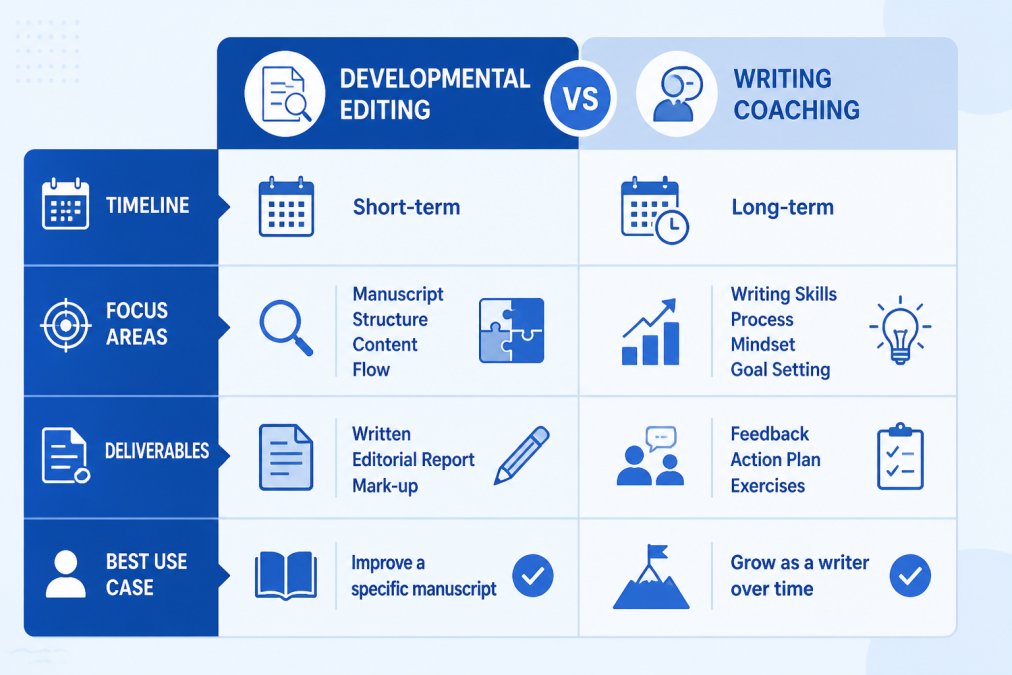
Many writers benefit from both at different stages. You might work with a coach while drafting, then hire a developmental editor once the manuscript is complete.
Understanding the Stages of Manuscript Revision
Manuscript revision isn't a single step. It's a series of distinct phases, each with different goals.
Stage One: Drafting and Developmental Revision
This is where a manuscript development coach is most valuable. You're building the story from the ground up. The focus is on premise, structure, character arcs, and narrative momentum. Developmental revision might mean reordering chapters, rewriting character backstories, or reimagining a subplot. It's not about fixing typos. It's about fixing the architecture.
Stage Two: Line Editing
Once the story structure is solid, line editing refines the prose. This is where you're looking at sentence clarity, word choice, rhythm, and voice consistency.
Stage Three: Copyediting
Copyediting is technical. Grammar, punctuation, consistency in formatting, fact-checking.
Stage Four: Proofreading
The final pass. Typos, spacing issues, formatting errors.
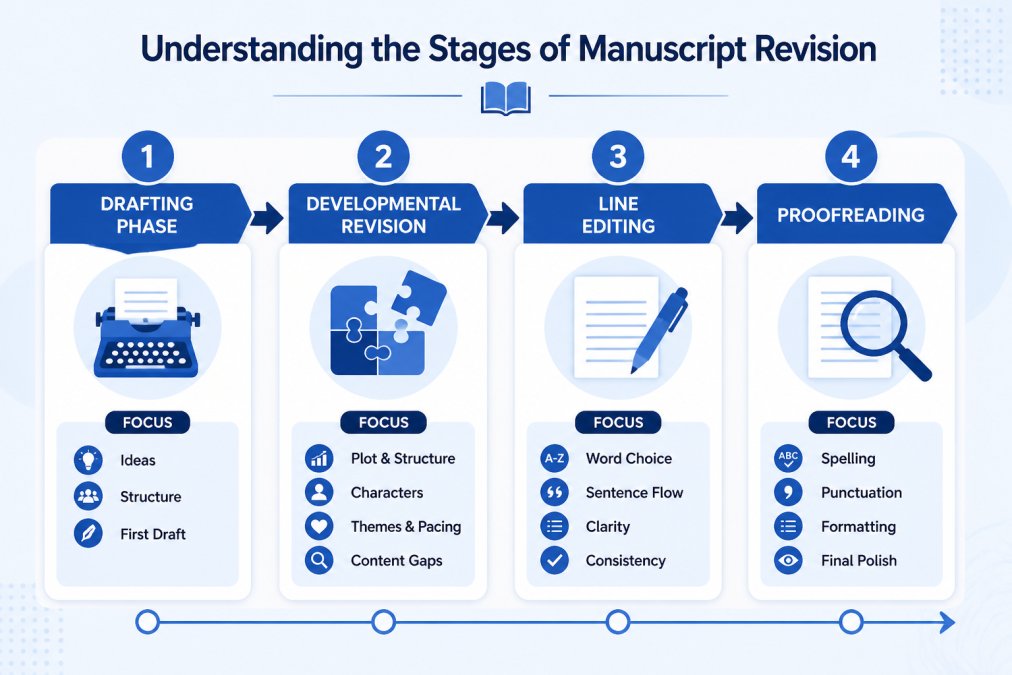
Most writers try to do all four stages at once (apa.org). The result is slow, frustrating progress. A manuscript development coach helps you separate these stages. You draft without editing. You do developmental work without worrying about commas. You revise structure before you polish prose.
How to Find a Manuscript Coach Who Matches Your Needs
Not all coaches are right for all writers. Personality fit, expertise, and process matter.
Look for relevant experience. A coach should have demonstrable experience in the kind of writing you're doing. Ask about their background, what they've published, what kinds of projects they've coached.
Understand their process. How often would you meet? What happens between sessions? Do they read your manuscript in full before you start, or do they work chapter by chapter? One approach might suit your working style better than the other.
Assess their honesty. You want someone who will tell you the truth, not someone who'll tell you what you want to hear. A good coach identifies what's working and what isn't. If a coach promises easy fixes or guaranteed results, that's a red flag.
Consider personality fit. You'll be working closely with this person. You need to trust them and feel comfortable being vulnerable about your work.
Check references if possible. If a coach has worked with other writers, ask for testimonials. Would they work with this coach again?
At writeinspire, we work with writers across all genres and experience levels. Our approach centres on treating your manuscript like it's heading into the marketplace, which means we focus on what readers, agents, and publishers actually respond to. We're here to help you build a story that holds up under real-world scrutiny.
What Happens After: Building Your Post-Coaching Workflow
Coaching doesn't end when the sessions end. The real work is integrating what you've learned into your ongoing creative practice.
During coaching, you've learned to think about story structure differently. You've practiced identifying weak character motivation. You've worked through revision strategies. Now you need to apply those skills independently. Some writers return to their manuscript and implement the feedback they received. Others start new projects with the insights fresh in their minds.
Many writers find that ongoing community helps. Joining a writing group, finding an accountability partner, or revisiting coaching periodically keeps momentum going. The initial intensive work with a coach creates a foundation, but finishing a manuscript is a marathon, not a sprint.
The best post-coaching writers treat their writing like a craft that requires ongoing development. They read widely in their genre. They study story structure. They seek feedback from trusted readers. They revise ruthlessly.
The signs you need a manuscript development coach usually add up over time. You've been writing for years but nothing's finished. You doubt everything you've written. You can feel the story but can't shape it. You're stuck in a loop of drafting and abandoning, or revising endlessly without progress.
A manuscript development coach doesn't make you a writer, you already are one. What they do is help you finish. They give you the structure, the feedback, and the accountability that transforms years of half-finished projects into a completed manuscript you're proud of.
If this resonates, the next step is finding the right coach for your work and your process. Consider booking a writing consultation to assess your manuscript needs. A good consultation clarifies exactly what kind of support will move you forward, whether that's developmental coaching, manuscript assessment, or a structured program like the Script Development Program, which offers ongoing support tailored to your project.

The manuscript sitting in your drawer doesn't need more time or more solitude. It needs a professional eye, honest feedback, and a structured plan to finish. That's what a manuscript development coach provides. The question isn't whether you need one, it's whether you're ready to finally get the work done.
Frequently Asked Questions
What's the difference between a developmental editor and a writing coach?
A developmental editor typically reviews a completed or near-complete manuscript and provides written feedback on structure, pacing, character development, and narrative arc. A manuscript development coach works with you throughout the writing and revision process, offering ongoing guidance, accountability, and real-time problem-solving. Coaching is collaborative and interactive; editorial feedback is usually delivered after the fact. Coaches help you build the skills to solve problems yourself, while editors diagnose problems in finished work.
How do you know if your manuscript is ready for professional feedback?
Your manuscript doesn't need to be perfect to benefit from a coach. Many writers find coaching most valuable during the drafting or early revision stages, when structural issues can be addressed before you're too invested in a particular direction. If you have a draft, even a rough one, a manuscript development coach can help you identify what's working and what needs rebuilding. The key is having enough material and a genuine commitment to the revision process.
At what stage of the writing process should you hire a manuscript development coach?
The best time depends on your situation. Some writers benefit from coaching before they start drafting, to clarify the story structure and character arcs. Others hire a coach mid-draft when they feel stuck or unsure about direction. Many bring a completed first draft to a coach for developmental feedback and ongoing support through revision. If you have a story you can feel but don't know how to shape, or if you've started but can't finish, that's a strong sign coaching will help now.
How can a manuscript development coach help if I'm stuck with writer's block or procrastination?
A coach provides accountability, structure, and clarity, three things that dissolve creative block. When you're stuck, it's often because the story direction is unclear, the stakes aren't high enough, or you're uncertain about character choices. A coach helps you diagnose what's actually blocking progress, rebuilds your confidence in the work, and creates a realistic action plan. Regular check-ins keep momentum going even when motivation dips. Many writers find that external accountability transforms procrastination into progress.
This article was written using GrandRanker