

Table of Contents
- What's the Real Difference Between a Writing Coach and a Freelance Editor
- When to Hire a Developmental Editor
- Types of Editorial Services for Authors
- Is Professional Writing Coaching Worth It
- Manuscript Feedback vs. Craft Instruction
- How to Choose the Right Service for Your Project
- Conclusion
What's the Real Difference Between a Writing Coach and a Freelance Editor
The question "writing coach vs editor" comes up constantly among authors trying to figure out which professional will actually move their manuscript forward. The answer matters because these are fundamentally different services, and picking the wrong one wastes money and delays your work.
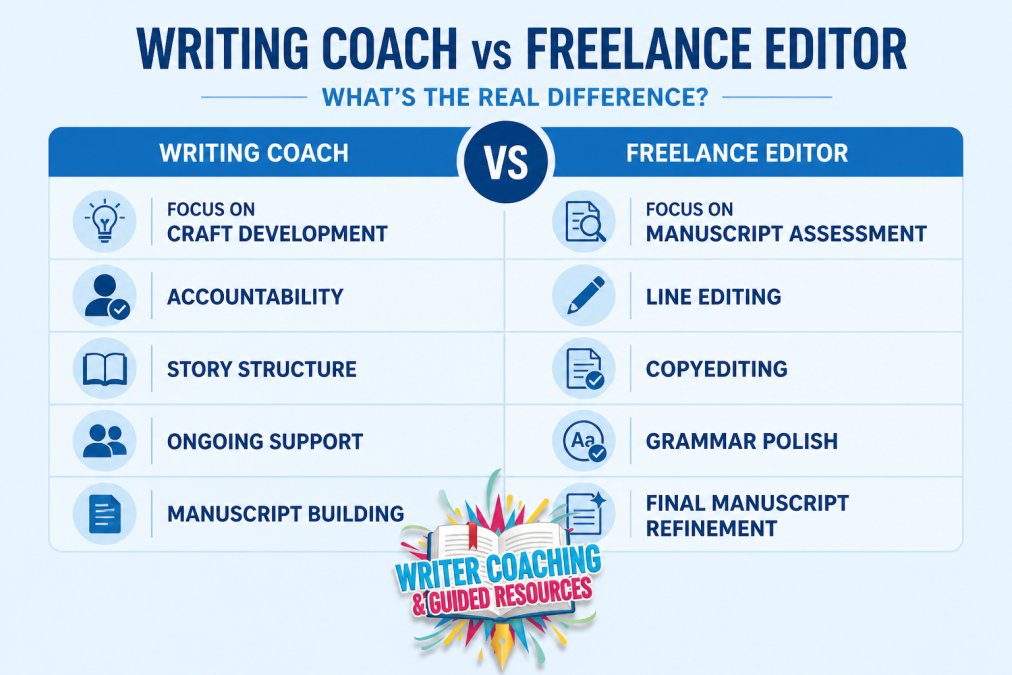
A writing coach focuses on you as a writer. They work on craft development, accountability, story structure, and the thinking process that gets words onto the page. A freelance editor focuses on your manuscript. They assess what's already written, identify problems, and fix them through line editing, copyediting, and structural feedback.
The distinction sounds simple until you're halfway through a project and realise you hired the wrong person for what you actually needed.
The Writing Coach's Role
A writing coach is invested in your development as a writer, not just the manuscript you're working on right now. They help you understand story structure, build narrative momentum, develop your author voice, and overcome the creative blocks that stop most writers from finishing.
The coaching relationship is forward-looking. You're learning tools and processes you'll use on the next project too. A good coach works with you on premise, theme, character development, and pacing before you've written thousands of words, or while you're mid-draft and stuck. They ask questions that force clarity. They hold you accountable to deadlines. They push you to dig deeper into your characters' motivations and the emotional stakes of your story.
WriteInspire's approach to writing coaching, for instance, centres on building the story properly from the ground up. Rather than waiting until a manuscript is finished to assess it, coaches work alongside writers during the creation phase, helping shape narrative arc, strengthen character development, and ensure every scene has purpose and tension. This developmental work happens while the manuscript is still being built, not after.

Coaching is particularly valuable if you've been carrying a story in your head for years but never finished it, or if you've drafted something but know it's not working structurally. The coach helps you understand why it's not working and teaches you how to fix it yourself.
The Freelance Editor's Role
A freelance editor works on completed or near-completed manuscripts. Their job is to assess what exists and improve it through targeted feedback and revision. They might focus on developmental editing (big-picture structure and narrative flow), line editing (sentence-level clarity and rhythm), copyediting (grammar, consistency, style), or a combination.
Editors come in after the heavy lifting of drafting is done. They read what you've written and identify problems: plot holes, inconsistent character behaviour, pacing that drags, prose that confuses readers, or dialogue that doesn't reveal character. Then they either fix it directly (copyediting) or provide detailed feedback so you can fix it yourself (developmental or line editing).
The editor's relationship with your manuscript is bounded. They review it, provide feedback or corrections, and the engagement ends. Unlike a coach, they're not teaching you a process you'll apply to future projects. They're making this manuscript stronger.
When to Hire a Developmental Editor
A developmental editor makes sense when you have a complete or near-complete draft and you know something's not working, but you're not sure what. You've written the whole thing. The story exists. But the pacing feels off, or readers are confused by the plot, or your protagonist doesn't feel real, or the ending falls flat.
Developmental editing addresses manuscript-level problems: structure, narrative arc, character consistency, emotional credibility, and whether the story actually delivers on its promise. The developmental editor reads your full manuscript, identifies the core issues, and provides detailed feedback on what needs to change and why.
This is different from coaching because you're not learning the process, you're getting expert assessment of a finished product. The editor is saying, "Here's what's not working and here's what to do about it." You then decide whether to implement the feedback and do the revision work yourself, or hire someone else to help with the revision.
When to hire a developmental editor:
- Your manuscript is complete or nearly complete
- You've revised it yourself and know something's still off
- You want professional assessment before querying agents or self-publishing
- You need specific, manuscript-focused feedback rather than craft instruction
- You're ready to pay for expertise rather than accountability
Types of Editorial Services for Authors
Authors often confuse editorial services because the terminology overlaps and different editors use labels differently. Understanding what each service actually does helps you choose correctly.
Developmental Editing
Developmental editing is the heaviest intervention. The editor reads your entire manuscript and assesses its structural integrity: Does the story arc work? Are the characters consistent and believable? Does the pacing maintain momentum? Are there plot holes? Is the emotional journey credible?
Developmental feedback often includes:
- Overall manuscript assessment and viability
- Story structure and narrative arc analysis
- Character development and consistency notes
- Pacing and tension feedback
- Scene-by-scene commentary on purpose and effectiveness
- Major revision recommendations
This is the most expensive editorial service because it requires the deepest engagement with your work. A developmental editor might spend 20-30 hours on a full manuscript, depending on length and complexity (peer-reviewed research).
Line Editing and Copyediting
Line editing focuses on sentence-level clarity, rhythm, and style. The editor reads every line and improves how you've said what you've said. They catch awkward phrasing, repetitive word choices, inconsistent voice, and prose that confuses readers. They're not rewriting your story, they're making your sentences stronger.
Copyediting comes after line editing. It's the final polish: grammar, punctuation, consistency, style guide adherence, and formatting. A copyeditor catches typos, inconsistent character names, formatting errors, and style issues. It's the last layer of refinement before publication.
Line editing and copyediting are less expensive than developmental editing because they're more mechanical and require less interpretive judgment. They're also faster, a copyeditor can move through a manuscript quicker than a developmental editor because they're looking for specific, objective problems rather than making subjective assessments about story and character.
Is Professional Writing Coaching Worth It
The value of writing coaching depends on where you are as a writer and what you actually need. If you've been trying to finish a manuscript for years and haven't made real progress, coaching is worth the investment. If you're disciplined, you finish drafts regularly, and you just need someone to clean up your prose, you might be better served by an editor.
Coaching works because it combines three things: structure, accountability, and craft instruction. You learn a process for building stories. You commit to deadlines and check-ins. You get feedback on your work as you create it, not after you've written 80,000 words in the wrong direction.
Many writers find that working with a coach removes the isolation and self-doubt that stops them from finishing. Having someone invested in your success, someone who understands story and can help you solve problems before they become catastrophic, changes the outcome. Writers who work with coaches tend to finish manuscripts. Writers who don't often don't.
The catch is that coaching requires active participation. You have to show up, do the work, and be willing to revise. A coach can't write the book for you. They can guide you through the process, but you're still doing the heavy lifting.
Manuscript Feedback vs. Craft Instruction
This is where the coaching vs. editing distinction becomes clearest. Manuscript feedback tells you what's wrong with what you've written. Craft instruction teaches you how to write better in the first place.
An editor gives you feedback: "This scene doesn't have enough tension." "Your dialogue reveals nothing about character." "The pacing drags here."
A coach gives you instruction: "Here's how to build tension in a scene. Here's how dialogue reveals character. Here's how to structure a chapter so it maintains momentum."
Feedback is reactive. Instruction is generative.
If you get editorial feedback and you don't understand how to fix the problem, you're stuck. You either hire someone to rewrite it for you (expensive) or you struggle through revisions without knowing whether you're actually improving things.
If you get coaching and instruction, you learn the principles. You can apply them to this manuscript and every manuscript you write in the future.
This is why coaching has a longer-term payoff. You're not just fixing this one book, you're developing as a writer. You're learning craft principles that transfer to your next project.
How to Choose the Right Service for Your Project
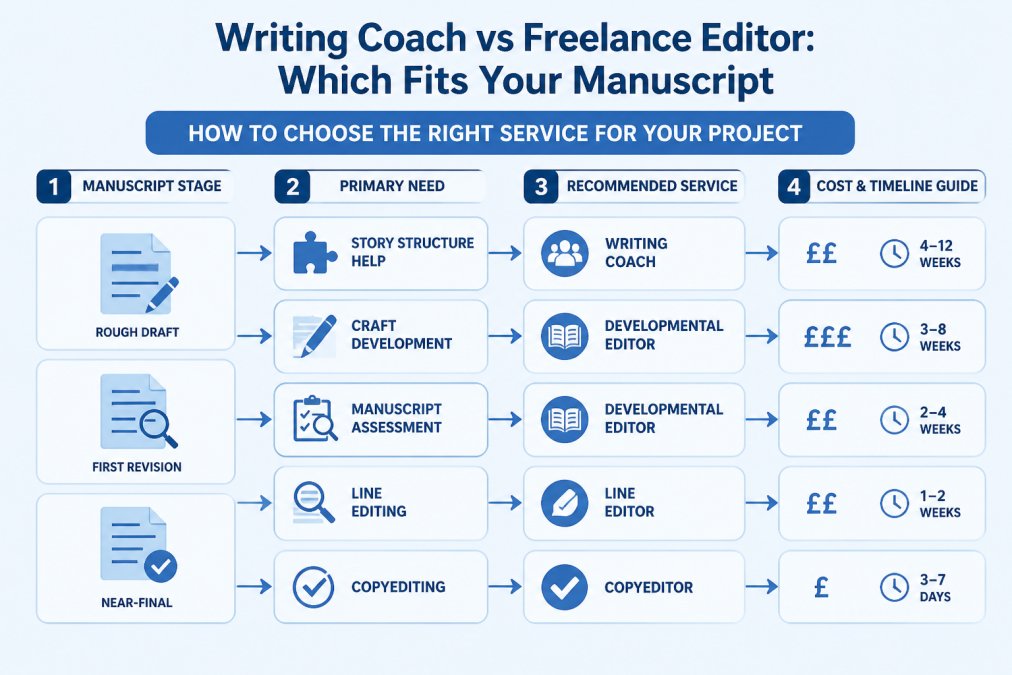
The decision hinges on three questions: What stage is your manuscript in? What problem are you trying to solve? What's your budget and timeline?
Questions to Ask Before You Commit
Before you hire anyone, ask yourself these questions:
What stage is the manuscript in?
- Rough draft or outline: coaching is better. You need help building the story.
- First or second revision: coaching or developmental editing. You need to know if the structure works.
- Near-final draft: line editing or copyediting. You need polish, not structural help.
What's the actual problem?
- "I don't know how to structure this story": coaching.
- "I've written it but it doesn't work": developmental editing.
- "It works but the writing is clunky": line editing.
- "It's almost done, just needs cleanup": copyediting.
What's your timeline?
- Coaching relationships typically run 3-6 months or longer (apa.org). You're building a process over time.
- Developmental editing takes 4-8 weeks depending on manuscript length (peer-reviewed research).
- Line editing takes 2-4 weeks.
- Copyediting takes 1-2 weeks.
What's your budget?
- Writing coaching ranges from hourly consultation to ongoing monthly support.
- Developmental editing costs more per hour but is time-bounded.
- Line editing and copyediting are less expensive because they're more standardised.
WriteInspire's Writing Coaching & Guided Resources service, priced at $145.00, for example, works for writers who have a story they can feel but don't know where to start, or who've drafted something they know isn't finished. The service includes help formulating story premise, developing narrative arc, strengthening characters, and refining language, the full developmental work. It's designed for writers who want a professional story partner, not just a manuscript review.
If you've got a half-finished manuscript sitting in a drawer for five years, coaching is exactly what you need. The coach helps you understand why it stalled, what the story is really about, and how to finish it. You're not paying someone to fix it, you're learning how to finish it yourself.
If you've finished a manuscript and you're pretty sure it works but you want professional confirmation before you query agents or self-publish, developmental editing makes more sense. You want an expert assessment of a finished product.
The key is matching the service to your actual need. Hiring a copyeditor when you need a coach wastes money because the copyeditor can't help you finish the draft. Hiring a coach when you just need line editing also wastes money because you're paying for instruction you don't need.
Choosing between a writing coach and a freelance editor comes down to this: Are you trying to learn how to finish a manuscript, or are you trying to improve one you've already written? A coach teaches you the craft and keeps you accountable. An editor assesses your finished work and helps you polish it. Both have value. The wrong choice for your situation just costs money without moving you forward.
WriteInspire offers both coaching and editorial support tailored to where you are in your writing journey. Whether you need help building your story from the ground up through Writing Coaching & Guided Resources, or you're looking for a focused consultation on structure and craft with Writing Consultation Creative Support for $145.00, the service is built around rigorous manuscript development, not vanity publishing. Start with a clear picture of what your manuscript needs, and you'll know exactly which professional to hire.

Frequently Asked Questions
What is the primary difference between a writing coach and a freelance editor?
A writing coach focuses on your development as a storyteller and helps shape your manuscript's story structure, character arcs, and narrative momentum through ongoing dialogue and accountability. A freelance editor typically works on the manuscript itself, assessing its strengths and weaknesses, refining language, and polishing prose. Coaches build your skills; editors refine your work. Many writers benefit from coaching first (to develop the story properly), then editing later (to polish the final draft).
When should I hire a developmental editor versus a writing coach?
Hire a writing coach early, when you're still developing your story or working through a rough draft. You need someone to help you shape the narrative arc, develop your characters, and maintain momentum. Choose a developmental editor when your manuscript has a solid structure but needs feedback on pacing, plot holes, or character consistency. If you're at the final stage and your story is solid, a copyeditor handles grammar and line-level polish. The manuscript's stage determines which service fits best.
Is professional writing coaching worth the investment?
Yes, if you're serious about finishing a manuscript and improving your craft. Writing coaching provides accountability, expert feedback on story structure, and guidance through creative blocks, three things most writers struggle with alone. The cost is offset by finishing faster and avoiding months of revision dead-ends. The real value isn't in the service itself; it's in the finished, properly shaped story you walk away with.
How do I know if my manuscript is ready for professional editing?
Your manuscript is ready for editing when you've completed a full draft and revised it yourself at least once. Editors work best on material that has a clear story, developed characters, and a beginning, middle, and end, even if it's rough. If your manuscript is still in early drafts or you're unsure about its structure, a writing coach is a better fit. Sending an unfinished or structurally unclear manuscript to an editor wastes both your money and their time. Know your manuscript's stage before you hire.
Can a writing coach help with structural issues like plot holes and character development?
Absolutely. Structural problems, weak plot arcs, underdeveloped characters, pacing issues, are exactly what writing coaches address. Coaches help you identify where your story loses momentum, where characters feel flat, and where the narrative logic breaks down. They work with you to strengthen these elements before you've written the final draft, which saves you from major rewrites later. This is one of the key reasons coaching early in the process pays off: you build the story right from the start rather than trying to fix it after it's written.
This article was written using GrandRanker