

Table of Contents
- What Professional Writing Coaching Actually Is
- Signs You Need a Writing Coach
- Writing Coach vs Developmental Editor: Understanding the Difference
- What to Expect from a Writing Coaching Session
- Pricing Models and What You'll Actually Invest
- Real ROI: When Writing Coaching Pays for Itself
- Red Flags and How to Choose the Right Coach for You
- Conclusion
What Professional Writing Coaching Actually Is
Professional writing coaching is structured, one-on-one guidance focused on developing your craft and moving your manuscript forward. Unlike a traditional editor who marks up your text, a coach works on the bigger picture: story structure, character development, voice, pacing, and the habits that keep you writing when motivation fades.
A coach asks questions that help you find your own answers. They hold you accountable to your goals and identify patterns in your thinking that block progress. At writeinspire, we've spent over 30 years working with writers at every stage, from those with half-finished manuscripts to authors preparing for publication, and the pattern is consistent: writers need someone in their corner who understands the craft deeply enough to guide them through the messy middle of a project.
Writing coaching covers manuscript development, helping you shape your story from concept through completion. It addresses structure, dialogue, pacing, and emotional resonance, plus the psychological side: self-doubt, false starts, and moments when you're convinced your work is worthless. A good coach recognises these as part of the process, not signs you should quit.
The coaching relationship is collaborative. You're not paying someone to fix your work; you're investing in learning how to fix it yourself.
Signs You Need a Writing Coach
You've been writing for years but never finished anything. Notebooks full of ideas, a laptop with half-started documents, a drawer of abandoned manuscripts. The problem isn't lack of talent, it's that you don't have a system for moving from concept to completion. A coach helps you understand why you stall at the same point (usually the midpoint) and builds writing habits that stick.
You doubt everything you write. You finish a chapter convinced it's rubbish, or compare your first draft to someone else's published work and feel defeated. This is the most common obstacle coaching addresses. A coach who has seen hundreds of manuscripts knows your self-doubt is normal, not predictive (peer-reviewed research). They can show you what actually works in your writing.
You've got a manuscript sitting in a drawer for years. Life got in the way. You lost confidence. A coach can help you return with fresh perspective, identify what's salvageable, and understand what you've learned as a writer since you stepped away.
You're ready to pursue publication but unsure what that means. Traditional publishing, self-publishing, hybrid approaches, the landscape is complex. A coach with publishing experience can guide you on whether your manuscript is ready and how to position yourself as a writer.
You're writing in a niche or genre where feedback is hard to find. A coach specialising in your area brings expertise directly to your work.
Writing Coach vs Developmental Editor: Understanding the Difference
A writing coach and a developmental editor serve related but distinct purposes.
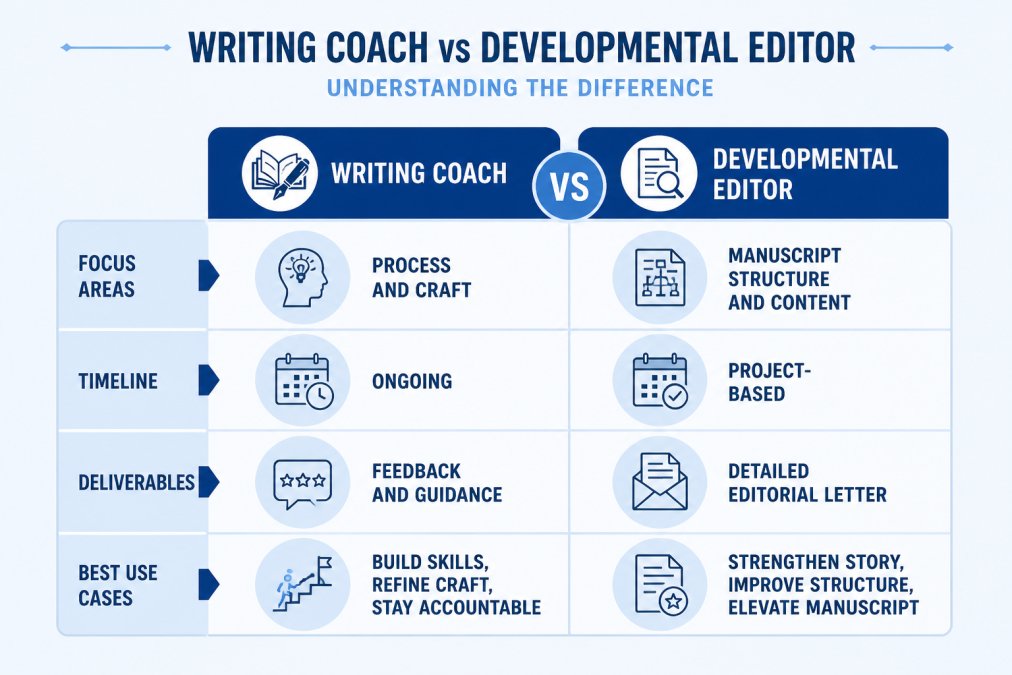
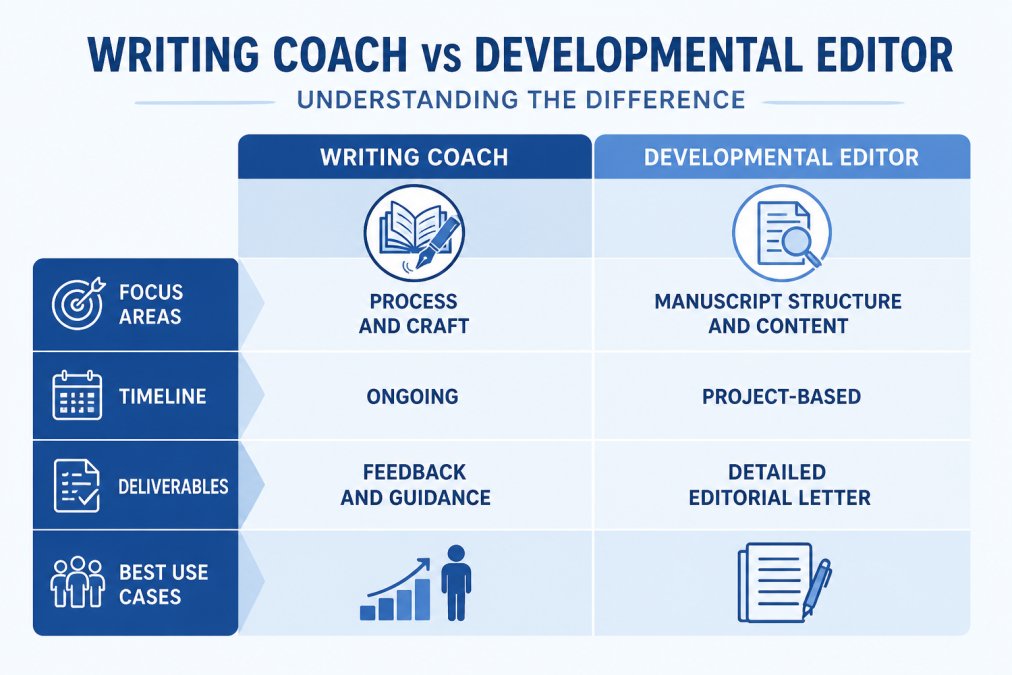
A developmental editor focuses on your manuscript. They read your complete work and provide detailed feedback on structure, plot, character arcs, pacing, and narrative strategy. They produce an editorial letter identifying what's working and what needs attention. This is transactional and time-bound.
A writing coach focuses on you. They work with you over time, helping you develop the habits, skills, and mindset that produce strong writing. A coach asks: Why did you make that choice? What are you trying to achieve in this scene? What patterns do you notice in your own writing process?
The timeline differs too. Developmental editing is project-based. Coaching is typically ongoing, building momentum and skill over weeks or months.
Neither is inherently better. Many writers benefit from both at different stages. You might work with a coach while drafting to develop your process, then hire a developmental editor once your manuscript is complete to assess its readiness for publication.
The key question: do you need feedback on a finished manuscript, or do you need guidance on your process and craft? That answer determines which service serves you better.
What to Expect from a Writing Coaching Session
A typical coaching session is a conversation, not a lecture. You come with questions, challenges, or a section of your work you want to discuss. The coach listens, asks clarifying questions, and helps you work through the problem yourself.
Early sessions might focus on your project: what you're trying to achieve, who your characters are, what themes matter to you. The coach builds understanding of your vision, not imposing their own.
When you bring manuscript pages, the coach reads them beforehand and identifies patterns. Maybe your dialogue feels flat because you're not trusting your characters' voices. Maybe your pacing stumbles because you're over-explaining. The coach points out these patterns and asks what you notice.
You'll likely get focused homework designed to build a particular skill or move your manuscript forward. This might be rewriting a scene focusing only on dialogue, drafting the next chapter without stopping to edit, or analysing how a published author handles a technique you're struggling with.
A good coaching session leaves you with clarity and momentum. You understand what question to ask next and feel capable of tackling the work ahead.
Sessions typically run 60 to 90 minutes. Some coaches work weekly, others fortnightly or monthly. The frequency depends on your needs and your project's pace. A writer drafting might benefit from weekly check-ins. Someone revising might work every other week.
The relationship evolves. Early sessions build foundational habits. As you progress, you'll tackle more sophisticated craft questions. Later sessions might address psychological blocks that emerge as you near completion.
Pricing Models and What You'll Actually Invest
Writing coaching investment varies depending on the model and the coach's experience.
Hourly rates depend on the coach's experience and location. This model works if you need occasional guidance or want to test whether coaching suits you before committing to a larger investment.
Project-based fees cover a defined scope: coaching through a complete manuscript revision, a six-week intensive, or a specific number of sessions. This model suits writers with a clear endpoint in mind and provides predictability.
Retainer models provide ongoing access to coaching on a monthly basis. This model works best for writers committed to long-term development and those who benefit from regular accountability and support.
At writeinspire, we offer coaching through structured programs designed to fit different needs and timelines. For example, our Writing Consultation Creative Support is available for $145.00, offering a private, one-on-one session. For more extensive support, our Writer Coaching & Guided Resources is also $145.00, providing ongoing support. For those looking for a comprehensive program, the Script Development Program is $1,795.00, and Creative Story Mastery - Supported (Access) is $3,420.00.


The real question isn't the rate, it's the return on your investment. A coach who helps you finish a manuscript you've been working on for five years delivers extraordinary value.
Real ROI: When Writing Coaching Pays for Itself
The return on writing coaching investment depends entirely on your goals. If your goal is to finish a manuscript, coaching accelerates completion. Writers working alone often take years to finish projects that a coach helps them complete in months (peer-reviewed research).
If your goal is publication, a manuscript that's structurally sound and emotionally resonant is infinitely more likely to find readers than one that's rough. The investment in coaching to reach that standard is modest compared to pursuing a manuscript that isn't ready.
If your goal is to improve your craft, the return is less tangible but perhaps more valuable. A writer who learns to trust their instincts and understands story structure deeply produces better work for the rest of their life.
Many writers report that coaching transformed their relationship with writing itself (peer-reviewed research). They stopped seeing it as something they had to force and started experiencing it as something they wanted to do. That shift often leads to more consistent output and better work.
The psychological ROI matters too. Finishing a manuscript you've carried for years changes how you see yourself. You move from "I'm someone who wants to write" to "I'm a writer." That identity shift often leads to the next project.
Red Flags and How to Choose the Right Coach for You
Not every coach is right for every writer, and some red flags can save you money and frustration.
Avoid coaches who promise guaranteed publication or agent representation. No one can guarantee that. A coach can help you produce excellent work, but they can't control whether an agent or publisher chooses it.
Be cautious of coaches who insist on a single approach or methodology. Writing is too individual for one-size-fits-all solutions. A good coach adapts their approach to your needs, your project, and your learning style.
Watch for coaches who haven't published or worked in the industry themselves. Ask about their background. What have they written? How long have they been coaching? What's their experience with your genre or format?
Check whether they have references or testimonials from writers they've worked with. A coach with genuine experience should be able to point you toward writers willing to speak about their work together.
Avoid coaches who spend more time selling you on their expertise than understanding your project. A good initial consultation involves them asking questions about your work, your goals, and your challenges.
Trust your instincts about the relationship. Coaching is intimate work. You're sharing your writing, your doubts, your creative vision. You need to feel genuinely heard and supported. If something feels off in initial conversations, it probably is.
Ask directly: What's your experience with writers at my stage? What's your track record with writers in my genre? Can you share examples of how you've helped writers move through the specific challenges I'm facing? A coach confident in their work will answer these questions clearly.
Professional writing coaching is worth the investment when you're committed to finishing your work and improving your craft. The real cost isn't the fee you pay, it's the opportunity cost of not getting coaching and spending years on a manuscript that could have been completed in months.
WriteInspire's coaching approach focuses on rigorous manuscript development and craft mastery, drawing on over 30 years of experience working with writers. Whether you're working through a half-finished manuscript or preparing for publication, the guidance and accountability a coach provides accelerates your progress and deepens your skill. The investment pays dividends not just in the manuscript you complete, but in the writer you become.
Frequently Asked Questions
How do I know if I'm ready for professional writing coaching?
You're ready when you've been writing but hitting a wall, whether that's finishing a manuscript, improving your voice, or structuring your story. If you've spent months or years on a project that's stalled, or you've completed drafts but aren't confident in their quality, coaching can unlock what you're missing. You don't need to be published or polished; you need genuine commitment to improving your craft and willingness to take feedback.
What's the difference between a writing coach and a developmental editor?
A writing coach guides your writing process, helps you build habits, and develops your craft over time through accountability and feedback. A developmental editor typically works on a finished or near-finished manuscript, focusing on structure, plot, and character. Coaching is ongoing skill-building; editing is targeted manuscript improvement. Many writers benefit from coaching first to strengthen fundamentals, then editing later for polish.
Can writing coaching actually help me finish a manuscript?
Yes, but it works best when combined with your own commitment. Coaching provides structure, accountability, and professional feedback, three things that stop most writers from finishing. A coach helps you break through creative blocks, clarify your story, and build writing habits that sustain progress. Half-finished manuscripts often sit because writers lose confidence or direction; coaching directly addresses both.
Is writing coaching worth it compared to online courses or writing groups?
Each serves a different purpose. Online courses teach technique; writing groups offer community and peer feedback; coaching provides personalised guidance tailored to your specific manuscript and goals. Coaching is most valuable when you need expert feedback on your work, accountability to finish, or help navigating a particular creative challenge. If you're building foundational skills, a course might be the right start. If you're stuck or need professional guidance, coaching typically delivers faster progress.
This article was written using GrandRanker