

Table of Contents
- What Manuscript Coaching Actually Is
- Is Professional Writing Coaching Worth It?
- The Manuscript Development Process
- Manuscript Assessment vs Coaching: What's the Difference?
- Setting Realistic Goals for Your Manuscript
- Common Misconceptions About Coaching and Publishing
- Red Flags in Coaching Contracts and What to Watch For
- The Financial Reality: ROI and What You'll Invest
What Manuscript Coaching Actually Is
Manuscript coaching is a collaborative process where a professional guide works with you to develop your story from concept through completion. Unlike editing, which focuses on fixing what's already written, coaching shapes your creative process itself. A coach helps you understand narrative structure, character development, pacing, and the thousand small decisions that separate a first draft from a publishable manuscript.
At writeinspire, we see coaching as an active partnership. You're not handing over your work to someone who tells you what's wrong. Instead, you're learning the craft alongside someone with decades of experience. The coach asks questions that reveal the story you're actually trying to tell, identifies where your narrative drive stalls, and helps you develop the discipline to finish what you start.
Many writers confuse coaching with critiquing. A critique tells you what didn't work. Coaching teaches you why it didn't work and how to fix it yourself. That distinction matters enormously. After months of coaching, you should be a better writer, not just the owner of a better manuscript.
Is Professional Writing Coaching Worth It?
Whether coaching delivers value depends entirely on what you're trying to achieve and how committed you are to the work. If you're hoping someone will magically transform your manuscript into something publishable without significant effort from you, the answer is no. If you're serious about mastering your craft and completing a manuscript that reflects your vision, coaching can be transformative.
The real question isn't whether coaching works in theory. It's whether you're the kind of writer who benefits from structured accountability and professional feedback. Some writers thrive with a coach. Others do better joining a writers' group or working through a structured course on their own. There's no universal answer.
What coaching offers that alternatives don't is personalized guidance. A writing course teaches general principles. A writers' group offers peer feedback. A coach works specifically with your manuscript, your goals, and your creative challenges. That specificity has real value, but only if you're prepared to act on it.
Many writers hesitate because they're unsure they have what it takes. That doubt is actually common among serious writers. What matters is whether you're willing to push through it. Coaching can help you develop the confidence and skills to finish, but the coach can't want it more than you do.
The Manuscript Development Process
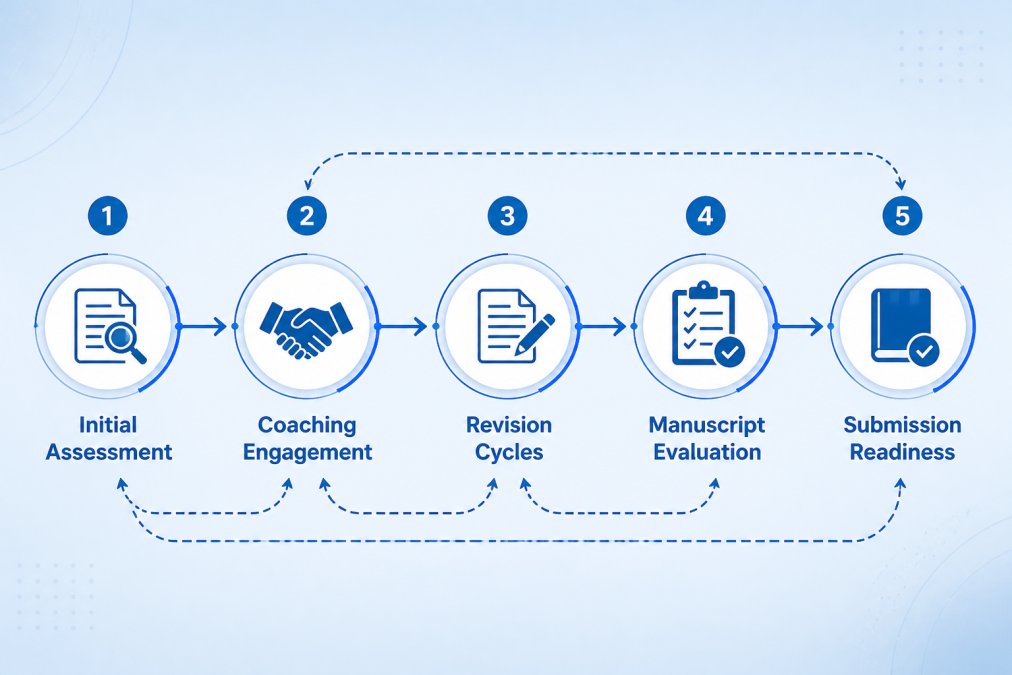
The manuscript development process typically moves through distinct phases, each building on the previous one. Understanding what happens at each stage helps you set realistic expectations and know what to ask for.
What to Expect in Your First Session
Your first session establishes the foundation for everything that follows. A good coach will ask about your manuscript, your publishing goals, your timeline, and what specific challenges you're facing. This isn't therapy, it's diagnosis. The coach needs to understand what you're working with before offering guidance.
Expect to spend time talking about your story itself. What's the core conflict? Who is your protagonist and what do they want? Where does the narrative lose momentum? These questions might feel basic, but they often reveal gaps in your own understanding of your manuscript. Many writers discover their story's real problem only when forced to articulate it clearly.
By the end of the first session, you should have clarity on what coaching will focus on. Will you work on structure? Character development? Pacing and dialogue? The coach should outline a rough roadmap for your engagement, though that roadmap will shift as your manuscript evolves.
The Feedback Loop and Revision Coaching
Real manuscript development happens in the feedback loop. You write or revise a section. Your coach reviews it and offers feedback. You revise again based on that feedback. The cycle repeats until the manuscript reaches submission readiness.
This is where realistic expectations matter most. Revision isn't one pass, it's multiple passes, each addressing different layers of the manuscript. A common pattern is structural revision first (does the story flow logically?), then character and emotional depth (do readers care about what happens?), then prose-level work (does each sentence do its job?).
The feedback loop requires patience. You might revise a chapter three times and still not get it right. That's normal. It's also why coaching differs from hiring an editor to fix everything. A coach teaches you to see the problems and solve them. An editor solves them for you. One builds your skills; the other doesn't.
Manuscript Assessment vs Coaching: What's the Difference?
These two services sound similar but address fundamentally different needs. Understanding the distinction helps you choose what's actually useful for your situation.
A manuscript assessment is a one-time evaluation. Someone reads your manuscript and provides detailed feedback on what works and what doesn't. They might identify structural problems, weak characterisation, pacing issues, or prose-level errors. You receive a report, often comprehensive, and then you're on your own to interpret it and make changes.
Coaching is an ongoing relationship. A coach works with you over weeks or months, guiding your revision process, answering questions as they arise, and adjusting the focus based on what emerges. You're not just getting feedback; you're getting a structured process for implementing that feedback.
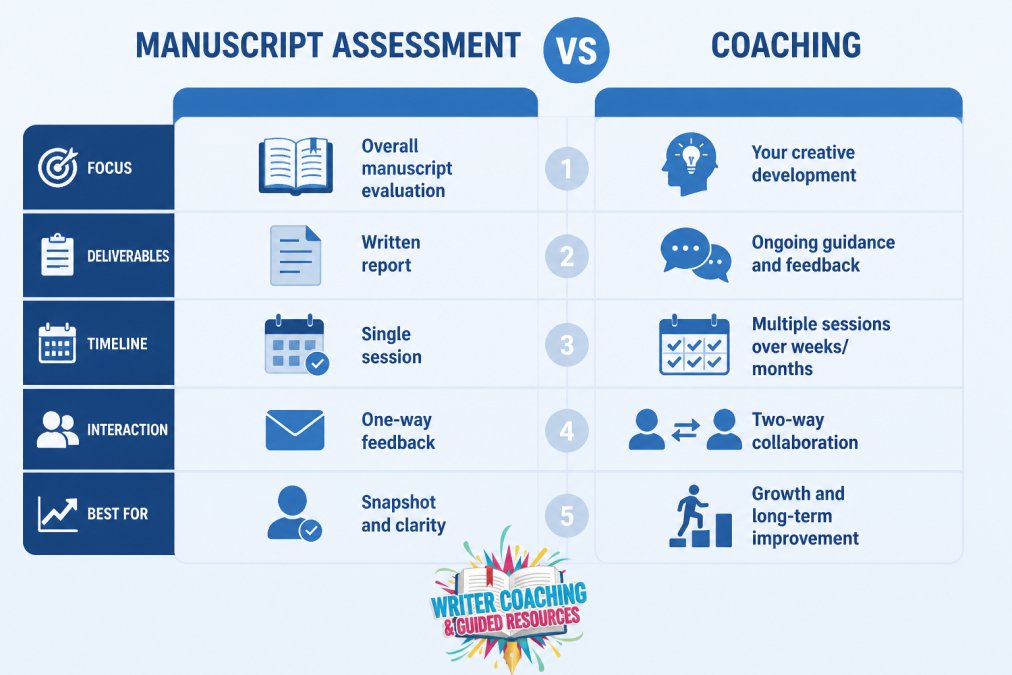
Many writers benefit from assessment first, then coaching. The assessment tells you what needs fixing. Coaching teaches you how to fix it and, more importantly, how to avoid those problems in future manuscripts.
Setting Realistic Goals for Your Manuscript
Unrealistic goals sabotage more writing projects than lack of talent ever does. Before you start coaching, get clear on what you actually want to achieve.
Common goals include: finishing a first draft, revising an existing manuscript for submission, preparing work for self-publishing, or developing your craft over the long term. Each requires different coaching approaches and different timelines. Finishing a first draft might take three months. Getting a manuscript submission-ready might take six to twelve months.
Genre expectations matter enormously. A literary novel has different market demands than a thriller or romance. A picture book has different structural requirements than a young adult novel. Your coach should help you understand what your specific genre requires, then guide you toward meeting those standards.
One critical reality: coaching won't turn an unpublishable manuscript into a bestseller. What it can do is take a manuscript with genuine potential and help you develop it fully. It can transform a rough first draft into something genuinely good. It can teach you to recognize and fix your own recurring problems. But the core story has to be there to begin with.
Be specific about your timeline. "I want to finish my manuscript" is vague. "I want a completed first draft in four months" is measurable. Specific goals help your coach structure the engagement and keep you accountable.
Common Misconceptions About Coaching and Publishing
Several persistent myths prevent writers from getting help they actually need.
Myth: Coaching is for writers who aren't naturally talented. Reality: Coaching is for writers serious about their craft. Many successful published authors have worked with coaches. Coaching isn't remedial, it's professional development.
Myth: A good manuscript doesn't need coaching. Reality: Nearly every manuscript benefits from outside perspective. Your familiarity with your own work creates blind spots. A coach helps you see what you can't see alone.
Myth: Publishing success is mostly luck. Reality: Luck exists, but it favours writers who've done the work. A well-developed manuscript with clear narrative drive and strong execution has far better odds than a rough draft, regardless of how brilliant the core idea is.
Myth: You should have a finished manuscript before seeking coaching. Reality: Coaching at various stages, from outline through first draft through revision, serves different purposes. Some writers benefit from coaching early to establish strong foundations.
Myth: Coaching guarantees publication. Reality: No coach can guarantee that. What coaching can do is dramatically improve your manuscript and teach you the craft skills that increase your chances. The final decision rests with agents and publishers.
Myth: Self-publishing means you don't need coaching. Reality: Self-published work faces the same quality standards as traditionally published work. In some ways, the bar is higher because you're entirely responsible for quality control.
Red Flags in Coaching Contracts and What to Watch For
Before committing to coaching, examine the agreement carefully. Some red flags deserve serious attention.
Unclear deliverables. If the contract doesn't specify what you'll actually receive, how many sessions, what feedback format, what timeline, proceed with caution. You should know exactly what you're getting.
No exit strategy. Coaching should have a defined endpoint or at least clear terms for ending the engagement. Open-ended commitments without clear milestones create dependency rather than development.
Pressure to commit long-term upfront. Reputable coaches typically work in phases. You might start with a three-month engagement, then reassess. Coaches who demand six-month or year-long commitments before you've even started are prioritizing revenue over your needs.
Vague credentials. Your coach should be able to discuss their experience clearly. What have they published? What manuscripts have they worked with? How long have they been coaching? Genuine experience is verifiable.
Guarantees of publication or agent representation. No legitimate coach can guarantee these outcomes. Anyone promising them is misleading you. What they can guarantee is improved craft and a better manuscript.
One-size-fits-all approach. Every manuscript is different. Every writer has different needs. A coach who uses the identical process for every client isn't tailoring guidance to your specific situation. Your coaching should feel customised to your work.
Resistance to questions. A good coach welcomes questions about their process, experience, and approach. If a coach becomes defensive when you ask for clarification, that's a warning sign.
The best coaches are transparent about what they can and can't do. They're clear about their process. They welcome your questions. They treat the engagement as a professional relationship, not a sales transaction.
The Financial Reality: ROI and What You'll Invest
Manuscript coaching requires financial investment. Understanding what you're paying for helps you evaluate whether it makes sense for your situation.
Coaching typically ranges from individual consultations to comprehensive multi-month engagements. The variation in cost reflects differences in coach experience, engagement depth, and market positioning. A single consultation might cost $145.00, while an ongoing coaching relationship like our Writer Coaching & Guided Resources is also $145.00. For more intensive development, our Script Development Program is $1,795.00.

The question isn't whether coaching is expensive. It's whether the value you receive justifies the investment for your specific goals. If you're serious about publishing, whether traditionally or independently, coaching often delivers better returns than alternatives. A well-developed manuscript has far better odds of success than a rough one.
Consider the alternatives. You could hire a freelance editor to fix your manuscript. You could take online courses in craft. You could join a writers' group. Each has merit, but each addresses different needs. Coaching combines feedback, guidance, and accountability in ways other services don't.
The real ROI isn't just the manuscript itself. It's the skills you develop. After working with a coach, you should be a better writer. You should understand your own creative process more clearly. You should be able to identify and fix problems in future work. That capability has value far beyond a single manuscript.
Many writers hesitate because they're uncertain about the outcome. That uncertainty is real. Coaching isn't a guarantee of publication or commercial success. What it is a structured investment in your development as a writer and your manuscript's quality. Whether that justifies the cost depends on how serious you are about your writing and what you're trying to achieve.
Completing a manuscript takes discipline, clarity, and sustained effort. That's where realistic expectations for manuscript coaching matter most. At writeinspire, we work with writers who understand that coaching isn't magic, it's structured guidance from someone experienced enough to help you see what you can't see alone. If you're committed to finishing your manuscript and developing your craft, coaching offers a clear path forward. Our approach focuses on your creative development and manuscript quality, not on vanity publishing or empty promises. Whether you're starting from scratch or revising a manuscript that's been sitting in a drawer, coaching can help you move from intention to completion. Explore how writeinspire's Writer Coaching & Guided Resources can support your manuscript journey.
Frequently Asked Questions
What's the difference between manuscript coaching and editing?
Manuscript coaching focuses on developing your craft, story structure, narrative drive, and authorial voice through an ongoing feedback loop. Editing is a service where someone fixes grammar, style, and mechanics in your finished work. Coaching helps you become a better writer; editing polishes what you've already written. Most writers benefit from coaching first, then editing later.
How long does a typical manuscript coaching engagement last?
Most coaching engagements run between 3 to 12 months, depending on your manuscript's stage and your goals. If you're starting from scratch, expect longer. If you have a half-finished draft, you might move faster. The timeline depends on how often you meet, how much revision work you do between sessions, and how quickly you implement feedback. Your coach will help set realistic milestones at the start.
Can a manuscript coach guarantee my book will be published?
No legitimate coach will promise publication. What a good coach does is help you develop a manuscript that meets publishing industry standards, improve your narrative drive and story structure, and prepare you for submission to literary agents or publishers. Publication depends on market timing, genre expectations, agent interest, and sometimes luck. Coaching increases your odds by making your work stronger, but it can't guarantee outcomes.
How do I know if I'm ready for manuscript coaching?
You're ready if you have a clear writing goal (finishing a draft, revising an existing manuscript, or mastering your craft), you're willing to invest time and effort into revision, and you're open to objective feedback. You don't need a finished manuscript, many writers start coaching with just an idea or a partial draft. What matters is commitment and a genuine desire to improve.
What should I prepare before my first manuscript coaching session?
Bring a clear sense of what you want to achieve: are you drafting, revising, or learning fundamentals? Have your manuscript pages or outline ready (even if rough). Write down your biggest questions or concerns about your work. Know your genre and target audience. Be honest about how much time you can commit weekly. Your coach will guide you from there, but coming prepared shows you're serious and helps them tailor guidance to your needs.
How do I measure progress during the manuscript coaching process?
Progress looks different for every writer. Track completed pages or chapters, improvements in your POV consistency, stronger dialogue pacing, clearer story structure, and how well you implement feedback. Some writers measure progress by writing milestones (finishing a first draft), others by the quality of revision feedback they receive. Work with your coach to define what success looks like for your specific project and check in regularly on whether you're hitting those markers.
What red flags should I watch for in a coaching contract?
Be cautious of contracts that promise publication, guarantee bestseller status, or lack transparent pricing. Avoid coaches who won't share their qualifications or published work. Watch for vague timelines, unclear deliverables, or contracts that lock you in for years without an exit clause. Good coaches are transparent about what they can and can't do, offer clear session structures, and allow you to end the engagement if it's not working.
Is professional writing coaching worth the investment?
It depends on your goals and commitment. If you've been writing for years but never finished anything, coaching provides structure and accountability that often works better than a writers' group or solo online course. If you're serious about developing a publishable manuscript or mastering your craft, coaching offers personalised feedback and a professional editorial guidance that self-teaching can't match. The ROI comes from finishing your work and improving faster than you would alone.
This article was written using GrandRanker