

Table of Contents
- Why Every Indie Author Needs a Manuscript Checklist
- What You'll Need Before You Start
- Step 1: Build Your Manuscript Self-Editing Checklist
- Step 2: How to Prepare a Manuscript for Professional Editing
- Step 3: Book Formatting Requirements for Self-Publishing
- Step 4: The Technical File Validation Checklist
- Step 5: Legal, Tax and Copyright Compliance for Indie Authors
- Step 6: Budgeting, ROI Tracking and Post-Launch Maintenance
- Frequently Asked Questions
Last Updated: September 11, 2026
Why Every Indie Author Needs a Manuscript Checklist
A manuscript checklist is a written set of checks you work through at each stage of finishing a book, from first structural pass to final file upload. It turns a vague, overwhelming task into a sequence of small decisions you can actually tick off.

At writeinspire, we've spent over 30 years coaching writers through exactly this stage, and the pattern is always the same: the writers who finish are the ones who stop treating the manuscript as one giant job. Most guides tell you to "just keep editing." That's useless advice. A checklist tells you what to check, in what order, and when to stop.
Below, we'll show you exactly how to draft a manuscript checklist for indie authors, with the six stages that carry a book from messy draft to published file.
What You'll Need Before You Start
Gather these before you write a single checkbox:
- A complete manuscript draft, even a rough one. Half-finished is fine; blank is not.
- A style sheet listing your spelling choices, character names, and capitalisation rules.
- Beta-reader feedback, if you have it, kept in one document.
- A folder structure:
drafts/,edits/,cover/,final-files/. - Your target audience and reader persona written in one sentence.
Step 1: Build Your Manuscript Self-Editing Checklist
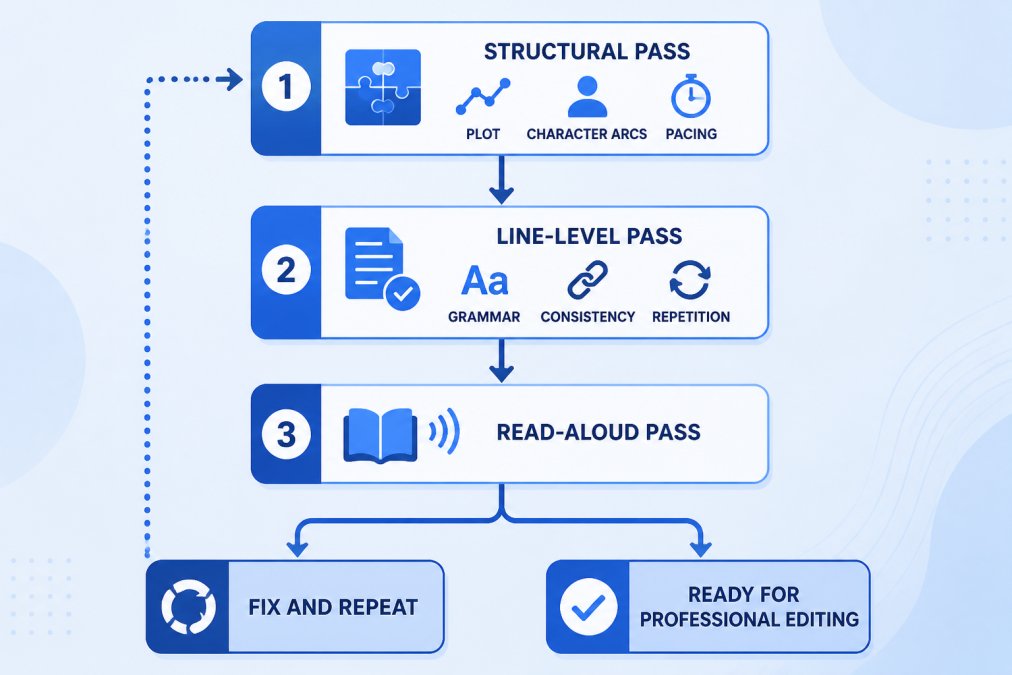
The manuscript self-editing checklist is the longest part of your document, and it should be split into distinct passes. Do them separately, in order. Trying to fix commas while restructuring a chapter is how writers stall for months.
A workable structure is four passes, each with its own short list of questions. You run one pass, fix what it surfaces, then move to the next. You do not loop back until the read-aloud pass is done.
Pass 1: Structural and Story-Level Checks
This pass is about whether the book works as a book. Read the whole manuscript in as few sittings as you can manage, and resist the urge to correct anything at sentence level.
- Does every scene change something? If a scene ends where it began, cut it or fold its useful content into a neighbouring scene.
- Does each main character want something specific, and does that want drive the plot rather than sit alongside it?
- Does the midpoint genuinely raise the stakes, or does it just mark the page count?
- Does the ending resolve the central problem you set up on page one?
- Are there subplots that never touch the main story? Either weave them in or remove them.
- Is any chapter doing the same job as the one before it?
Pass 2: Line-Level and Consistency Checks
Now you work sentence by sentence, but still against a list rather than by feel.
- Search for your crutch words and cut half. Most writers have three or four they lean on without noticing.
- Check names, places, and timeline dates against your style sheet. Inconsistency here is the single most common thing a copy-editor flags.
- Read dialogue aloud. Anything you stumble over gets rewritten.
- Confirm point of view stays consistent within each scene.
- Check that your tense holds. Drifting between past and present is easy to miss across a long draft.
- Verify that chapter lengths are roughly even, unless a short chapter is doing deliberate work.
Pass 3: The Read-Aloud Pass
Read the whole thing aloud, or use a text-to-speech tool. This catches rhythm problems, repeated sentence openings, and dialogue that only looks natural on the page. It is slow. It is also the pass that most reliably improves a manuscript.
Pass 4: The Formatting and File Pass
Before you call the manuscript done, confirm the boring things: consistent heading styles, no stray tracked changes, no comments left in the file, and a single font throughout. This pass exists so that the technical checks later in this article are not the first time you look at your file's structure.
Knowing When to Stop
A checklist is only useful if it has an end. A reasonable rule: when a full pass surfaces nothing but preferences, word choices you could argue either way, you are done self-editing. Further passes at that point are procrastination dressed as diligence, and they delay the professional edit that will actually move the book forward.
Step 2: How to Prepare a Manuscript for Professional Editing
Learning how to prepare a manuscript for professional editing comes down to one rule: fix what you can see, then hand over a clean file. Editors charge for their expertise, not for tidying typos you could have caught yourself.
What to Fix Before You Hand It Over
Run a spellcheck, apply your style sheet, resolve any structural notes you've been avoiding, and format consistently with double spacing and a standard font. Then write a one-page brief covering genre, audience, and the three things you're least sure about. A common mistake is sending an editor a first draft with no context. You'll get generic feedback and pay full rate for it.
Step 3: Book Formatting Requirements for Self-Publishing
Book formatting requirements for self-publishing differ by format. Print needs a trim size, margins, and bleed set correctly. Ebooks need reflowable text with no fixed page breaks. Get the interior right before you commission cover art, because spine width depends on final page count.
| Format | Key Requirement | Common Mistake |
|---|---|---|
| Print (paperback) | Trim size, gutter margin, bleed | Wrong spine width on cover |
| Ebook | Reflowable text, linked contents | Manual page breaks |
| Large print | Larger body text, wider leading | Reusing standard margins |
Step 4: The Technical File Validation Checklist
Technical file validation is the step most indie authors skip, and it's the one that gets books rejected at upload. Before you submit anywhere, open your final file and confirm:
- Fonts are embedded or converted to outlines
- Images are at print resolution, not screen resolution
- No RGB colour in a print file
- Table of contents links work in the ebook version
- Cover file meets the retailer's size and ratio rules
- File opens cleanly on a device you don't own
Step 5: Legal, Tax and Copyright Compliance for Indie Authors
This is the section most guides skip entirely, and it is the one where a mistake is expensive to undo. Treat it as a checklist in its own right.
Copyright: What Is Automatic and What Is Not
Copyright in your work is automatic once it is written down in material form. You do not need to register it to own it. What registration gives you is a formal record of authorship and date, which is useful if you ever need to enforce your rights or prove priority.
In practice, the steps that matter for most indie authors are:
- Keep dated drafts. Your file naming convention from earlier in this article is doing double duty here.
- Understand that copyright covers your text, not your title or your ideas. Titles are generally too short to attract copyright.
- If you use anyone else's material, quotations, song lyrics, images, maps, confirm you have permission or a licence before publication. This is the most common source of takedown requests.
- If you commission cover art or illustrations, get the assignment of rights in writing. Paying for artwork does not automatically transfer copyright.
official copyright authority guidance
Business Structure: Why It Matters Before You Earn
Most authors start as a sole trader, which is the simplest arrangement and requires no separate registration beyond a business number if you are trading under a name. As royalties grow, some authors move to a company structure for liability and tax reasons. The right answer depends on your circumstances, and it is worth a conversation with an accountant before you commit either way. What matters for the checklist is that you make the decision deliberately rather than by default.
Tax: Recording Income and Claiming Expenses
Royalties are income. Distributors may withhold tax on payments depending on your residency and the forms you file, so it is worth understanding what you have submitted before your first payment arrives.
- Keep every royalty statement. They are your primary record.
- Track deductible expenses as you go: editing, cover design, formatting, software, and any paid promotion.
- Set aside a portion of royalties for tax rather than spending them and reconciling later.
- If you sell through international platforms, check whether any foreign tax has been withheld and whether you can claim it back.
tax guidance for small business
Distribution and Retailer Requirements
Every distributor and retailer has its own terms. Before you upload, confirm:
- Whether the platform requires you to hold the rights to distribute in every territory you have selected.
- Whether you have agreed to exclusivity anywhere, because that limits where else you can sell.
- What the platform's policy is on returns, pricing changes, and removing a title.
- Whether you need to supply tax or identity documentation before payments are released.
A Simple Compliance Checklist
- Dated drafts retained
- Third-party permissions confirmed in writing
- Cover and illustration rights assigned in writing
- Business structure decided deliberately
- Royalty records kept from the first payment
- Expenses tracked as they occur
- Distributor terms read before upload
- Tax documentation submitted where required
Step 6: Budgeting, ROI Tracking and Post-Launch Maintenance
Track what you spend and what comes back, or you'll never know whether the next book should be marketed differently. Keep a simple spreadsheet: editing, cover, formatting, and any paid promotion in one column; royalties in another.
Post-launch maintenance matters more than most authors expect. Broken retailer links, outdated back-matter, and a stale book description all quietly cost sales. Schedule a review every six months.
For writers who want structure rather than guesswork, writeinspire's creative writing coaching programs pair a manuscript checklist with ongoing feedback, so you're never editing in the dark.
If you'd like to see how this works in practice, writeinspire's Writer Coaching & Guided Resources gives you a working writer's support system, and [the 90-Minute Draft Method helps you build momentum when the blank page](/products/the-90-minute-draft-method-ambition) wins.

Frequently Asked Questions
What should be included in a manuscript self-editing checklist?
A strong self-editing checklist covers three passes. First, structural checks: does every scene advance the plot, do character arcs resolve, is pacing consistent? Second, line-level checks: grammar, tense consistency, repeated words, dialogue tags. Third, a read-aloud pass to catch awkward phrasing. Add a final check for chapter numbering, scene breaks and consistent formatting before you move to professional editing.
How do I prepare my manuscript for professional editing?
Complete your own self-editing pass first so your editor focuses on craft, not typos. Format the document with double spacing, a standard font, page numbers and clear chapter headings. Write a short synopsis and character list for context. Flag any passages you are unsure about. This preparation means your editor spends time on structure and style rather than basic cleanup, which gives you better value from every editing hour.
Should indie authors use a checklist for manuscript formatting?
Yes. Formatting requirements differ between ebook and print, and between retailers. A checklist stops you from missing trim size, margin, bleed or embedded-font requirements. For ebooks, check reflowable text, hyperlinked table of contents and no fixed page breaks. For print, check trim size, gutter margins and resolution of any images. Validate your final file with a previewer before uploading to any distribution channel.
How do indie authors publish books and stay compliant with legal requirements?
Indie authors typically publish through print-on-demand or ebook distribution platforms. Before you upload, register your copyright, apply for an ISBN if you want bookstore and library distribution, and understand your tax obligations on royalties. Keep records of every expense for deductions. A checklist that includes legal and tax steps prevents costly problems after launch, when fixing metadata or ownership issues becomes far harder.
Finishing a manuscript isn't about talent; it's about having a sequence you trust when motivation runs out. writeinspire has spent three decades helping writers build exactly that, through personalised coaching, manuscript development support, and structured programs that treat you as a working writer rather than a customer. Get started with writeinspire and turn your checklist into a finished book.