

Table of Contents
- Why YA Needs Its Own Outlining Approach
- Start With Voice, Stakes and Audience
- Choose Your YA Novel Plot Structure Template
- Build Your Outline Step by Step
- Young Adult Fiction Word Count Guidelines by Sub-Genre
- Pacing Techniques for Young Adult Novels
- The Best Outlining Tools for Fiction Writers
- Common Outlining Mistakes and How to Fix Them
- Frequently Asked Questions
Last Updated: September 15, 2026
Why YA Needs Its Own Outlining Approach
Learning how to outline a novel for young adult fiction starts with one truth: YA readers demand a pace that adult fiction can take its time building toward. At writeinspire, we've spent over 30 years coaching writers through manuscript development, and the outlines that fail most often are the ones borrowed wholesale from adult fiction. A YA novel needs a protagonist whose internal world is still forming, stakes that feel enormous because they are enormous to a teenager, and a first chapter that hooks before the reader's attention drifts. Get the outline right and the draft almost writes itself. Get it wrong and you'll revise for years.
Start With Voice, Stakes and Audience
Voice is the single hardest element to retrofit into a YA manuscript, so build it into the outline before you write a word. Ask three questions: Who is telling this story, what do they want more than anything, and what are they afraid to lose? The answers shape every scene that follows.
A common mistake is outlining plot beats before you know how your protagonist sounds. In practice, this means you write a technically sound structure that reads flat. Jot a page of your protagonist's unfiltered thoughts first, then let that voice colour the outline itself.
Stakes in YA are personal, not global. Saving the world matters less than surviving the school term with your friendships intact. Outline the emotional cost of every beat, not just the external event.
Choose Your YA Novel Plot Structure Template
Most outlining guides hand you one template and wish you luck. That approach falls apart in YA because a contemporary romance and a portal fantasy need completely different scaffolding. The template should follow the sub-genre, not your personal comfort zone.
Here is how the three most reliable structures map onto common YA categories.
Three-act structure, best for contemporary, romance and issue-driven YA. The inciting incident should land by the end of chapter three, and the midpoint reversal should change the protagonist's understanding of a relationship or a truth about themselves, not just their external situation. A quiet contemporary might run 20-24 chapters across the three acts, with the second act carrying the emotional weight and the third act resolving the internal arc.
Hero's journey, best for fantasy, speculative and dystopian YA. The ordinary world needs to feel genuinely ordinary before the call to adventure, because teen readers need to understand what the protagonist is leaving behind. The ordeal and the reward map neatly onto the YA pattern of a costly victory that forces the protagonist to grow up. Expect a longer second act here, often 30-40 chapters, because world-building and quest beats need room to breathe.
Save the Cat beat sheet, best for thriller, mystery and high-concept YA. Its 15 beats give you tight pacing control, which matters when every chapter needs to end on a hook. The "fun and games" section is where you showcase the premise, and the "all is lost" beat should hit around the 75% mark to leave room for a satisfying third-act climb.
Whichever template you pick, map it to a chapter outline before you draft. A beat sheet tells you what happens; a chapter outline tells you where it happens, and that is what exposes pacing problems early. If your chosen structure has a beat landing in the wrong chapter for your sub-genre, you have found a problem worth fixing before you write a single scene.
Build Your Outline Step by Step
Building a YA outline is a sequence, not a single sitting. Work through these four steps in order and you'll have a draft-ready roadmap.
Step 1: Write the One-Sentence Premise
Capture your entire story in one sentence: a protagonist, a goal, a conflict, and a consequence. If you can't, the idea isn't ready to outline yet.
Step 2: Map the Emotional Arc Before the Plot
List how your protagonist changes from first page to last. Every plot beat should push that internal arc forward. Emotional stakes drive YA more than external goals.
Step 3: Place Your Story Beats
Drop your chosen structure's beats onto a chapter outline. Mark the inciting incident, rising action, climax and resolution, then check that tension never flatlines.
Step 4: Draft the Query Letter as Your Outline Test
Write the query letter before the manuscript. If the premise, stakes and character arc don't hold together in a few paragraphs for a literary agent, they won't hold together across a full draft.
Young Adult Fiction Word Count Guidelines by Sub-Genre
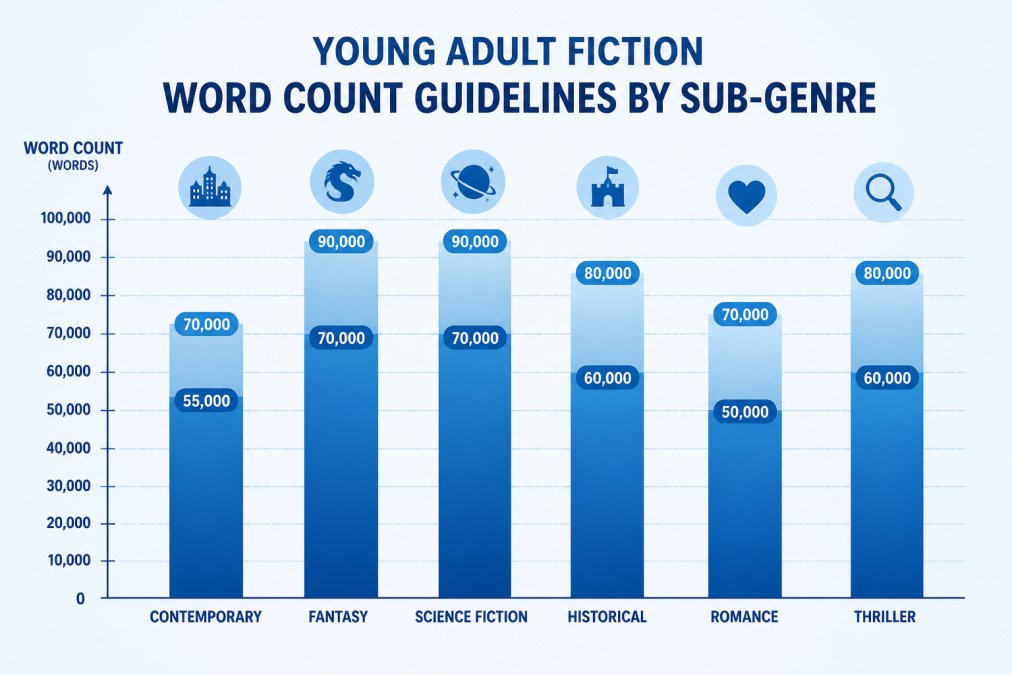
Young adult fiction word count guidelines vary sharply by sub-genre, and outlining to the wrong length wastes months. Contemporary YA typically runs shorter, while fantasy and science fiction carry more world-building and run longer. Outline your chapter count against these ranges so your pacing stays honest.
| Sub-Genre | Typical Word Count | Outline Focus |
|---|---|---|
| Contemporary | 55,000-70,000 | Emotional arc, tight beats |
| Fantasy | 70,000-90,000 | World-building, quest structure |
| Science fiction | 70,000-90,000 | Concept, escalating stakes |
| Historical | 60,000-80,000 | Period detail, character growth |
| Romance | 50,000-70,000 | Relationship beats, internal conflict |
| Thriller | 60,000-80,000 | Pacing, cliffhangers |
Pacing Techniques for Young Adult Novels
Pacing techniques for young adult novels come down to chapter endings and scene economy. End chapters on a question, a decision or a reveal, never on a tidy resolution. YA readers keep turning pages for momentum, not description.
Watch for the saggy middle, where rising action stalls. Fix it by cutting any scene that doesn't change your protagonist's situation or understanding. If a scene could be removed without consequence, it's slowing your pacing.
The Best Outlining Tools for Fiction Writers
The best outlining tools for fiction writers split into two camps: digital and analogue. But the real question for YA writers is not which tool is best in general, it is which tool helps you see the emotional arc and the plot arc side by side, because YA lives or dies on how those two lines intersect.
Scrivener lets you build a corkboard of scene cards and colour-code them by POV, sub-genre beat or emotional intensity. For YA, the useful move is to create a custom metadata field for "emotional beat" and tag each card with what the protagonist is feeling, not just what is happening. When you view the corkboard, you can spot a run of low-intensity cards and fix the sag before it reaches the draft.
Plottr is built around visual timelines, which suits YA because you can lay plot beats and character arcs on parallel tracks. A common pattern is to run one track for the external plot and one for the internal arc, then check that every major plot turn also moves the internal line. If a plot beat does not shift the protagonist's emotional state, it is probably a scene you can cut or merge.
Notion works well if you prefer a database approach. You can build a table with columns for chapter number, POV, plot beat, emotional beat, word count target and sub-genre convention, then filter and sort to check pacing across the whole novel. It is less visual than Scrivener or Plottr but more flexible if you like to query your own outline.
Analogue methods, index cards, whiteboards, sticky notes on a wall, still work, and they suit writers who think spatially.
Common Outlining Mistakes and How to Fix Them
Frequently Asked Questions
Is 60,000 words enough for a YA novel?
Yes, for most contemporary young adult fiction. Contemporary YA typically sits between 55,000 and 70,000 words, so 60,000 is comfortably within range. Fantasy and science fiction run longer, often 70,000 to 90,000 words, because of world-building. If your manuscript lands at 60,000 and the story feels complete, you are in good shape. Check that your plot structure and pacing hold up before adding words just to hit a number.
What are the essential plot beats for a young adult novel?
Most YA outlines include an inciting incident that disrupts the protagonist's world, a first plot point where they commit to action, a midpoint shift that raises emotional stakes, a climax where the internal and external conflicts collide, and a resolution showing who the protagonist has become. The character arc matters as much as the plot beats. Map both on the same timeline so every external event forces an internal change.
What are the best outlining tools for fiction writers working on YA?
Digital tools help, but the method matters more. Scrivener suits writers who want to rearrange scenes and keep research in one place. Plottr and Milanote work well for visual storyboarding. For a structured approach, the Creative Story Mastery modules walk you through finding a story, developing it, building characters, and shaping scenes, which gives you a framework before you open any software.
How do I maintain pacing throughout a YA manuscript?
Vary chapter length and end scenes with unresolved tension. YA readers expect momentum, so cut scenes that repeat information or delay the next decision. Use a pacing chart to track tension across your outline: mark where the story slows and where it accelerates. If three consecutive chapters carry the same emotional weight, one of them needs a complication, a reversal, or a reveal.