

Table of Contents
- What a Novel Structure Coach Actually Does
- Writing Coach vs Developmental Editor: Which Do You Need?
- How a Coach Diagnoses a Sagging Middle and Narrative Flow
- Novel Outline Templates for Beginners (And How to Adapt Them)
- How to Fix Plot Holes in a Novel Without Rewriting Everything
- How Long Does It Take to Edit a Novel With a Coach?
- Conclusion: What Structural Coaching Is Worth to Your Manuscript
- Frequently Asked Questions
Last Updated: September 14, 2026
What a Novel Structure Coach Actually Does
Improving your novel structure with a coach means working with someone who reads your manuscript the way a builder reads a set of plans, checking that every beam carries its weight before the walls go up. At writeinspire, we help writers turn half-finished drafts into manuscripts that hold together from first page to last. A structure coach doesn't rewrite your book or hand you a template to fill in. The job is to help you see the shape of your own story clearly, then give you the tools to fix what isn't working.

That distinction matters, because most writers who stall out don't have a writing problem. They have a structure problem they can't name yet.
A novel structure coach is a writing professional who specialises in the architecture of story: how your narrative arc builds, where tension rises and falls, whether your chapters earn their place, and whether your ending delivers on the promise your opening made. Unlike a general writing group, a coach works to an agreed plan with you, session by session.
What most guides miss is that structure coaching is diagnostic before it's prescriptive. A good coach reads your draft looking for the load-bearing walls, not the wallpaper.
Inside a Coaching Session: What Happens in the First Hour
The first session usually starts with questions, not edits. A coach will ask what you're trying to say, who the book is for, and where you feel it's breaking down. From there, most sessions move through three phases: a structural read of the pages you've submitted, a discussion of the story beats that aren't landing, and a set of concrete tasks for the next stretch of drafting.
Expect to leave with writing goals you can act on that week.
Writing Coach vs Developmental Editor: Which Do You Need?
The difference comes down to teaching versus treatment. A developmental editor assesses your finished manuscript and delivers a report or a marked-up draft: here's what's broken, here's how to fix it. A writing coach works alongside you while you fix it, building your skills.
What most guides skip is that the two roles often overlap in practice, and the right choice depends less on the label than on three questions: how complete is your draft, how well can you already diagnose your own work, and what do you want to be true after the process ends?
| Your Situation | Best Fit | Why |
|---|---|---|
| Complete draft, need assessment | Developmental editor | Manuscript assessment against publishing standards |
| Mid-draft, stuck on structure | Writing coach | Works with you while you revise |
| First novel, learning craft | Writing coach | Builds skills for future books |
| Polished draft, line-level fixes | Copy editor | Grammar, style, consistency |
| Third draft, still not landing | Coach first, then editor | Coach helps you see the pattern; editor confirms the fix |
The Genre Twist Nobody Mentions
Structural needs shift by genre, and that changes which professional you want first.
- Thriller and crime: pacing is the structure. A coach who reads for escalation and reveal spacing will catch a sagging middle faster than a general editor, because the problem is usually a beat that arrives too early or too late.
- Romance: the emotional arc is the structure. The meet-cute, the dark moment, and the reconciliation each need to land at specific points, and a coach can help you feel where the beats are misfiring.
- Memoir and literary fiction: the through-line is the structure. These manuscripts often fail because the theme is buried, not because the plot is broken, and a coach is better placed to ask the questions that surface it.
- Fantasy and science fiction: the world-building is the structure. A coach helps you decide what the reader needs to know, and when, so the rules of your world don't crowd out the story.
A developmental editor can absolutely work in any of these genres, but the coaching conversation is where the writer learns to spot the pattern themselves.
When Coaching Beats an Edit (and When It Doesn't)
Coaching can be highly effective when the problem is recurring. If you've written three drafts and the same structural issue keeps showing up, a weak midpoint, a passive protagonist, a subplot that goes nowhere, an edit fixes this book, but coaching can help address the underlying pattern.
An edit beats coaching when the manuscript is genuinely finished and you need a professional verdict before submission. At that point, more teaching won't help; you need a reader who can tell you what's working and what isn't.
Many writers eventually use both, and in that order. Coaching first can help you arrive at the edit with a manuscript that's more structurally sound, and you may understand the editor's notes more deeply.
How a Coach Diagnoses a Sagging Middle and Narrative Flow
The muddy middle is the most common structural failure in unpublished manuscripts, and it's almost never a pacing problem on its own. It's a consequence of the midpoint shift being too weak, so the second act has nothing to push against.
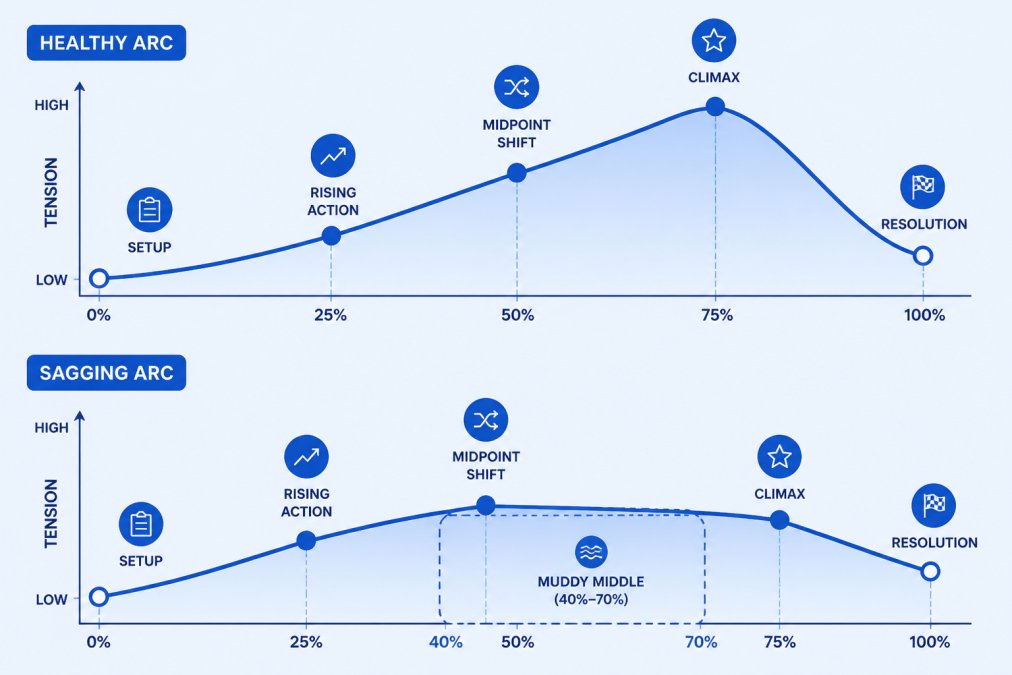
A coach reads for narrative flow by tracking three things: does each scene change something, does the protagonist's goal sharpen or shift, and do the stakes escalate rather than repeat. When tension flatlines across a long stretch, the fix is usually structural rather than cosmetic. Adding a subplot won't help if your protagonist has no reason to keep going.
A Structural Audit You Can Run Before You Book
- Write one sentence per chapter describing what changes
- Mark where your midpoint shift lands (aim for roughly halfway)
- List every scene where nothing changes for the protagonist
- Check whether your ending answers the question your opening posed
- Note any character who disappears for more than three chapters
If more than a quarter of your chapters show no change, that's your sagging middle, named and located. If you'd rather not guess, a writing consultation can give you an outside read before you commit to a longer program.
Novel Outline Templates for Beginners (And How to Adapt Them)
Novel outline templates for beginners work best as scaffolding, not scripture. The three-act structure, the hero's journey, and the seven-point story structure all describe the same underlying rhythm: a character wants something, faces escalating resistance, and is changed by the attempt. Pick the one that matches how your brain already thinks about story, then adapt it to your genre.
Here's what each one actually asks you to do:
- Three-act structure: Divide your story into setup, confrontation, and resolution. The first act ends when the protagonist commits to the goal. The second act ends at the lowest point. The third act resolves the question the opening posed. Simple, flexible, and the backbone most other templates are built on.
- Hero's journey: Twelve stages, from the ordinary world through the ordeal to the return. Useful for quest-driven stories and anything with a strong transformation arc. The risk is that it can feel formulaic if you follow it too literally.
- Seven-point story structure: Seven beats, hook, plot turn one, pinch one, midpoint, pinch two, plot turn two, resolution. Tighter than the hero's journey and popular with writers who like a clear checklist.
Adapting Templates by Genre
This is where most beginner guides stop, and it's the part that actually matters. A template gives you the beats; your genre tells you where to place them and how much weight each one carries.
- Thriller: The midpoint needs to be a genuine reversal, not just a new piece of information. Pinch points should tighten the noose. If your midpoint doesn't change what the protagonist is willing to do, the second half will sag.
- Romance: The beats are emotional, not plot-driven. The meet-cute, the first kiss, the dark moment, and the grand gesture each need to land at roughly the right page count, or the payoff feels unearned.
- Memoir: The template is your own life, which means the structure comes from theme, not chronology. Most memoir drafts fail because they follow events in order rather than following the question the writer is trying to answer.
- Fantasy and science fiction: The world-building is a character. Templates help you decide when to reveal the rules, but the genre rewards a slower first act than a thriller would allow.
- Literary fiction: The three-act structure still applies, but the acts are often defined by internal change rather than external event. A slower opening is acceptable if the voice and the question are strong enough.
A Simple Way to Test Your Template Choice
Before you commit to a template, write one sentence per beat and read them aloud. If the beats sound like a plot summary, the template is doing the work and your story isn't. If they sound like a story you'd want to read, you're on the right track.
Templates give you a book roadmap; your genre tells you where to put the corners. A coach can help you see which corners your story actually needs, and which ones you can cut.
How to Fix Plot Holes in a Novel Without Rewriting Everything
Most plot holes aren't gaps in logic. They're gaps in motivation, where a character acts because the plot needs them to rather than because they would. Fixing them rarely requires a full rewrite. It requires tracing the thread back to where it snapped.
Start by writing down the moment the hole becomes visible, then work backwards to the earliest scene where a small change would prevent it. Often a single added line of dialogue, a shifted detail, or a scene moved two chapters earlier closes the gap. Structural editing at this level is surgical, not demolition.
A coach earns their keep here, because spotting your own plot holes is genuinely hard. You know what you meant, which is exactly why you can't see what's missing on the page.
How Long Does It Take to Edit a Novel With a Coach?
How long it takes to edit a novel with a coach depends on the state of your draft and how much time you can give it each week. A writer with a complete but structurally shaky manuscript might spend three to six months in coaching. Someone drafting from scratch while learning craft should expect longer.

The honest answer is that it varies. What coaching does control is momentum: regular sessions and writing milestones keep a manuscript moving when life gets busy.
If you've got a half-finished draft sitting in a drawer, that's not a reason to start over. It's a manuscript waiting for a structural read.
Conclusion: What Structural Coaching Is Worth to Your Manuscript
The real value of improving your novel structure with a coach isn't a cleaner outline. It's the support to finish. Writers who understand story structure can often better identify problems and what to do about them.
At writeinspire, our Writing Coaching & Guided Resources pairs you with ongoing support built around your schedule, while our Creative Story Mastery program teaches the craft fundamentals that make structural coaching stick. You bring the story you can feel in your bones. We'll help you build it so it stands.
Get started with writeinspire and turn the manuscript in your drawer into one that's publishing-ready.
Frequently Asked Questions
How can a writing coach help fix a sagging middle in my novel?
A sagging middle usually means the stakes stop rising and the protagonist stops making decisions that cost them something. A coach maps your story beats against the narrative arc, finds where momentum drops, and rebuilds the middle around a midpoint reversal, escalating obstacles and a clearer goal. You leave each session with specific scenes to add, cut or reorder, not vague encouragement. Most writers find two or three targeted sessions are enough to expose why the middle stalls and what to do about it.
What is the difference between a writing coach and a developmental editor?
A developmental editor assesses a finished draft and delivers a report on structure, pacing and plot holes, then steps back. A writing coach works alongside you while you draft, asking questions, setting writing milestones and teaching craft so you can solve structural problems yourself. Many authors use coaching during drafting and bring in an editor once the manuscript is complete. If your draft is finished and you want an outside verdict, an editor fits. If you are stuck mid-manuscript, coaching keeps you moving.
How do I know if my novel structure is ready for a coach?
You do not need a polished draft to start. Coaches work with everything from a one-page premise to a complete manuscript. What matters is that you can describe your protagonist, their goal, the central conflict and roughly how the story ends. If you can explain those four things, a coach can help you build or repair the structure around them. If you cannot, that is exactly the first conversation worth having.
How long does it take to edit a novel with a coach?
It depends on the state of the draft and how much time you can give it. A structural pass on a complete manuscript often takes several weeks of sessions plus your own revision time between them. If you are drafting from scratch, expect months rather than weeks, because you are writing new material as well as fixing old. Writers with an hour or two a week can still make steady progress when each session ends with a clear, small next step rather than a mountain of notes.