

Table of Contents
- Why Multi-POV Novels Fail (and How to Fix It)
- Step 1: Define Your Narrative Scope and POV Cast
- Step 2: Map Your Multi-POV Novel Structure with Examples
- Step 3: Best Practices for Switching Perspectives in Fiction
- Step 4: How to Keep Track of Multiple Character Arcs
- Step 5: Use Tools for Outlining a Multi-Perspective Book
- Common Pacing Pitfalls and How to Avoid Them
- Your Editing Checklist for POV Consistency
- Frequently Asked Questions
Last Updated: September 7, 2026
Why Multi-POV Novels Fail (and How to Fix It)
Most first attempts at a multi-POV novel collapse under their own weight. The writer juggles several narrators, loses track of who knows what, and the middle turns into a muddle. The failure is rarely about talent. It is usually about structure.
A multi-POV novel follows two or more point-of-view characters through alternating chapters or sections. The technique creates dramatic irony, broadens the story world, and builds tension. When it works, it feels effortless. When it does not, readers put the book down.
The good news is that the problems are predictable, which means they are solvable. The fix is almost always the same: decide your scope first, map your structure second, and manage your cast with discipline.

Step 1: Define Your Narrative Scope and POV Cast
Before you write a single scene, ask yourself why this story needs more than one perspective. If one narrator could carry the plot, adding more only dilutes your focus. Multi-POV structures earn their place when the story world is too large for one character, or when the central conflict depends on characters holding different pieces of the truth.
A multi-POV novel is not the same as an omniscient narrator who dips into everyone's head at will. The best practice for switching perspectives in fiction is to commit to a limited third person or first person perspective, and to stay locked inside one POV character per scene.
Once you know you need multiple voices, limit the cast. A common mistake is assuming more narrators equals more depth. Readers need roughly a hundred pages with a character before they invest emotionally. If you rotate through six narrators in a 90,000-word manuscript, nobody gets enough page time to land.
Step 2: Map Your Multi-POV Novel Structure with Examples
Two structural templates handle the vast majority of successful multi-POV novels. Choosing one before you draft saves months of rewriting. But a template alone is not a plan, you need to know how the chapters actually fall into place.
The Braided Structure
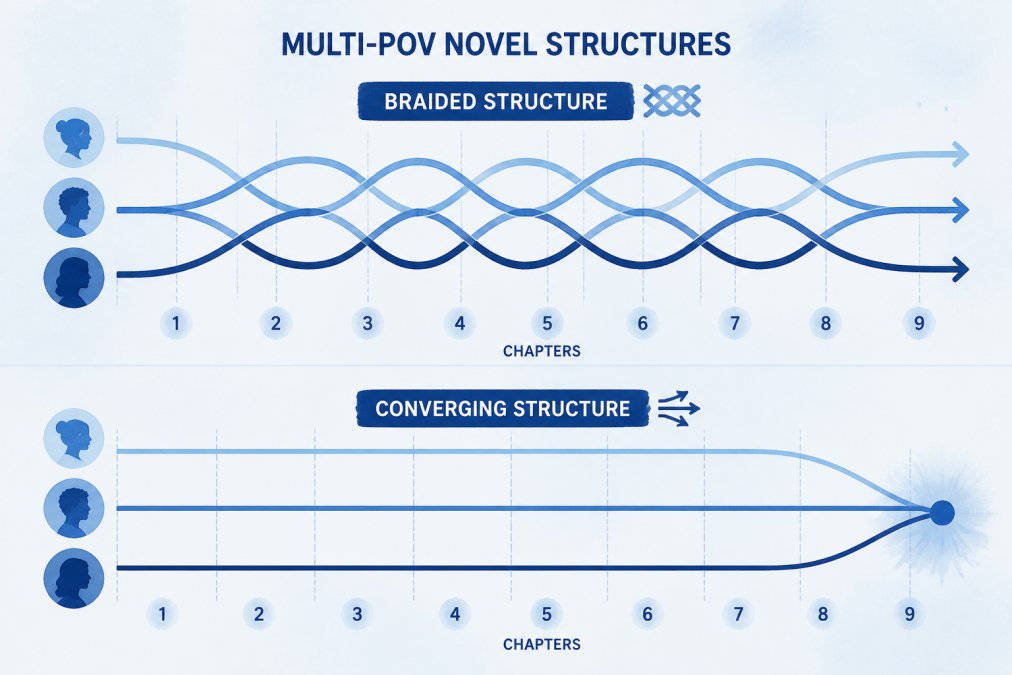
The braided structure alternates POV characters chapter by chapter, weaving their plot threads together. Each narrator experiences their own arc, but their stories intersect at regular intervals. This suits ensemble casts where characters share a world but pursue separate goals.
A typical braided pattern for a 90,000-word novel (roughly 30 chapters) looks like this:
| Chapters | POV Character | Story Function |
|---|---|---|
| 1-3 | Character A | Establish A's world and the inciting incident from their perspective |
| 4-5 | Character B | Introduce B's parallel situation; hint at connection to A |
| 6-8 | Character A | A reacts to the inciting incident; meets a secondary character who will matter later |
| 9-10 | Character C | Bring in the third thread; reveal information A and B do not yet have |
| 11-14 | A and B alternating | The threads begin to brush against each other; characters hear rumours about each other |
| 15-20 | All three rotating | The midpoint collision, characters finally meet or a shared crisis forces their paths to cross |
| 21-26 | A and B dominant | The consequences of the midpoint; C's thread feeds into the others |
| 27-30 | All three, faster rotation | The climax, each character plays a role in the final confrontation |
The key mechanism here is rotation speed. Early in the book, you can afford longer stretches with one character (2-3 chapters) to build investment. As you approach the climax, the rotation should tighten.
A useful rule of thumb: if a character disappears for more than five chapters in a braided structure, readers will start to forget why they care. If you need to step away longer, give them a memorable exit line or image that will linger.
The Converging Structure
The converging structure follows each POV character in longer, separate blocks before bringing them together for a shared climax. This works well when your characters start in different locations or worlds. The pacing challenge is keeping early sections alive when the payoff is chapters away.
A converging pattern for a 90,000-word novel might look like this:
| Chapters | POV Character | Story Function |
|---|---|---|
| 1-6 | Character A | Complete first act from A's perspective; establish the central mystery or goal |
| 7-12 | Character B | Parallel first act from B's perspective; the reader sees the same world from a different angle |
| 13-18 | Character A | Second act for A; the stakes rise and a crucial piece of information is uncovered |
| 19-24 | Character B | Second act for B; B discovers something that contradicts A's understanding |
| 25-28 | Alternating A and B | The threads converge, the characters meet, clash, or join forces |
| 29-30 | A and B together | The climax, told from whichever character has the most at stake in the final confrontation |
The risk in a converging structure is the block transition. When you switch from A's block to B's block after six chapters, you are asking the reader to reset their emotional investment. The fix is to end each block on a moment of high tension that keeps A's story alive while they spend time with B.
Choosing Between the Two
| Structure | Chapter Pattern | Best For | Risk |
|---|---|---|---|
| Braided | Alternating POV every 1-2 chapters | Ensemble casts, shared world | Losing momentum on slower threads |
| Converging | Long POV blocks (4-6 chapters) | Characters in separate locations | Sagging middle sections |
A third option exists, though it is less common: the frame structure, where one POV character narrates the present-day story while other perspectives appear only as flashbacks or embedded narratives. This works well for mysteries and literary fiction, but it places a heavy burden on the frame narrator.
Whichever structure you choose, sketch out the full chapter map before you write. You do not need to know every scene, but you should know which character owns each chapter and what job it does for the plot. This map becomes your navigation tool when the draft gets messy.
Step 3: Best Practices for Switching Perspectives in Fiction
Use Scene Breaks as Your Signal
Your reader should never have to guess whose head they are in. The cleanest signal is a chapter break, which gives you a fresh page to establish the new POV character by name and situation within the first paragraph. If you switch mid-chapter, use a scene break with a clear marker.
Head-hopping, sliding between characters' thoughts within a single scene, is different from intentional switching. It breaks narrative consistency and confuses readers about whose perspective governs the scene. Save the omniscient narrator for a story that genuinely needs that device.
Give Each POV a Distinct Voice
Character voice is what separates a readable multi-POV novel from a confusing one. Each narrator should have a recognisable vocabulary, sentence rhythm, and set of preoccupations. If you covered the names, readers should still know whose chapter they are reading.
A practical test: read one page from each POV character aloud. If you cannot tell them apart by sound alone, the voices need more work. This matters most when your characters share a background, since similar characters will naturally sound alike.
Step 4: How to Keep Track of Multiple Character Arcs
Tracking multiple character arcs is a logistics problem, and it deserves a logistical solution. Each POV character needs a documented goal, motivation, and conflict, both internal and external. Internal conflict comes from flaws and fears; external conflict arrives through plot events. Both must be present or the arc will feel flat.
Keep a running document for each narrator that records:
- Their goal at the start of the book and how it changes
- The lie they believe about themselves or the world
- The moment their arc turns
- What they have learned by the final chapter
Plot threads also need tracking. Note which characters know which secrets at any given point. Readers will forgive many things, but they will not forgive a POV character withholding information they clearly learned three chapters earlier.
Step 5: Use Tools for Outlining a Multi-Perspective Book
A multi-POV outline is a working document, not a prison. The most effective tool is a chapter-by-chapter spreadsheet with columns for POV character, setting, timeline, plot threads advanced, and character arc beats. This gives you a bird's-eye view of narrative balance at a glance.
Colour-coding helps. Assign each POV character a colour and fill in the chapter rows. You will immediately spot problems: one character disappearing for 200 pages, two narrators covering the same event from identical angles, or a middle section where no plot thread advances.
For writers who prefer a guided approach, structured coaching can make the difference between a promising outline and a finished manuscript. writeinspire's Creative Story Mastery story development module walks you through shaping narrative arcs and organising ideas into a framework that serves both writer and reader, while the character development module helps you build narrators with genuine depth. If you want personalised feedback on your structure, a one-on-one writing consultation lets you discuss your POV plan directly with an experienced coach.

Common Pacing Pitfalls and How to Avoid Them
Multi-POV novels have a pacing problem that single-narrator books avoid: every time you switch perspectives, you reset the reader's investment. The fix is to end each POV section on a story beat that creates tension, a question, a threat, or a revelation that makes the reader want to return.
Another common issue is the "chronological reset", where a new POV chapter re-covers ground the reader has already seen. Revisiting a scene from a second perspective can work, but it must reveal new information that changes the reader's understanding. If the second pass adds nothing, cut it.
Watch your middle sections. With multiple plot threads, the temptation is to advance each one a little in every chapter, producing a book where nothing moves very far. Instead, let some threads rest while others surge forward. Narrative scope is about depth as much as breadth.
Your Editing Checklist for POV Consistency
When you finish the draft, editing for POV consistency requires a dedicated pass. Work through the manuscript with this checklist:
- Every scene stays locked inside one POV character from opening to close
- The POV character is identifiable within the first two paragraphs of each chapter
- No information appears that the POV character could not know or reasonably infer
- Each narrator's voice remains distinct in vocabulary and rhythm
- Every POV character has both an internal conflict and an external goal
- No character disappears for more than a third of the book without a reason
- Chapter breaks and scene breaks clearly signal every perspective shift
- The final chapter resolves or deliberately leaves open each narrator's character arc
Work through the list one item at a time, from the first page to the last. This pass is tedious, but it is the difference between a manuscript that feels like a single story told by many voices and one that feels like several stories stapled together.
The Three Most Common POV Errors (and How to Spot Them)
A checklist tells you what to look for, but it helps to know the specific errors that trip up most writers. Here are the three patterns we see most often, along with diagnostic questions to catch them.
1. The Leaky Narrator
This happens when your POV character knows something they have not learned yet. It is rarely blatant, more often it appears as a subtle turn of phrase. Your character might describe a stranger as "nervous" when they have no way to know that, or reference an event that happened off-page.
Diagnostic question: For every scene, ask yourself: what does this character know right now, and how did they learn it? If the answer involves information from another character's private scene, you have a leak.
2. The Camera Cut
This is the opposite problem. The scene stays in one character's head, but the narration briefly dips into another character's reaction, a raised eyebrow, a private thought, a feeling the POV character could not perceive. It often happens in dialogue scenes.
Diagnostic question: Underline every sentence that describes what a non-POV character is thinking or feeling internally. If you cannot rewrite it as something the POV character observes from the outside, it is a camera cut.
3. The Voice Slip
Each narrator should have a distinct vocabulary and rhythm. Voice slips happen when a character suddenly sounds like the author, or like another narrator. This is hardest to catch because it feels natural in the moment.
Diagnostic question: Read one full chapter from each POV character in sequence, without the chapter headings. If you cannot reliably tell whose chapter you are reading, the voices have merged.
A Two-Pass Editing Method
Rather than trying to catch everything at once, split your POV edit into two separate passes.
Pass One: The Knowledge Pass. Read the manuscript looking only for information errors. Track what each character knows at every point. Create a simple timeline of revelations and check that no character acts on knowledge they should not have. This catches leaks and continuity problems.
Pass Two: The Voice Pass. Read the manuscript aloud, one POV character at a time, reading only their chapters in sequence. This lets you hear the voice consistently without interruption. Mark any passage where the character sounds off, too formal, too casual, too much like another narrator.
When to Break the Rules
Every rule in the checklist has exceptions. Literary fiction sometimes uses an omniscient narrator who deliberately moves between heads within a scene, but this is a conscious craft choice, not an accident. If you break a rule, make sure it is intentional and consistent. A single accidental head-hop will pull readers out of the story; a deliberate omniscient voice maintained across the whole book is a different contract.
The test is whether the reader always knows whose experience they are sharing at any given moment. If they do, your structure is working. If they are ever unsure, the edit is not done.
Frequently Asked Questions
How many viewpoints is too many for a single novel?
For most novels, three to five viewpoint characters is a safe range. More than that and you risk shallow character development and a confused reader. Ask if each new perspective brings a unique piece of the plot or a different thematic lens. If two characters witness the same events and react similarly, combine them. The limit is less about a magic number and more about whether you can give each character a full, satisfying arc without bloating the word count.
What is the best way to transition between viewpoints in a novel?
The most reliable method is to use a clear scene break or a new chapter, then signal whose head you're in within the first sentence or two. This is a best practice for switching perspectives in fiction because it prevents head-hopping. Avoid switching mid-scene unless you are an experienced writer using it for a specific effect. Consistency in your transitions builds reader trust and keeps the narrative grounded.
How do you keep character voices distinct in a multi-POV story?
Focus on each character's vocabulary, sentence rhythm, and core concerns. A soldier might use short, direct sentences; a poet might think in metaphors. Give each one a specific goal and fear that colours how they interpret events. During editing, read each character's chapters in isolation to see if their voice holds up. If you could swap the names without noticing, you have a voice problem to fix.
Structuring a multi-POV novel is one of the hardest technical challenges in fiction, and most writers benefit from an experienced second pair of eyes on their outline before they invest months in a draft. That is exactly the kind of rigorous manuscript development writeinspire offers, with over 30 years of coaching experience behind every session. Get started with writeinspire and turn your tangled cast of narrators into a story readers cannot put down.