

Table of Contents
- What Narrative Structure Actually Does for Your Story
- How Structure Builds Reader Engagement and Emotional Impact
- Three-Act Structure Examples and How They Work in Practice
- The Role of Plot Points, Pacing, and Story Beats
- How to Outline a Novel Using Structural Frameworks
- Common Narrative Structure Mistakes Writers Make
- Choosing the Right Structure for Your Story and Genre
- Conclusion
- Frequently Asked Questions
Last Updated: September 4, 2026
Every novel, whether a sweeping literary epic or a tight genre thriller, is built on a backbone of deliberate choices about what happens when, and why. This is why narrative structure matters in novels: it is the invisible architecture that turns a sequence of events into a story with purpose and momentum. At writeinspire, we have spent over 30 years coaching writers, and we have seen countless promising manuscripts fail not because of weak prose, but because of a missing or muddled structural foundation. Without a clear framework, even the most beautiful sentences can leave a reader feeling lost rather than moved. This guide will show you exactly how structure works, why it is the difference between a draft that stalls and a manuscript that sings, and how to apply proven frameworks to your own work.
Narrative structure is the logical and emotional framework that organises a story's events into a coherent, engaging sequence. It is the difference between a random collection of incidents and a plot that builds toward meaning. When structure is working well, the reader barely notices it; they are simply carried along. When it is absent, they feel it immediately as confusion, boredom, or a sense that the story is going nowhere.
What Narrative Structure Actually Does for Your Story
Most writers think of structure as a constraint, a set of boxes to fill in. In practice, it is the opposite. A good structural framework provides the container that allows your creativity to flow freely, because you always know where you are in the story and what needs to happen next.
Structure serves three core functions. First, it establishes a logical flow of cause and effect, ensuring that each scene grows naturally from the one before it. Second, it manages the reader's emotional investment by controlling when information is revealed and when tension is released. Third, it provides the story backbone that carries thematic resonance, allowing you to make a point without stating it directly.
A common mistake is to confuse a plot outline with structure. An outline lists events; structure shapes how those events function in relation to one another. One scene might serve as the inciting incident that disrupts the status quo, while another acts as a moment of quiet reflection that deepens character transformation. Understanding the difference is the first step toward mastering storytelling craft.
How Structure Builds Reader Engagement and Emotional Impact
Reader engagement is not a mystery; it is a direct result of how well you manage tension and release. Structure is the primary tool for this management. It dictates when to raise the stakes, when to offer a breather, and when to deliver the emotional payoff that makes the journey worthwhile.
Consider the relationship between pacing and emotional impact. A story that rushes from one dramatic event to another quickly exhausts the reader's capacity for caring. A story that meanders without purpose loses them to boredom. Skilled structural planning creates a rhythm, alternating moments of high tension with scenes of character development and subtext, allowing the emotional impact of key moments to land with full force.

This is where the concept of the narrative arc becomes essential. The arc is the trajectory of emotional intensity over the course of the novel. It typically rises toward a climax and then resolves. When you map your scenes against this arc, you can see at a glance whether your pacing is too flat, too frantic, or perfectly balanced. This is also why structure is inseparable from plot development; the arc gives your plot its shape and its emotional meaning.
Three-Act Structure Examples and How They Work in Practice
The three-act structure is the most enduring and widely used story framework for good reason: it mirrors how humans naturally process narratives. It is the story framework that underpins most commercially successful novels and films, offering a reliable blueprint for narrative coherence.
Act One is the setup. It introduces the protagonist, their ordinary world, and the inciting incident that disrupts it. This incident forces the protagonist to make a choice that sets the central conflict in motion. By the end of Act One, the reader should understand what the story is about and what is at stake. Act Two is the rising action, the longest section, where the protagonist faces escalating obstacles. This act often features a midpoint reversal that raises the stakes and complicates the goal. Act Three delivers the climax, the final confrontation where the central conflict is resolved, followed by the denouement, which shows the new equilibrium and the character's transformation.
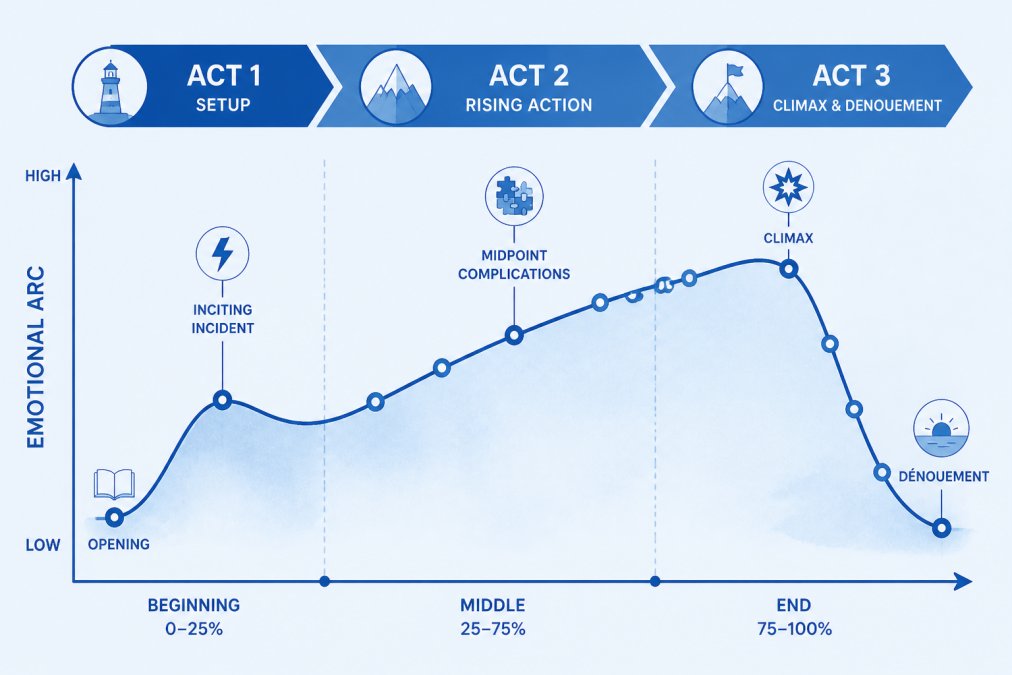
To see this in practice, consider a simple mystery novel. Act One introduces the detective and the crime. Act Two follows the investigation, with false leads and rising danger. Act Three is the confrontation with the culprit and the resolution of the case. The framework is flexible enough to accommodate any genre, yet it provides the structural integrity that keeps a story focused.
The Role of Plot Points, Pacing, and Story Beats
If the three-act structure is the skeleton, then plot points and story beats are the joints and muscles that allow it to move. Understanding how these elements work together is crucial for any writer aiming to strengthen their story's structural integrity.
Plot points are major turning points that shift the direction of the story. The first major plot point, often called the 'lock-in', ends the setup and forces the protagonist into the main conflict. The midpoint is another critical plot point, a major revelation or reversal that changes the protagonist's understanding of the problem. These moments are the hinges upon which the entire narrative turns.
Story beats are smaller, more frequent units of action. A single scene might contain several beats: a moment of realisation, a decision, a small conflict. Thinking in beats helps with scene construction, ensuring every scene has a purpose and a mini-arc of its own. This granular view is where foreshadowing and subtext are woven in, creating a sense of depth and cohesion that rewards attentive readers.

Pacing is the speed at which these beats and plot points unfold. A common structural mistake is to spend too long on setup and then rush the climax, or to place a high-tension scene where a quieter moment of reflection is needed. The best way to manage pacing is to be aware of the energy of each scene and to arrange them in a pattern that builds and releases tension deliberately.
How to Outline a Novel Using Structural Frameworks
Outlining is where theory becomes practice. This is how you translate an understanding of structure into a working document that will guide your drafting. A well-considered outline is not a cage; it is a map that prevents you from getting lost in the woods of your own imagination.
A practical method for outlining a novel is to start with the macro-structure and work down to the micro-detail. This approach ensures that your high-level narrative arc is sound before you invest time in writing scenes that may not serve the story.
- Define your ending. Know where your protagonist will end up emotionally and physically. This is your destination.
- Identify your major plot points. Working backwards from the ending, map the climax, the midpoint reversal, and the inciting incident. These are your four or five key structural pillars.
- Draft a scene list. For each act, brainstorm the scenes needed to move from one plot point to the next. Do not worry about order yet; just generate ideas.
- Arrange and sequence. Order your scenes for maximum pacing and logical flow. Look for places where tension lags and consider where a flashback or a subplot might add depth.
- Review for character transformation. Ensure your protagonist's arc is visible. What do they believe at the start, and how does each act challenge that belief?
This process, which we guide writers through in our structured coaching programs, turns the daunting task of writing a novel into a series of manageable decisions. For a quicker way to get from a blank page to a working draft, many of our writers use The 90-Minute Draft Method to generate momentum before applying a full structural outline. The goal is to make decisions about your story's architecture before you are deep in the prose, where changing course is costly and difficult.

Common Narrative Structure Mistakes Writers Make
Even with a solid understanding of theory, writers often stumble in predictable ways. Recognising these common narrative structure mistakes is the first step to avoiding them. The good news is that most structural problems are fixable in revision, provided you know what to look for.
One of the most frequent issues is a weak or delayed inciting incident. If the story takes too long to start, the reader loses interest before the central conflict is even introduced. Another common pitfall is a passive protagonist. If the main character is simply reacting to events rather than making decisions that drive the plot, the story will feel flat, regardless of how well the structure is plotted. The protagonist's choices, not the author's, should be the primary engine of the narrative.
A third major mistake is the 'sagging middle'. This occurs in Act Two when the writer is unsure how to escalate the conflict and instead fills the space with repetitive scenes or subplots that do not connect to the main narrative purpose. This is often where writers abandon manuscripts. Finally, many stories suffer from a rushed resolution. After spending hundreds of pages building tension, the climax and denouement feel rushed and unearned, leaving the reader unsatisfied.
Choosing the Right Structure for Your Story and Genre
While the three-act structure is a powerful default, it is not the only option. The best structure for your novel depends on your genre, your story's needs, and the experience you want to create for the reader. Choosing the right structure is a strategic decision that should serve your story's purpose.
Genre often carries strong structural expectations. A romance novel, for instance, typically follows a structure built around the meeting, separation, and reunion of the protagonists. A thriller, on the other hand, relies on a ticking clock and a series of escalating set-pieces. Readers of genre fiction have expectations, and meeting them is part of the contract you make with your audience. This does not mean you cannot innovate, but you should understand the rules before you break them.
For more literary or experimental work, you might consider non-linear structures. However, this is where the intersection of structure and reader cognitive load becomes critical. A non-linear narrative, using flashback or multiple timelines, demands more work from the reader to assemble the story. This can be a powerful tool for thematic resonance, but it requires meticulous planning to ensure the reader is not simply confused.
There are also several established alternatives to the three-act structure, including the hero's journey, the seven-point structure, and the five-act structure. The hero's journey, with its stages of departure, initiation, and return, is particularly suited to epic fantasy and adventure stories. When choosing a framework, consider what is best for the story you want to tell, not just what is popular. The goal is narrative coherence that serves the story, not a rigid formula that constrains it.
Conclusion
Mastering narrative structure is the single most effective way to transform a promising but unwieldy manuscript into a compelling novel. It is the difference between a story that meanders and one that moves with purpose, between a draft that stalls and a book that readers cannot put down. When you understand the role of plot points, pacing, and story beats, you are no longer guessing; you are making intentional choices that build toward a powerful emotional impact.
The challenge for most writers is not a lack of talent, but a lack of structured guidance to apply these principles to their own work. At writeinspire, we provide rigorous creative writing coaching and manuscript development support, building on over 30 years of experience to help you master the storytelling process from first spark to finished manuscript. Our Creative Story Mastery program walks you through story development and scene construction, ensuring your narrative has a solid foundation. Get started with a writing consultation and bring your story to life with a structure that works.
Frequently Asked Questions
What are the most common narrative structures used in fiction?
The three-act structure remains the most widely used framework, dividing your novel into setup, confrontation, and resolution. The hero's journey works well for adventure and fantasy stories, following a protagonist through call to adventure, trials, and transformation. Non-linear structures, using flashbacks, multiple perspectives, or parallel timelines, offer flexibility when your story demands it. The key is matching your structure to your genre, character arc, and the emotional journey you want readers to experience. Different genres favour different approaches: romance often follows a structure centred on relationship development, whilst thrillers typically use a tighter three-act model with accelerating tension.
Can a novel succeed without a traditional narrative structure?
Yes, but with caveats. Experimental novels, literary fiction, and some contemporary works deliberately reject traditional structures to create meaning through form itself. However, even non-linear narratives rely on underlying structural logic, they simply make readers work harder to find the pattern. The risk is that without clear story beats, rising action, or narrative coherence, readers may feel lost rather than intrigued. Most successful 'unstructured' novels still have intentional architecture; the author simply reveals it differently. For new writers, mastering traditional structure first gives you the foundation to break rules effectively later.
How does narrative structure influence reader engagement?
Structure controls pacing, tension, and emotional investment. When story beats land at the right moments, readers stay hooked because they sense forward momentum and rising stakes. A well-constructed narrative arc creates anticipation, readers want to know what happens next because the structure makes them care about the outcome. Poor structure, sagging middles, delayed inciting incidents, or unearned climaxes, kills engagement because readers lose faith in where the story is headed. Structure also shapes how readers process information and form emotional connections to characters. By controlling when readers learn key information and how characters transform, you guide their emotional response throughout the novel.
What's the difference between outlining and narrative structure?
Outlining is the practical tool; narrative structure is the framework. An outline lists scenes, plot points, and what happens in sequence. Narrative structure is the underlying architecture, how those scenes connect, build tension, and create meaning. You can outline a story without understanding its structure, which is why many writers feel their drafts lack direction. Structure answers the 'why' questions: why does this scene matter, why does the reader care, why does this moment create impact. When you understand narrative structure, your outline becomes intentional rather than just a checklist of events.
This article was written using GrandRanker