

Table of Contents
- Start With Your Story Idea
- Create a Structured Outline
- How Long Does It Take to Write a Book?
- Build Your Writing Routine
- How to Improve Fiction Writing Skills Step by Step
- Best Tools for Manuscript Organisation
- Book Writing Templates for Beginners
- Finish Your Manuscript and Move Forward
- Frequently Asked Questions
Last Updated: September 30, 2026
Start With Your Story Idea
Learning how to write a book begins with a spark. That spark might come from a personal experience, an overheard conversation, a "what if" question, or simply a character who won't leave your head. The challenge isn't finding the idea, it's recognizing which ideas are worth the months of work ahead.
The strongest story ideas share something in common: they explore a question or tension that genuinely fascinates you. Not what you think you should write about, but what you actually want to spend time with. A story idea doesn't need to be fully formed. It can start as a single image, a relationship dynamic, or a problem your protagonist faces. What matters is that it pulls at you.

Before you commit to writing a book, spend time with your idea. Write about it in a journal. Talk it through with someone you trust. Ask yourself: What's the core conflict here? Who does this story belong to? Why does this particular story need to exist? These aren't academic questions, they're the foundation that will keep you writing when motivation fades.
The Creative Story Mastery program guides you through this discovery phase, helping you move from a raw spark to a story premise with genuine structure and emotional weight.
Create a Structured Outline
An outline is not a cage. It's a map. And maps don't remove the journey, they just make sure you don't wander in circles for three months.
Many writers skip the outline step, convinced that planning kills creativity. The opposite is usually true. A solid outline gives you permission to be spontaneous within the structure. You know where the story needs to go, so you can focus on how to get there. You know what each scene needs to accomplish, so you can play with tone, dialogue, and surprise without losing momentum.
Your outline doesn't need to be elaborate. At minimum, identify your story's turning points: the inciting incident that upsets the status quo, the midpoint crisis that raises the stakes, and the climax where everything resolves. Between those anchors, sketch out the major scenes and what each one reveals about your characters or advances your plot.
A practical approach is to list your scenes as single-line summaries. "Sarah discovers the letter" or "The partnership falls apart" or "He makes his choice." This gives you a roadmap without locking you into specific dialogue or descriptions. As you write, you'll discover new details and moments, that's the creative part. The outline just ensures those discoveries serve the story.
How Long Does It Take to Write a Book?
The honest answer: it depends. But that's not helpful, so let's be more specific.
A typical novel manuscript takes between three months and two years to draft, depending on your word count goal, how much time you can dedicate to writing, and how clear your outline is. A 70,000-word manuscript written at 1,000 words per session would take roughly 70 writing sessions. If you write twice a week, that's about nine months. If you write daily, it's ten weeks.
But speed isn't the real variable. Consistency is. Writers who produce a manuscript fastest aren't necessarily the most talented, they're the ones who show up regularly, even when it's just for an hour. A writer who manages 500 words three times a week will finish faster than someone who waits for a weekend marathon session that never quite happens.
The timeline also shifts once you finish drafting. Editing, revision, and polishing typically add another three to six months. If you're pursuing traditional publishing, add query time, agent search, and publisher timelines, that can stretch to several years from manuscript to bookshelf.
The real question isn't how long it should take. It's how much time you can realistically commit each week, and whether you're willing to stick with it long enough to finish. Most unfinished manuscripts fail not from lack of talent but from interrupted consistency.
Build Your Writing Routine
The single most reliable path to finishing a manuscript when learning how to write a book is a writing routine. Not inspiration. Not talent. Routine.
A routine removes the daily decision of whether to write. It makes writing automatic, like brushing your teeth. You don't wake up and debate whether to brush your teeth, you just do it. The same principle applies to writing. When writing has a designated time and place, you're far more likely to actually do it.
Your routine doesn't need to be rigid. Some writers work best early morning, others late at night. Some prefer a coffee shop, others a quiet home office. The specifics matter less than the consistency. Pick a time and place you can realistically maintain, then protect it fiercely.
Start small. An hour a day is powerful, but 30 minutes consistently beats sporadic four-hour sessions. A writing routine that you actually sustain beats an ambitious one you abandon after two weeks. Build the habit first, then expand it if you want.
Module 2 - Creative Story Mastery →
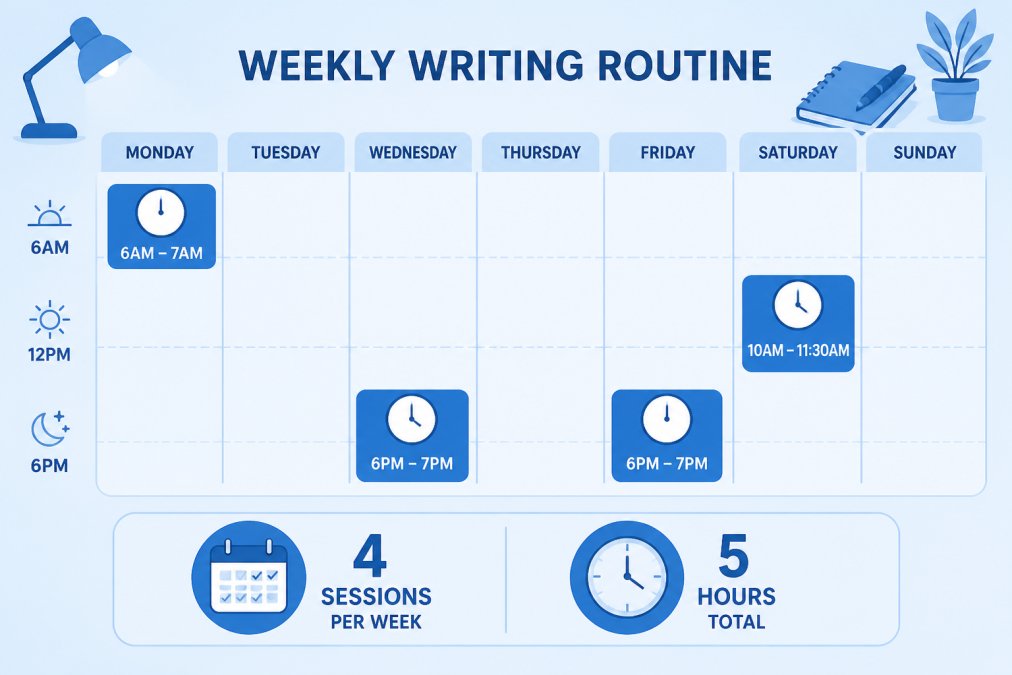
Track your progress. Keep a simple log of words written or pages completed. This serves two purposes: it shows you that momentum is real, and it provides gentle accountability. You don't need to hit a specific target every session. But you do need to show up.
The research on habit formation shows that consistency matters more than intensity. A small, sustainable routine creates the neural pathways that make writing easier over time.
How to Improve Fiction Writing Skills Step by Step
Writing skill develops through practice and feedback, not through reading about writing.
The first step is to write badly. Seriously. Your first drafts will be rough. They should be. The goal of a first draft is to get the story out, not to make it perfect. Too many writers stall their manuscripts by trying to polish as they go. You end up rewriting the first chapter twelve times while the rest of the story remains unwritten.
Write the whole thing first. Then improve it.
Once you have a complete draft, the real learning begins. Read your manuscript aloud. You'll catch awkward phrasing and repetitive sentence structures that your eyes miss on the page. Notice where you lose interest or where the pace drags. These are signals that your reader will experience the same thing.
Study the craft in books and articles, but apply it to your own work. Don't just read about dialogue, examine the dialogue in your manuscript. Is it revealing character? Does it move the plot forward? Could it be tighter? The gap between understanding a writing principle and actually executing it in your own work is where real skill develops.
Get feedback from readers who understand story. A writing group, a trusted friend who reads widely, or a professional coach can identify patterns you can't see in your own work. Feedback isn't criticism, it's information. Use it to understand how your story lands with readers.
Revision is where you develop as a writer. Each pass through your manuscript teaches you something. Your second draft teaches you about structure. Your third teaches you about character consistency. Your fourth teaches you about language and voice. This is the work that transforms a rough draft into something publishable.
Best Tools for Manuscript Organisation
The right tools help you stay organised without becoming a distraction.
Many writers overthink this step.
Book Writing Templates for Beginners
Templates provide structure without prescribing exactly how your story must unfold.
Finish Your Manuscript and Move Forward
Finishing a manuscript is harder than starting one. The initial excitement fades. The middle section feels long and uncertain. Doubt creeps in. This is where most manuscripts die, not from lack of talent, but from loss of momentum.
Frequently Asked Questions
How does a beginner start writing a book?
Begin by identifying your story idea, even if it's just a character, a question, or a scene that excites you. Write down what draws you to this story. Then create a simple outline of the main events or turning points. Set a realistic writing goal, perhaps 500 words three times a week. Start drafting without worrying about perfection; your first draft is meant to be rough. Many writers find that working with a writing coach or using structured resources like Creative Story Mastery helps them clarify their premise and build confidence before diving into the full manuscript.
How long does it take to write a book?
The timeline varies widely depending on your genre, length, writing frequency, and experience. A 60,000-word novel typically takes 6 months to 2 years if you write regularly. Writing 500 words daily means you could complete a first draft in 4-5 months. However, the total time includes not just drafting but also revision, editing, and refinement. Many authors find that structured coaching and clear story development at the start actually speeds up the writing process by preventing false starts and major rewrites later.
What is the difference between drafting and editing?
Drafting is about getting the story out of your head and onto the page, quantity over quality. Your internal editor should stay quiet during drafting. Editing comes after: you reread what you've written, assess structure and pacing, strengthen characters, clarify dialogue, and refine language. Mixing drafting and heavy editing slows you down and kills momentum. Many writers draft quickly first, then step back and edit with fresh eyes. This separation helps you finish the manuscript faster and produce stronger work.
Can I balance writing a book with a full-time job?
Yes. You don't need large blocks of uninterrupted time to make progress. Even 30-60 minutes of focused writing three or four times a week adds up. The key is consistency and protecting that time as non-negotiable. Many successful authors work full-time while building their manuscript. Establishing a clear writing routine, setting modest daily or weekly word-count goals, and using tools to stay organised helps you stay on track. Working with a coach who understands your schedule can also help you design a realistic plan that fits your life.