

Table of Contents
- Why Authors Look Beyond Manuscript Agencies
- Traditional Publishing: Submitting Directly to Publishing Houses
- How to Find a Freelance Book Editor for Manuscript Development
- Self-Publishing Platforms for Debut Authors
- Hybrid Publishing: A Middle Path for Independent Writers
- How to Format a Manuscript for Submission to Publishers
- Common Mistakes When Seeking Representation Without an Agency
- Building Your Author Platform and Industry Connections
Last Updated: August 15, 2026
Why Authors Look Beyond Manuscript Agencies
Not every author needs a literary agent. For decades, the industry operated on a simple assumption: get representation or don't get published. But that assumption has cracked wide open.
Manuscript agency alternatives have become genuinely viable pathways for serious writers. Some authors find traditional agents gatekeep their work into oblivion. Others discover that waiting 18 months for a response, only to receive a form rejection, isn't the only route to a finished book. Still others want control over their creative decisions or speed more than they want an advance cheque.
Publishing houses now accept unsolicited manuscripts from certain genres. Self-publishing platforms have matured into professional distribution channels. Hybrid publishing models offer a middle ground that didn't exist a decade ago. Direct-to-publisher submissions, once considered career suicide, now produce books that compete on shelves and in algorithms.
At writeinspire, we've worked with hundreds of authors navigating these choices. The ones who succeed understand what they actually need, then choose the path that delivers it.
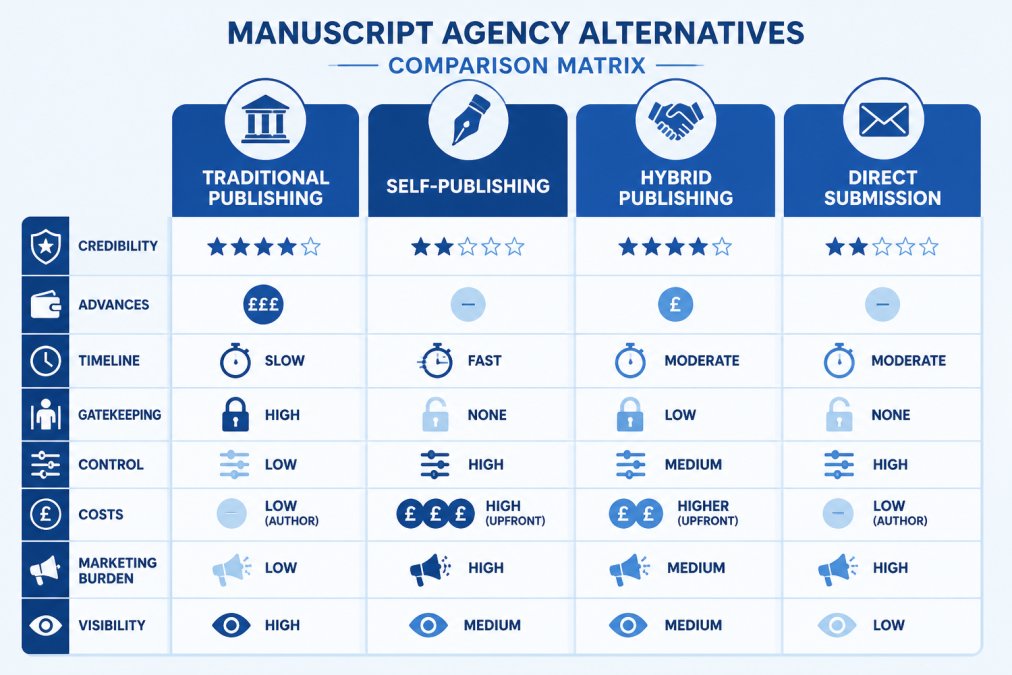
Traditional Publishing: Submitting Directly to Publishing Houses
Many publishing houses will read unsolicited manuscripts. Not all, but enough that direct submission deserves serious consideration as a manuscript agency alternative.
Prepare a query letter, a one-page pitch that hooks the acquisitions editor in the first paragraph. Research which publishing houses acquire work in your genre. Follow their submission guidelines exactly. Then wait.
Submission timelines stretch across months. Most queries land in a rejection pile, but some reach editors who see something worth developing. You lose the agent's industry connections and negotiating power, but gain speed and control. Your manuscript goes straight to the decision-maker.
This works best for debut authors in genre fiction: romance, mystery, science fiction, fantasy. These categories have clear submission guidelines and active acquisitions teams.
Research submission guidelines carefully. Publishers Weekly's submission database lists houses accepting direct submissions. Writer's Market resources provides detailed requirements by publisher and genre. Follow every instruction. Editors notice when writers ignore guidelines.
How to Find a Freelance Book Editor for Manuscript Development
Before you query anyone, your manuscript needs serious development. This is where freelance book editors become essential.
A freelance editor isn't a proofreader. Editors reshape structure, question character motivation, identify pacing problems, and strengthen weak scenes. They're the difference between a draft that's been written and a manuscript that's been crafted.
Developmental editors work on big-picture issues: plot structure, character arcs, narrative flow. Line editors focus on prose clarity and voice consistency. Copy editors handle grammar and punctuation. Most debut authors need developmental editing first, then line editing, then copy editing.
The Editorial Freelancers Association maintains a directory of vetted professionals. Many editors operate independently through their own websites. Ask in writing communities for recommendations. Check if your potential editor has worked on books in your genre.
Before hiring, request a sample edit. A reputable editor will review your first ten pages and show you what their feedback looks like. This lets you assess whether their approach matches your needs and temperament.
Self-Publishing Platforms for Debut Authors
Self-publishing has shed its vanity-press reputation. Serious authors now choose it deliberately, not as a fallback.
The appeal is straightforward: complete creative control, faster time to market, and higher royalty rates per copy sold. The trade-off is equally clear: you handle everything. Cover design, interior formatting, marketing, distribution, customer service. You're running a small publishing business.
Amazon's Kindle Direct Publishing (KDP) offers global reach and the largest reader audience. IngramSpark provides print-on-demand distribution to bookstores and libraries. Draft2Digital handles multiple ebook formats and retailers. Each has different strengths depending on whether you want print books, ebooks, or both.
Format your manuscript according to platform specifications. Upload your cover file. Set your pricing. Publish. Your book appears in the retailer's catalogue within days or weeks.
What self-publishing demands is marketing discipline. You must build your own audience through email lists, social media presence, reader engagement, and often paid advertising. Some self-published authors sell thousands of copies. Others sell dozens. The difference usually comes down to marketing effort, not writing quality.
This path works exceptionally well for genre fiction, where reader communities are active and engaged.
Hybrid Publishing: A Middle Path for Independent Writers
Hybrid publishing sits between traditional and self-publishing. It's the option most publishing guides overlook, which is precisely why it deserves attention.
In a hybrid model, a publisher provides professional services, editing, cover design, formatting, distribution, while the author retains creative control and shares revenue. You're partnering with a publisher who invests in your success because they profit when you do.
The key distinction from vanity publishing is this: the publisher has skin in the game. They want your book to succeed because their revenue depends on it.
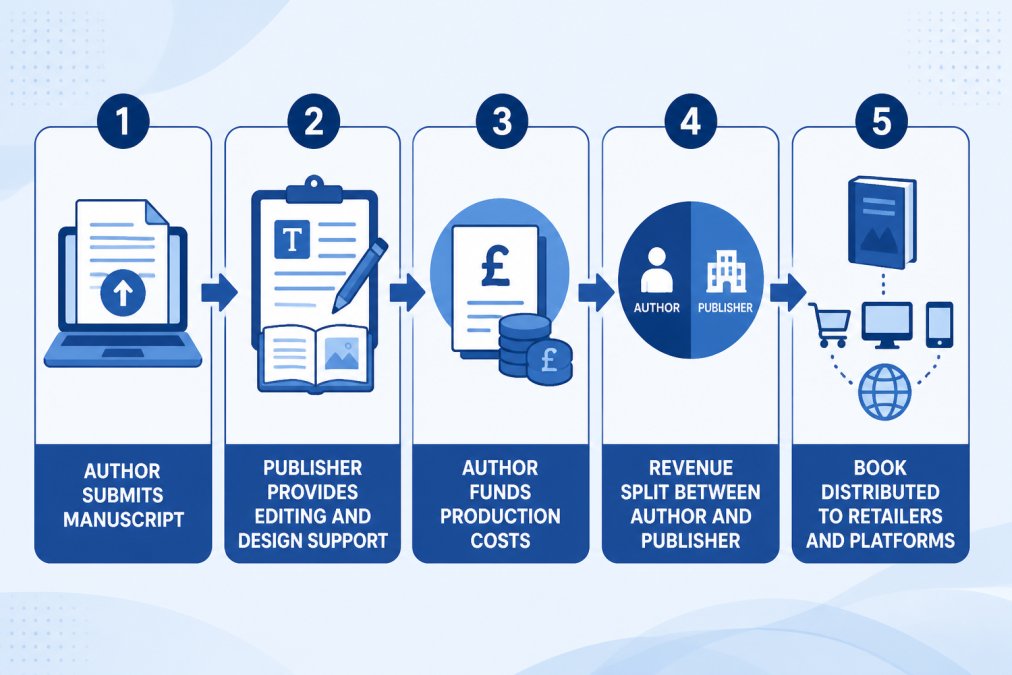
Hybrid publishing appeals to authors who want professional support without surrendering control to a traditional publisher. It appeals to authors tired of traditional querying rejection. It appeals to authors with existing platforms, newsletters, podcasts, social media audiences, who can drive their own sales.
Research hybrid publishers carefully. The Alliance of Independent Authors provides guidance on evaluating publishers. Ask for client references. Demand transparency about costs and revenue splits. Avoid any publisher who guarantees bestseller status or promises specific sales numbers. Those claims are red flags.
How to Format a Manuscript for Submission to Publishers
Formatting matters more than writers expect. A professionally formatted manuscript signals that you understand publishing standards.
Double-space your document. Use a standard serif font like Times New Roman, 12-point. Number your pages. Include your name and contact information on the first page. Leave one-inch margins on all sides. These are industry standards that make manuscripts easier to read and edit.
Beyond the basics, formatting requirements vary by publisher. Check submission guidelines for each one. Follow them exactly.
For ebook formatting, requirements differ again. Ebook readers display text differently than printed pages. If you're self-publishing, invest time in learning proper ebook formatting or hire someone who specialises in it. A poorly formatted ebook frustrates readers and damages your reputation.
Common mistakes include inconsistent spacing, incorrect chapter heading formatting, embedded images in positions that don't translate to ebook readers, and manual line breaks instead of paragraph breaks. Understand the difference between direct formatting (selecting text and changing its appearance) and style-based formatting (applying predefined styles). Style-based formatting survives conversion to ebook and print formats. Direct formatting often doesn't.
Common Mistakes When Seeking Representation Without an Agency
Writers pursuing manuscript agency alternatives make predictable errors.
The first mistake is querying too early. Your manuscript isn't ready. Agents and publishers receive thousands of queries and reject most within seconds if the opening pages don't hook them. Invest in developmental editing before you query anyone.
The second mistake is querying the wrong publishers. You've written a romance novel but query a publisher known for literary fiction. Research publishers carefully. Understand what they actually publish. Read books in their catalogue.
The third mistake is sending generic query letters. A query that could apply to any book signals you haven't done your research. Reference a specific book the publisher released recently. Explain why your manuscript fits their list.
The fourth mistake is querying simultaneously to dozens of publishers without tracking responses. Maintain a spreadsheet. Track submission dates, responses, and follow-up dates.
The fifth mistake is giving up too quickly. Rejection is normal. Most manuscripts receive dozens of rejections before finding a home. Persistence matters.
Building Your Author Platform and Industry Connections
Here's what separates authors who get published from those who don't: platform.
An author platform is your existing audience. It might be an email list, social media following, podcast, or blog with regular readers. Publishers care about platform because it predicts sales. An author with engaged subscribers can drive book sales immediately upon publication.
Building platform takes time. Start now, even before your manuscript is finished. Write regularly, blog posts, essays, social media updates, newsletter content. Build an email list. Engage with readers in your genre. Participate in writing communities. Attend conferences. Read widely in your category and review books honestly.
Industry connections matter equally. Meet other writers. Attend writing conferences. Join critique groups. Follow editors and agents on social media. Engage thoughtfully with their content. When you eventually query, you're not a stranger.
This isn't transactional networking. It's genuine participation in the writing community. Writers who succeed are generous, they read widely, recommend other writers' work, participate in craft discussions, and build real relationships.
The payoff comes later. A fellow writer recommends your work to their agent. An editor you met at a conference requests your manuscript. A book blogger with genuine interest helps drive early sales. These connections emerge from authentic engagement.
Seeking publication without a traditional agent doesn't mean going it alone. It means choosing which support structure serves your work best. Whether you pursue direct submission, self-publishing, hybrid publishing, or a combination of these paths, the foundation remains the same: a manuscript that's been rigorously developed, a clear understanding of your market, and genuine persistence.
WriteInspire's Writing Consultation Creative Support service provides exactly this kind of rigorous development. One-on-one consultations help you strengthen structure, deepen character motivation, and polish prose before you submit anywhere. If you're serious about seeing your manuscript published, whether traditionally, independently, or through a hybrid model, professional manuscript development isn't optional. It's the difference between a draft and a book ready for the world.

Frequently Asked Questions
Can I publish my book without a literary agent or manuscript agency?
Yes, absolutely. Many authors bypass traditional agencies entirely by submitting unsolicited manuscripts directly to publishing houses, using self-publishing platforms, or pursuing hybrid publishing models. Each path has different requirements. Direct submission requires research into which publishers accept unagented work and adherence to their submission guidelines. Self-publishing gives you full control but requires managing editing, design, and marketing yourself. Hybrid publishing provides professional support while keeping you involved in key decisions. The path you choose depends on your timeline, budget, and how much creative control you want.
What are the main differences between traditional publishing, self-publishing, and hybrid publishing?
Traditional publishing involves querying agents or submitting directly to publishers who handle editing, design, and distribution in exchange for a percentage of sales. Self-publishing means you retain full control and profit but manage all costs and responsibilities yourself. Hybrid publishing sits in the middle: you partner with a publisher who provides professional services (editing, design, distribution support), you share production costs, and revenue is split. Traditional takes longest but offers credibility and upfront investment from the publisher. Self-publishing is fastest but demands the most from you. Hybrid balances speed, support, and creative control.
How do I know if I should hire a freelance book editor instead of working with an agency?
A freelance editor is ideal if you want focused feedback on structure, clarity, and craft without the broader representation services an agency provides. Editors specialise in manuscript development, line editing, or copyediting, depending on your manuscript's stage. Agencies typically focus on pitching and selling your work to publishers. If your manuscript needs rigorous development before submission, a freelance editor is often more cost-effective and faster. Many authors use both: they work with an editor to polish the manuscript, then query agents or submit directly. Choose an editor with experience in your genre and a track record you can verify.
What submission etiquette should I follow when approaching publishers directly without an agent?
Always follow the publisher's submission guidelines exactly. Check their website for what they accept (genre, word count, format). Address your query or cover letter to a specific editor or acquisitions team when possible, not a generic address. Keep your cover letter brief and professional: introduce your manuscript, mention why you're submitting to them specifically, and include a one-paragraph pitch. Format your manuscript pages according to industry standards (double-spaced, standard font, page numbers). Wait for their response window before following up, typically 6-12 weeks. Avoid simultaneous submissions to the same publisher unless they explicitly allow it. Rejection is normal; don't take it personally or argue with feedback.
How long does it typically take to get published if I bypass a manuscript agency?
Timeline varies dramatically by path. Direct submission to traditional publishers can take 6-18 months from initial contact to contract, then another 12-24 months to publication. Self-publishing is fastest: 2-6 months from manuscript completion to published book, depending on how quickly you arrange editing and design. Hybrid publishing typically takes 6-12 months from agreement to publication. If you're querying agents first, add 3-6 months of waiting and rejection before you might try direct submission. The trade-off is speed versus credibility: self-publishing is quickest but carries no publisher backing; traditional is slowest but offers editorial support and industry validation. Plan accordingly based on your goals.
This article was written using GrandRanker