

Table of Contents
- Manuscript Development vs Freelance Editing: A Quick Comparison
- What Manuscript Development Actually Involves
- What Freelance Editing Services Cover
- Manuscript Assessment vs Editing: Which One Comes First?
- Cost, Scope and Return on Investment
- Fitting Development or Editing Into Your Writing Workflow
- Questions to Ask a Potential Writing Coach or Editor
- Frequently Asked Questions
Last Updated: September 12, 2026
Manuscript Development vs Freelance Editing: A Quick Comparison
Manuscript development and freelance editing sit at opposite ends of the same road. One helps you build the story; the other polishes what already exists. Writers often ask whether they should hire a freelance editor or invest in manuscript development, and the honest answer depends entirely on how finished your draft really is. This guide from writeinspire breaks down what each service actually does, what it costs in time and effort, and how to tell which one your project needs right now.
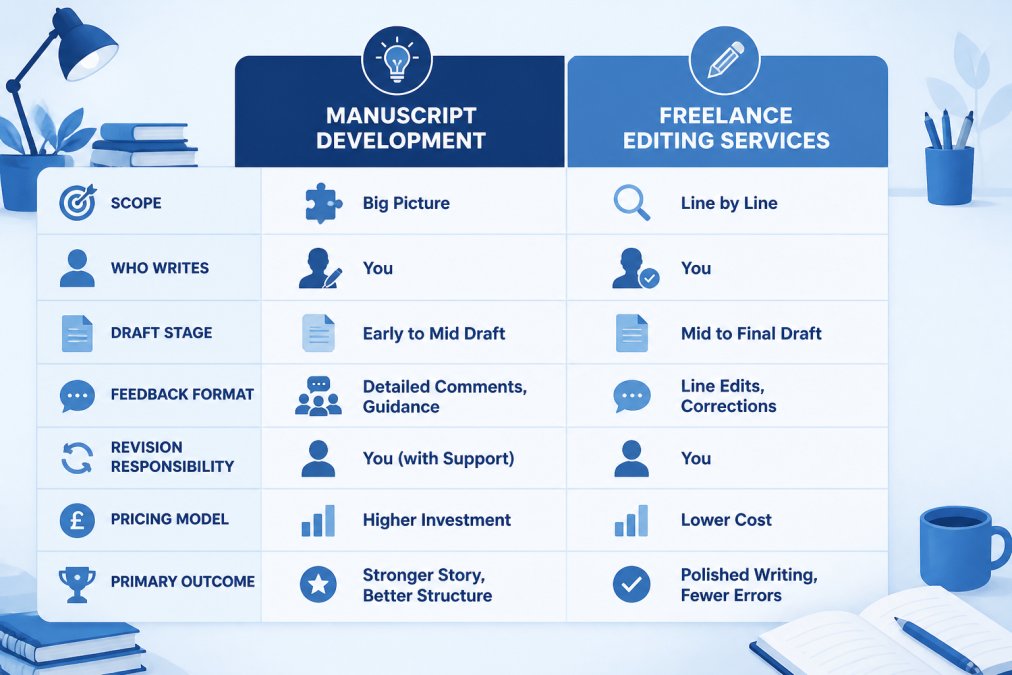
Here is the short version. Manuscript development is a collaborative process where a coach or developmental editor works with you while you write, shaping premise, structure, character and stakes before the prose is locked in. Freelance editing services step in after a draft exists, assessing and refining what is on the page. One builds the house. The other renovates it.
| Manuscript Development | Freelance Editing | |
|---|---|---|
| Scope | Story shaping, structure, coaching | Assessment and refinement of an existing draft |
| Who writes | You, with guidance | You wrote it already |
| Best stage | Idea to first draft | Complete draft onward |
| Feedback format | Sessions, exercises, notes | Editorial letter, track changes |
| Revision duty | Shared, ongoing | Yours, after feedback |
| Pricing model | Program or coaching fee | Project or per-word fee |
| Primary outcome | A finished, structured manuscript | A cleaner, tighter manuscript |
What Manuscript Development Actually Involves
Manuscript development is the work of turning a raw idea into a structured narrative before you commit thousands of words to it. It covers story architecture and the accountability that keeps you writing.
Story development: premise, arc and stakes
A development coach starts with the question most writers skip: what is this story actually about? From there you map the narrative arc, identify the conflict driving the plot, and work out what is at stake for your characters. Getting this right early saves months of rewriting later. WriteInspire's Creative Story Mastery story development module walks through premise, conflict, stakes and theme in exactly this order.
Coaching and accountability while you write
The second half of development is momentum. Most unfinished manuscripts die from drift, not from bad writing. Regular sessions, deadlines and next-step targets keep the draft moving. Accountability is often worth more than the feedback itself.
What Freelance Editing Services Cover
Freelance editing services take a completed draft and improve it at one or more levels, from big structural questions down to commas. The scope is defined by which stage of editing you buy.
The four stages: structural, line, copy and proof
Editing is not one job. It is four, usually done in sequence:
- Structural edit: story arc, pacing, character development, scene purpose
- Line edit: voice and tone, sentence rhythm, clarity at the paragraph level
- Copy edit: grammar and mechanics, consistency, style guide compliance
- Proofread: the final pass for typos before publication
Skipping straight to copy editing on a manuscript with structural problems wastes money. Fix the story first.
Editorial letter, track changes and revision rounds
A good editor sends an editorial letter summarising the big-picture issues, then returns your manuscript with track changes and margin comments. Revision rounds matter here. Ask how many are included before you sign anything.
Manuscript Assessment vs Editing: Which One Comes First?
A manuscript assessment comes first when you are unsure what your draft needs. An assessment is a diagnostic report on your manuscript's strengths and weaknesses. Editing is the treatment that follows.
If you have a finished draft and no idea whether the problem is structure or prose, book an assessment. It is cheaper than buying the wrong edit. Many writers discover their pacing sags in the middle third, or that their protagonist has no clear want, and those are development issues, not grammar issues. An assessment tells you which door to walk through.
Cost, Scope and Return on Investment
Editing and development are priced differently, and the return on investment is measured differently too. Understanding the mechanics behind each pricing model helps you compare quotes fairly and spot when a service is priced for the work it actually does.
How each service is priced
Freelance editors typically quote in one of three ways:
- Per word, common for copy edits and proofreads, where the work scales predictably with manuscript length. A 90,000-word manuscript costs more than a 60,000-word one at the same rate.
- Per hour, common for line edits and structural work, where the editor cannot know how dense the problems are until they start reading.
- Per project, a flat quote based on a sample of your manuscript. This gives you certainty, but only if the scope is written down.
Development programs are usually priced as a package across a set period, a block of sessions, a set number of manuscript reads, and a defined outcome. That package price reflects time and access, not word count, because the work happens while you are still writing.
The factors that move a quote up or down
Most practitioners find the same handful of variables drive the number:
- Manuscript length, the single biggest lever for per-word work.
- Genre and complexity, literary fiction with layered timelines takes longer to assess than a straightforward romance.
- Draft quality, a clean draft needs fewer passes; a messy one needs more.
- Turnaround time, a rush job usually attracts a premium.
- Number of revision rounds, each round is more editor time.
Ask any editor to break their quote down against these factors. A quote you cannot unpack is a quote you cannot compare.
Measuring return on investment
The ROI question is not "what does it cost" but "what does it save". A structural problem caught during development costs you a few sessions. The same problem caught after a full line edit costs you the edit, the rewrite, and a second edit. Manuscript development is the cheaper path when your draft is still taking shape.
For a finished draft, the return shows up in different ways: fewer rejections from agents and publishers, stronger reader reviews, and less time lost to a rewrite you did not need. A common pattern is that writers who invest in a structural edit before a line edit spend less overall than writers who buy the line edit first and discover the structure needs work.
Contractual protections worth checking
Before you pay anyone, confirm four things in writing: the exact scope of work, the number of revision rounds included, the delivery timeline, and who owns the feedback and materials. A simple collaboration agreement protects both sides. WriteInspire offers a creative writing collaboration agreement you can read and sign before work begins, which sets out scope and expectations clearly.

It also helps to agree on what happens if the project changes shape mid-way, for example, if you decide to restructure a third of the manuscript after the edit has started. A short clause covering scope changes and any additional rounds keeps the relationship clear and the work on track.
Fitting Development or Editing Into Your Writing Workflow
You do not need large blocks of time to make either service work. What you need is a rhythm, and a clear sense of which publishing path you are writing towards, because that changes when and how each service fits.
Development in the workflow
For development, a weekly slot of 90 minutes is enough to draft consistently, especially if your coach sets a clear target for each session. The 90-Minute Draft Method was built around exactly this constraint. Development sits alongside your writing, not after it. You draft, you meet, you adjust, you draft again. The feedback loop is short and continuous.
Editing in the workflow
For editing, the workflow is different: you write first, then hand over a complete draft, then work through the editorial letter and revisions in focused passes. Editing is a discrete stage, not a running conversation. You need a finished draft before it can begin.
Self-publishing versus traditional: where each service fits
This is the part most guides skip, and it matters because the two paths sequence the work differently.
If you are self-publishing, you are the publisher, which means you own every quality gate. A common sequence is:
- Finish the draft.
- Book a manuscript assessment or structural edit to fix story-level problems.
- Revise.
- Book a line edit, then a copy edit, then a proofread.
- Format and publish.
Development support can run earlier, while you are still drafting, and it often saves a full structural edit later. Because you are paying for every stage yourself, catching problems early has a direct effect on what you spend overall.
If you are pursuing traditional publishing, the sequence shifts. You typically need a polished, submission-ready manuscript before you query agents or publishers, which means the structural and line work happens before submission, not after acceptance. Development coaching is still useful while drafting, but the editing stages compress into the period just before you start submitting. Once a publisher acquires the book, their in-house editors take over, so the freelance editing you buy is the work that gets you through the door, not the work that replaces theirs.
A simple rule of thumb
If your draft is still changing shape, you are adding scenes, cutting characters, reworking the ending, you are in development territory. If the shape is settled and you are refining how it reads, you are in editing territory. Match the service to the stage, and the workflow takes care of itself.
Questions to Ask a Potential Writing Coach or Editor
Ask these before you commit, and listen carefully to the answers:
- What exactly is included in the scope, and what is not?
- How many revision rounds are covered?
- Who will actually be doing the work?
- What happens if I disagree with the feedback?
- What do you expect from me between sessions?
- Can I see a sample edit or a sample of your feedback style?
- What is your background, and what have you published or produced?
The answers reveal more than any testimonial. A coach who talks about process and craft is different from one who promises a bestseller.
The hardest part is not choosing between manuscript development and freelance editing. It is being honest about which stage your draft has actually reached. If you have a half-finished manuscript in a drawer, development support will get it moving again; if you have a complete draft, an editor will sharpen it. WriteInspire has spent over 30 years helping writers finish work they are proud of, through structured coaching, story development and one-to-one support rather than vanity publishing. Book a [writing consultation(/products/writing-consultation-creative-support) | writeinspire.com.au] and bring your draft. We will find what is working, identify what is not, and build a plan to finish it.
Frequently Asked Questions
What is the difference between manuscript development and copy editing?
Manuscript development works on the story itself: premise, structure, pacing, character logic and whether the ending delivers on the promise of the opening. Copy editing comes much later and deals with grammar, punctuation, spelling and consistency against a style guide. Development changes what happens and why; copy editing changes how the sentences read. A draft usually needs development first, because there is little point polishing prose in a chapter that may be cut or reordered.
At what stage should I hire a manuscript developer?
Most writers get the best value once they have a complete draft, even a rough one, or a detailed outline they are struggling to turn into scenes. If you have a half-finished manuscript sitting in a drawer, development can restart it. Hiring a developer before you have any draft is possible but harder to assess, because there is no material to stress-test. If you are unsure, ask for a manuscript assessment first.
Do I need a manuscript critique before I hire a freelance editor?
It helps. A manuscript assessment tells you which level of editing the draft actually needs, so you do not pay for line editing on a book with a broken second act. Many writers commission an assessment, act on the structural notes themselves, then book a copy edit or proofread once the story is stable. Skipping this step often means paying twice for the same problem.
What are the typical outcomes of a manuscript development session?
You should leave with a clear diagnosis of what is working and what is not, a revision plan you can execute, and specific decisions about structure, character motivation and scene purpose. Some writers also come away with pitch-ready material such as a log line, one-pager or synopsis. The measure of a good session is not encouragement, it is whether you know exactly what to change next and in what order.
How do I know if my story is ready for professional editing?
Your story is ready when the plot holds together, the main character's choices make sense, and you are no longer planning major rewrites. At that point line editing and proofreading will lift the prose rather than waste effort on scenes you might delete. If you are still unsure about the ending or the middle sags, development or a manuscript assessment will save you money before you commission an edit.