

Table of Contents
- Start With the Role: What a Writing Coach Actually Does
- Writing Coach vs Editor: Which One Your Manuscript Needs
- Manuscript Development Support: What It Should Actually Deliver
- Writing Coach Rates and Packages: How to Read the Numbers
- Ten Vetting Questions to Ask Before You Commit
- Red Flags: When to Walk Away From a Writing Coach
- Matching the Coach to Your Level and Genre
- Frequently Asked Questions
Last Updated: October 3, 2026
Start With the Role: What a Writing Coach Actually Does
A writing coach is a professional who works alongside you on craft, structure and momentum rather than simply correcting what you have already written. At writeinspire, we have spent more than 30 years helping storytellers finish work they are proud of, and the question we hear most often is simple: what should I actually look for before I commit?
The answer starts with understanding the role. A coach reads your work closely, asks hard questions about your story, and keeps you accountable between sessions. They are not there to flatter you. If you have a half-finished manuscript sitting in a drawer, a coach is often the difference between another five years of good intentions and a finished draft.
Writing coaching is the practice of guiding a writer through the craft and process of completing a manuscript, combining feedback on structure and voice with regular accountability and goal setting. It sits somewhere between teaching and collaboration.
Coaching, Mentoring and Accountability in Plain Terms
Mentoring tends to be broader and more career-focused. Coaching is project-focused and hands-on. Accountability is the engine underneath both.
A good coach will set writing goals with you, check in on them, and adjust the plan when life gets in the way. Many writers find that an hour or two a week is enough when someone else is holding the deadline. What matters is consistency, not volume.
Writing Coach vs Editor: Which One Your Manuscript Needs
A writing coach helps you build and finish the manuscript. An editor improves a manuscript that is already complete. If your draft still has structural problems, an editor will polish prose that should probably be cut, which wastes your money.
The distinction matters because writers often hire the wrong service first. Editorial support works brilliantly on a finished, structurally sound draft. It cannot fix a story that has no clear premise or a protagonist with no motive.
When You Need Both, and in What Order
The order is almost always coach first, editor second. Coaching builds the story. Editing refines it.
There is one exception. If your draft is genuinely finished and you only want line-level polish, go straight to an editor. If you are unsure which you need, ask for a manuscript assessment. A proper assessment diagnoses what is actually happening on the page before anyone commits to a full edit.
| Situation | Best First Step | Why |
|---|---|---|
| Unfinished draft, structure unclear | Writing coach | Story needs building, not polishing |
| Complete draft, story works | Editor | Prose refinement only |
| Not sure what is wrong | Manuscript assessment | Diagnosis before treatment |
| Half-finished for years | Writing coach | Accountability and momentum |
| Pitch or submission prep | Coach or assessment | Needs a revision plan first |
Manuscript Development Support: What It Should Actually Deliver
Manuscript development support should deliver a stronger story, not just a marked-up document. That means work on premise, structure, character, pacing and scene purpose, followed by a practical revision plan you can execute yourself.
Be wary of anyone who promises a bestseller or a publishing deal. We are not a vanity publisher, and we say so plainly. Honest feedback plus serious craft work beats hype every time.
What genuine development work looks like:
- Clarifying what the story is really about at its deepest level
- Testing whether the ending delivers what the premise promises
- Strengthening character motivation and emotional logic
- Checking that every scene has purpose, tension and consequence
- Building a revision plan with clear next steps
If a provider cannot explain how they will improve your story, only how many pages they will read, keep looking.
Writing Coach Rates and Packages: How to Read the Numbers
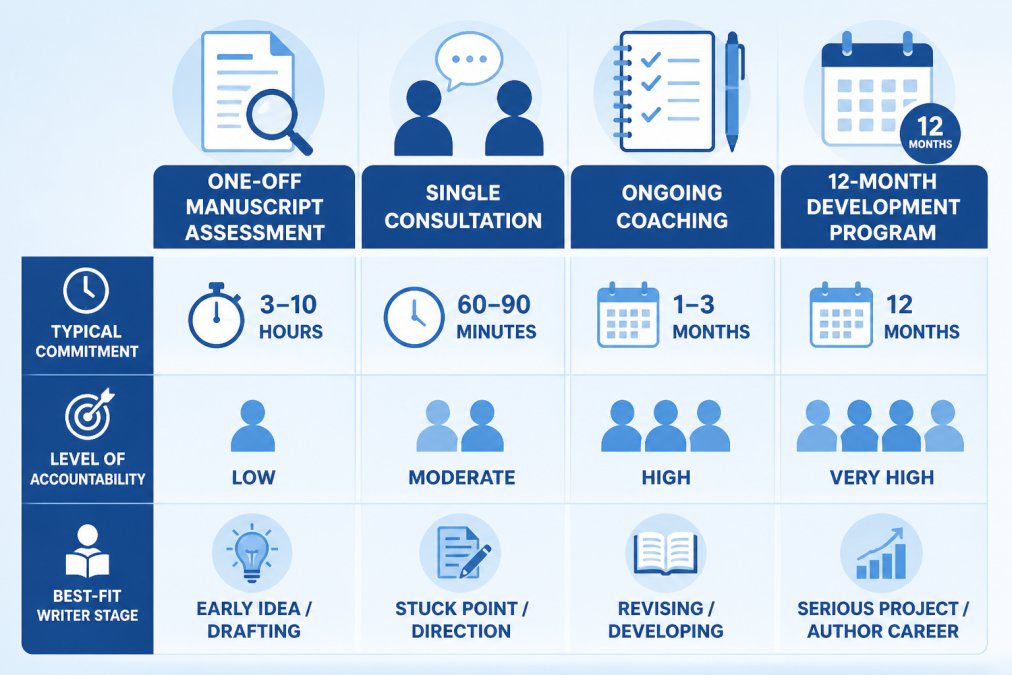
Most guides skip this part entirely, which leaves writers guessing about budget. Here is the honest version: coaching is priced in a few common shapes, and knowing which shape you are buying matters more than the headline figure.
The three common structures
- Per session. You pay for a single consultation or a block of sessions. Useful when you have one specific problem to solve, a stuck opening, a muddled midpoint, a query letter that is not landing.
- Project-based. You pay for a defined piece of work: a manuscript assessment, a structural report, a full development pass. The scope is fixed, and so is the deliverable.
- Retainer or ongoing. You pay for access over time, regular sessions, feedback between them, and accountability across the life of a draft. This is the most expensive shape because it does the most work.
What actually drives the number
Three things move the figure more than anything else: the length of your manuscript, the depth of feedback (a structural report is a different job from a line-level read), and how much access you get between sessions.
How to compare two quotes fairly
Ask each provider the same four questions: What exactly do I receive? How many sessions, and how long is each? What is the turnaround on written feedback? What happens if I need more? A quote that answers all four is comparable. A quote that only names a figure is not.
The mistake almost everyone makes
The most common error is buying the cheapest option and expecting a full manuscript turnaround. A single session can fix a specific problem. It will not carry you through a whole draft, and treating it that way wastes both the money and the feedback.
At writeinspire, our Writing Consultation Creative Support is a private one-on-one session for structure, style and clarity. Our Writer Coaching & Guided Resources is built for writers who want a professional story partner across the life of a project.

Ten Vetting Questions to Ask Before You Commit
Most guides tell you what a writing coach does. Very few tell you how to test one. That is the gap this section fills.
Writer Coaching & Guided Resources →
**1.
2. How do you assess a manuscript before we start? Good coaches read a sample, often the opening chapters plus a synopsis, before quoting a plan.
**3.
4. How do you handle a month where I write nothing? This is the most revealing question on the list.
5. What happens between sessions, and how quickly do you respond? Ask about turnaround on written feedback, whether you can email questions, and what the boundaries are.
6. Can you show me a revision plan you have built for another writer? You are not asking for confidential material, you are asking to see the shape of their thinking.
7. How do you give feedback on work that is not working? Listen for honesty delivered with care.
8. What is your experience with my genre? Genre conventions matter.
9. What do you expect from me in return? Good coaching is a two-way arrangement.
10. What does finished look like at the end of our work together? A strong coach can describe the endpoint: a complete draft, a revision plan, a submission-ready manuscript.
A coach who answers all ten with detail is worth serious consideration. One who deflects, over-promises, or answers every question with a sales pitch is not.
Red Flags: When to Walk Away From a Writing Coach
Walk away when a coach guarantees publication, refuses to explain their process, or flatters everything you write. Those are signs of a vanity operation, not professional guidance.
Other warnings worth taking seriously:
- No assessment before they quote you a package
- Pressure to sign up on the first call
- Feedback that only ever praises, never challenges
- No clear answer about who does the work
- Vague promises about "doors opening" in the publishing industry
Honest coaching sometimes stings. That is the point. Constructive feedback on structure, pacing and character is what moves a manuscript from promising to publish-ready.
Matching the Coach to Your Level and Genre
Genre experience matters more than most writers expect. A coach who lives in literary fiction may not be the right fit for a stage play, a screenplay or genre romance, because the conventions and reader expectations differ sharply.
Experience level matters too. New storytellers usually need more structure, more explanation and more encouragement to build creative confidence and a writing routine. Writers with a finished draft need sharper diagnosis and a harder conversation about what is not working.
At writeinspire, our Creative Story Mastery modules cover story development, character, scene, action and dialogue, so writers can build craft fundamentals alongside one-to-one support. That combination suits both first-timers and writers pushing a strong draft toward its final version.
Choosing the right coach comes down to honest diagnosis, real craft experience and a plan that survives a bad month. If you have a story you can feel in your bones and cannot get it finished, that is exactly the work we do. Our Writer Coaching & Guided Resources pairs you with a professional story partner, our Writing Consultation Creative Support gives you focused one-on-one guidance, and our Script Development Program carries scriptwriters across a full year of momentum. Get started with writeinspire and finish the manuscript you have been carrying in your head.

Frequently Asked Questions
What is the difference between a writing coach and an editor?
A writing coach works on your process and your craft over time: structure, momentum, accountability and the decisions behind the draft. An editor works on the manuscript itself, tightening line by line once the story holds together. Many writers need coaching first to get a complete draft, then an editor to polish it. Some coaches, including writeinspire's manuscript development support, do both, stress-testing structure and rewriting decisions rather than just correcting sentences.
How much does a writing coach charge?
Coaching is usually priced per session, per manuscript assessment, or as a package across several months. Expect to pay more for one-to-one feedback on a full manuscript than for a group workshop or short course. Ask exactly what is included: reading time between sessions, written feedback, or just the call itself. writeinspire's Writing Coaching & Guided Resources starts at $145, and the 12-month Script Development Program is $1,795.
How do I know if I am ready for a writing coach?
You are ready if you have something on the page, even a rough first chapter or a half-finished manuscript, and you keep stalling. You do not need a polished draft. Writers who benefit most are those who want honest feedback and are willing to rewrite, not just be told the work is good. If you have been circling the same draft for years, that is usually a sign structured support would help.
Should I look for a coach with specific genre experience?
For genre fiction, screenwriting or memoir, yes. A coach who knows how crime pacing, romance beats or script formatting work can spot problems faster. For general craft, strong structural coaching transfers across genres. Ask what they have written, produced or published in your area, and whether they have worked with writers at your stage. Genre-specific feedback on story arc and narrative flow saves months of revision.
What should I expect from an initial consultation with a writing coach?
A useful first session covers where your project is, what is working, what is not, and a clear plan for the next few weeks. You should leave with specific next steps, not just encouragement. Bring your draft or first ten pages and be ready for direct feedback. If the coach only praises the work and never names a weakness, that is a red flag rather than a good sign.