

Table of Contents
- What's the Real Difference Between a Writing Coach and a Freelance Editor
- When to Hire a Writing Coach: Stages of Manuscript Development
- When to Hire a Freelance Editor: What They Actually Do
- Questions to Ask a Potential Writing Coach
- How to Choose Between Coaching and Editing for Your Project
- Can You Use Both a Coach and an Editor?
- Making Your Decision: Which One Do You Need First?
- Frequently Asked Questions
Last Updated: September 28, 2026
What's the Real Difference Between a Writing Coach and a Freelance Editor
When considering writing coach vs editor, understand that a writing coach develops your creative process and builds your confidence as a storyteller, while a freelance editor refines your finished manuscript by fixing grammar, structure, and clarity. The core distinction: one shapes you as a writer, the other shapes your words on the page.
Think of it this way. A coach works with you before, during, and after you write. They ask questions that unlock your story. They hold you accountable to deadlines. They push you to dig deeper into character motivation or narrative arc. An editor comes in when you've already written something and need professional eyes to spot what isn't working.
But here's where it gets interesting: the best writers often use both, at different stages. Many aspiring authors start with coaching to finish their first draft, then hire an editor to prepare it for submission or publication. The sequence matters. Coaching first, editing later, tends to produce stronger results than trying to edit your way into a finished manuscript.
When to Hire a Writing Coach: Stages of Manuscript Development
Hire a writing coach when you need help shaping your creative process or developing your manuscript from concept through completion. Coaching works best at these specific moments in your writing journey.
Starting from scratch. You have an idea but no idea how to structure it. A coach helps you move from concept to first draft by building a framework strong enough to carry your story. They work with you to develop your premise, clarify your theme, and design a narrative arc that builds momentum instead of drifting.
Stuck in the middle. You've written 50 pages but lost the thread. Your characters feel flat or your plot stalls halfway through. A coach diagnoses what's happening and helps you rebuild the story's emotional engine so it moves forward with purpose.
Finished a draft but know it needs work. You've written a complete manuscript but sense something's off. Structure feels loose. Pacing drags. Characters don't feel believable. A coach works with you through revision cycles, teaching you how to see your own work critically and rebuild it stronger.
Preparing for submission. You're ready to query agents or publishers, but you want professional guidance on your manuscript's readiness. A coach reviews your work, identifies gaps, and helps you understand what agents will actually be looking for.
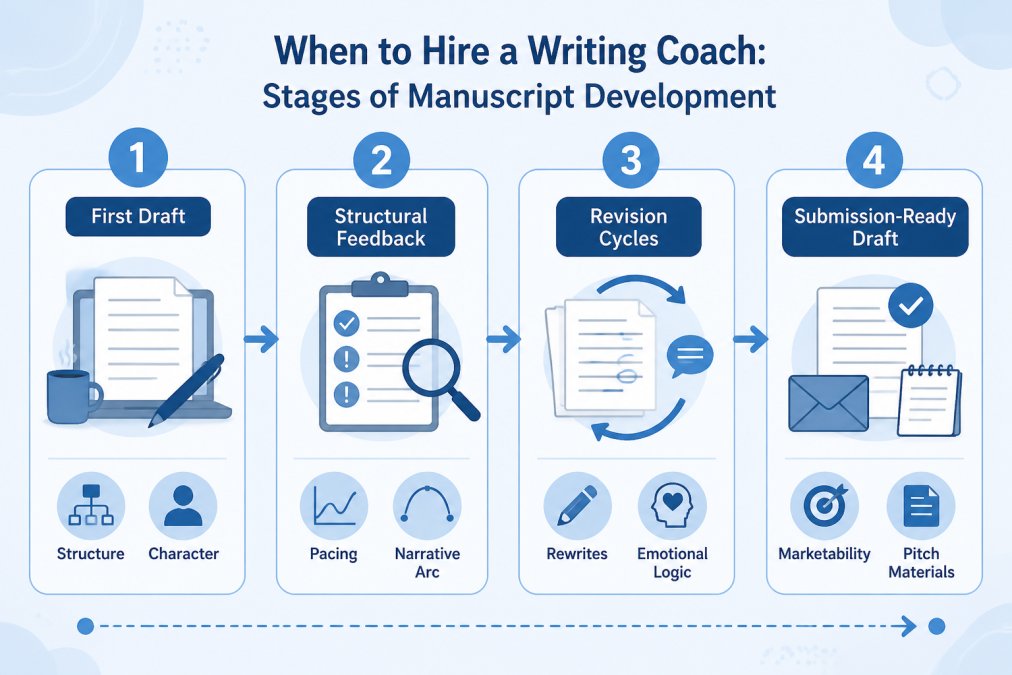
The coaching relationship is ongoing. You meet regularly (often monthly), share your progress, get feedback, and move forward with clear next steps. This accountability is what separates coaching from simply taking a course or joining a writers' group. You have someone invested in your specific story, pushing you to finish.
If you're looking for structured support, Writing Coaching focuses on building your manuscript properly rather than just polishing surface-level writing. The emphasis is on craft: how your story is shaped, whether your characters make believable choices, and whether every scene earns its place in the narrative.
When to Hire a Freelance Editor: What They Actually Do
Hire a freelance editor when you have a completed manuscript and need professional feedback on clarity, structure, flow, and technical quality. Editors work on the manuscript itself, not on you as a writer.
Developmental editing addresses the big-picture issues: Does the narrative arc work? Do characters feel real? Is pacing tight or does it drag? A developmental editor reads your entire manuscript and provides an editorial letter identifying structural problems, inconsistencies, and areas where emotional logic breaks down. They might recommend reorganising chapters, cutting scenes, or deepening character development.
Line editing focuses on sentence-level clarity and flow. A line editor examines how you've written each sentence, whether your word choices are precise, whether your voice is consistent, and whether the language moves the reader forward without unnecessary words.
Copy editing catches grammar, punctuation, spelling, and consistency errors. A copy editor ensures your manuscript follows a consistent style guide and reads cleanly.
Proofreading is the final pass before publication, catching typos and formatting issues the other rounds missed.
Most writers benefit from developmental editing first (if their manuscript needs structural work), followed by line editing, then copy editing, then proofreading. You don't need all four, but the sequence matters. Restructuring chapters after you've had line editing done wastes the line editor's time.
The editor-writer relationship is transactional. You submit your manuscript, they provide feedback or a revised version, and the work is complete. There's no ongoing accountability or mentorship. The editor isn't invested in your long-term development as a writer, they're focused on making this specific manuscript stronger.
Writing Consultation Creative Support →
Questions to Ask a Potential Writing Coach
Before committing to a coach, ask these questions to ensure they're the right fit for your project and your working style.
What's your experience with this genre or type of manuscript? A coach who specialises in literary fiction may not be the best match for a thriller or memoir. Ask for examples of manuscripts they've worked on and authors they've coached.
How do you structure the coaching relationship? How often do you meet? How long are sessions?
How to Choose Between Coaching and Editing for Your Project
The decision comes down to where you are in your writing journey and what your manuscript needs most.
Choose coaching if:
Choose editing if:
Choose both if:
| Your Situation | Best Choice | Why |
|---|---|---|
| Haven't finished manuscript yet | Coaching | Helps you complete the draft and develop the story |
| Manuscript complete but needs structural work | Developmental Editing or Coaching | Identifies and fixes big-picture issues |
| Manuscript complete and structurally sound | Line Editing or Copy Editing | Refines clarity, flow, and technical quality |
| First-time writer wanting to learn craft | Coaching | Teaches you how to see your own work critically |
| Experienced writer needing final polish | Editing | Professional refinement before submission |
Can You Use Both a Coach and an Editor?
Yes. In fact, many successful writers do exactly this.
The typical sequence: hire a coach first while you're developing and revising your manuscript. Meet regularly, work through structural issues, deepen your characters, and strengthen your narrative arc. Once you've completed multiple revision cycles and your manuscript feels solid, then hire an editor for the final professional pass.
Making Your Decision: Which One Do You Need First?
Here's the honest answer: most writers need coaching first.
If you haven't finished your manuscript, coaching is the priority. A coach helps you move from idea to completion, teaches you how to structure a story, and builds your confidence as a writer. That foundation matters more than polishing a manuscript that isn't yet whole.
Frequently Asked Questions
What's the primary difference between a writing coach and a freelance editor?
A writing coach works with you during the creative process, helping you develop your story, build narrative structure, strengthen characters, and maintain momentum as you write. A freelance editor typically works on a completed or near-complete manuscript, focusing on clarity, grammar, consistency, and polish. Coaches build the foundation; editors refine it. Think of coaching as sculpting the clay, editing as finishing the sculpture.
At what stage of manuscript development should I hire a writing coach?
Hire a coach when you have a story idea but aren't sure how to structure it, when you're stuck partway through a draft, or when you've finished something but know it needs serious work before it's ready. Coaches are most valuable before or during the writing process. If you have a complete draft and just need grammar and consistency fixes, an editor might be the better choice. Many writers benefit from a coach early, then an editor later.
Does a freelance editor provide feedback on plot and character development?
Some editors do, but it depends on the type. Developmental editors focus heavily on plot, character arcs, pacing, and story structure, very similar to coaching work. Line editors focus on sentence-level clarity and style. Copy editors handle grammar and consistency. Proofreaders catch typos. If you need structural feedback, ask specifically for a developmental editor. Standard editing typically assumes the story structure is already solid.
Can I benefit from both a writing coach and a freelance editor?
Absolutely. Many serious writers work with a coach to develop and revise their manuscript, then hire an editor for final polish. The coach helps you build a strong story; the editor ensures it's technically flawless and reads smoothly. This combination works well because coaching focuses on craft and creative decisions, while editing focuses on presentation. Working with both gives your manuscript the best chance of standing out.
How do I know if I'm ready to hire a writing coach versus an editor?
Ask yourself: Is my story idea clear but my structure messy? Do I need help finishing a draft? Am I stuck on character motivation or pacing? If yes to any of these, a coach is your answer. Do you have a complete draft that reads well structurally but has typos, awkward sentences, or inconsistencies? Then an editor is what you need. Coaches help you build; editors help you polish. Know which stage your manuscript is in, and you'll know which professional to hire.