

Table of Contents
- The Benefits of Joining a Writers Group for Independent Authors
- Peer Review for Independent Authors: Making Feedback Count
- Avoiding Vanity Publishing: How a Community Keeps You Honest
- Digital vs. In-Person Writing Communities: Which Fits Your Life?
- How to Vet a Writing Community Before You Commit
- The ROI of Community for Independent Authors
- Frequently Asked Questions
Last Updated: September 16, 2026
The Benefits of Joining a Writers Group for Independent Authors
Why join a writing community for independent authors? Because the solitary draft is a myth. Most writers finish more, and finish better, when other people are reading their pages and expecting the next ones. This guide from writeinspire looks at what a good community actually gives you, how to tell a real one from a flattering one, and how to make the time you spend there count.
Accountability and Deadlines That Keep Pages Moving
The single biggest benefit is a deadline that belongs to someone else. When a critique partner expects your chapter by Thursday, Thursday becomes real in a way that a private goal never does.
Constructive Criticism and Manuscript Feedback
Constructive criticism is feedback that names what is working, what is not, and why, in language specific enough to act on. "I loved it" is not feedback. "I lost track of who was speaking on page four" is.
Peer Review for Independent Authors: Making Feedback Count
Peer review for independent authors works best as a loop, not a one-way delivery. You receive notes, you decide what to use, you revise, and you bring the revision back to the same readers. That last step is the one most writers skip, and it is the one that turns opinions into progress.
The practical version looks like this:
- Submit a capped excerpt, usually 2,000 to 3,000 words
- Ask two or three focused questions alongside it
- Read all notes before responding to any of them
- Revise, then resubmit the same pages
- Note which changes worked, and tell your readers
Avoiding Vanity Publishing: How a Community Keeps You Honest
Avoiding vanity publishing starts with one uncomfortable question: is anyone being paid to tell you this is good? A community of peers has nothing to sell you, which is exactly why its praise means something.
Digital vs. In-Person Writing Communities: Which Fits Your Life?
Most guides treat "online" and "in-person" as one choice. They are not. The two formats run on different mechanics, attract different writers, and solve different problems. Knowing which one you actually need is the difference between a group you keep for years and one you quietly stop attending by March.
How online communities actually work
Online writing communities usually live on one of three platforms: a Discord server, a Slack workspace, or a forum-style group. Each has a different rhythm.
- Discord servers tend to be chat-first. Channels are split by topic, #critique, #accountability, #wins, and conversation happens in real time. The strength is momentum: you can post a page at 11pm and have notes by morning. The weakness is noise. Busy servers move fast, and a post can vanish under fifty messages about someone's word count.
- Slack workspaces are closer to a workplace. Threads stay organised, files are easy to find, and critique rounds are often scheduled rather than spontaneous. Better for structured groups, less good for casual chat.
- Forums and critique platforms are slowest but most searchable. A thread from two years ago can still teach you something. The trade-off is that engagement can dry up without a core of regulars.
How in-person groups actually work
A physical group, a library meet-up, a writers' centre workshop, a monthly pub gathering, runs on friction. You travel, you show up at a fixed time, you see the same faces. That friction is the feature.
The hybrid pattern most independent authors land on
A common pattern is one online accountability partner for weekly pages, plus one in-person or scheduled group for monthly deep critique. The online partner keeps the manuscript moving; the in-person group keeps the standard high. You get consistency and pressure without overloading either format.
| Format | Best for | Main strength | Main risk |
|---|---|---|---|
| Discord or Slack critique group | Busy schedules, niche genres, writers without a local scene | Flexible timing, wide reach, fast turnaround | Easy to drift away; noise can bury your post |
| In-person meet-up or workshop | Writers who need external commitment | Depth of critique, real accountability | Fixed times, travel, limited genre mix |
| Hybrid (online partner plus monthly meet) | Most independent authors | Consistency plus pressure | Needs coordination and two sets of manners |
A quick way to decide
Ask yourself three questions. Do you need someone to notice when you go quiet? Choose in-person. Do you need notes fast and your local scene is thin? Choose online. Do you need both? Run the hybrid and protect the weekly deadline above all else.
Writer Coaching & Guided Resources →
How to Vet a Writing Community Before You Commit
Vetting a writing community takes one session and five checks. Most writers join on atmosphere and leave three months later when the feedback turns out to be shallow. Do the checks first.
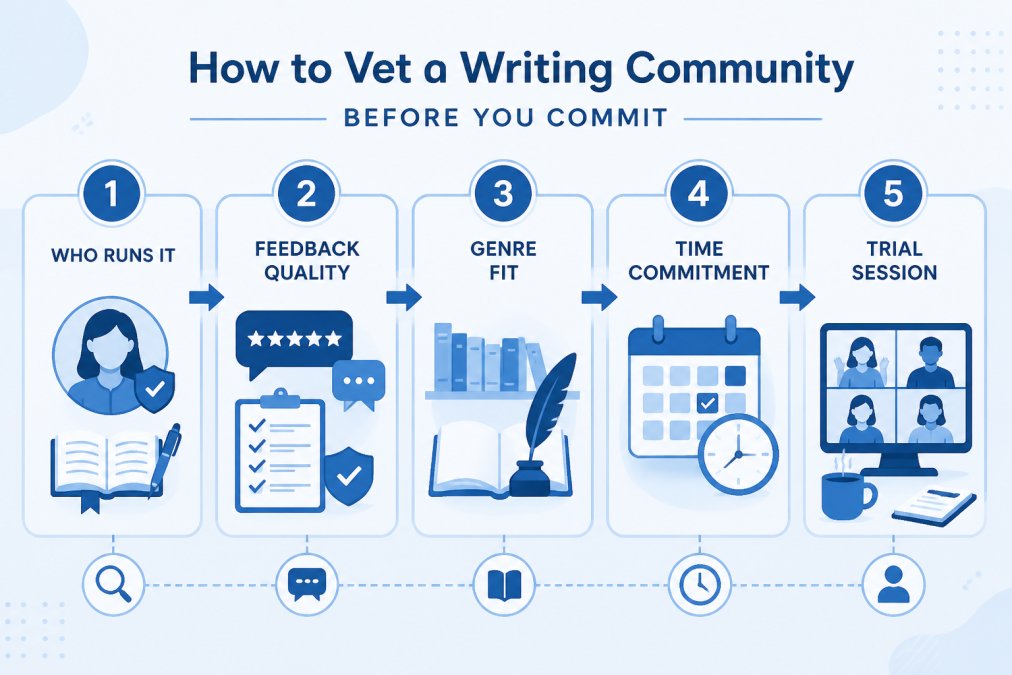
- Who runs it, and what have they published or produced?
- Do sessions produce specific, page-level notes?
- Are the other writers working in your genre?
- Can you meet the submission rhythm you are agreeing to?
- Have you sat in on one session before joining?
The ROI of Community for Independent Authors
For an independent author, a writing community is not just a craft resource. It is a small business network. The return shows up in three places: pages finished, skills sharpened, and the practical machinery of publishing that is almost impossible to build alone.
Pages finished
A weekly deadline with a partner moves a manuscript faster than private resolve, because letting someone else down costs more than letting yourself down. Most writers find that one accountability partner beats a group of five, because the promise is specific and the person notices when you go quiet.
Skills that transfer across every book
Reading other people's drafts teaches you to see the same problems in your own. That skill does not expire when the current manuscript does. A critique circle is, quietly, a craft course you keep attending.
The business side nobody talks about
This is where a community pays for itself in ways that have nothing to do with prose. Independent authors who work in groups routinely share:
- Marketing knowledge. Which ad platforms actually convert for a debut, which newsletter services are worth the setup, which cover styles signal the right genre. One author's expensive mistake becomes everyone else's shortcut.
- Newsletter swaps. Two authors with similar audiences agree to feature each other's new release to their lists. It costs nothing, reaches readers who already buy in the genre, and works best between writers who have built trust in a group first.
- Collaborative publishing. Boxed sets, multi-author anthologies, and shared-universe projects are common in genre communities. They split the workload, pool the audiences, and give each contributor a new release to promote without writing a whole book alone.
- Launch support. A group that knows your work will read advance copies, leave honest reviews where the platform allows, and share your launch post. That early momentum is hard to buy and easy to give.
- Blurbs and introductions. The writers you meet now are the ones who will recommend you, blurb you, and tell you which opportunities are worth your time in five years.
What a community will not do
A community will not write the book for you, and it will not replace a professional read on a manuscript that needs structural work. It gives you readers, deadlines, standards, and a network. You still have to turn up with pages, and you still have to decide which notes to act on. When you want that professional read, a Writing Consultation Creative Support session can sit alongside your group rather than replace it, and if you would rather work through a full manuscript with guidance, Writer Coaching & Guided Resources is built for exactly that.

Frequently Asked Questions
How do writing communities help with manuscript development?
They give you readers who know your genre and will tell you the truth about structure, pacing and character logic before a publisher or assessor sees it. The practical version looks like a critique circle that reads chapters in order, a beta reader who flags where the story sags, and an accountability partner who checks your weekly pages. That feedback loop turns a promising draft into something that holds up under real scrutiny, which is the same standard a professional manuscript development process applies.
What should I look for in a supportive writing community?
Look for clear feedback guidelines so criticism stays specific rather than personal, a genre-specific group or at least a few writers working in your area, and moderation that keeps discussion useful. Check whether members actually finish and publish work, not just talk about it. Ask how often people meet, what a session looks like, and whether you can sit in once before joining. A group that welcomes different points of view tends to keep writers around for years.
How can writing communities help avoid vanity publishing traps?
Vanity publishing usually arrives as flattery: someone offers to publish your book for a fee and promises it is brilliant. Experienced community members have seen that pitch before and will ask hard questions about who pays, who owns the rights, and what happens to unsold copies. They push you toward honest feedback and real revision instead of a paid shortcut. Avoiding vanity publishing is easier when the people around you value craft over compliments.
Are online writing groups as effective as local ones?
For most independent authors, yes, and often more so. Online groups reach writers in your genre who may live hours away, run on schedules that fit around work and family, and leave a written record of feedback you can revisit. Local groups win on atmosphere and the energy of meeting face to face. Many writers use both: a monthly in-person session for momentum and an online critique circle for regular manuscript feedback. Match the format to your writing routine rather than assuming one is better.