

Table of Contents
- Understanding Your Options Beyond Traditional Publishing
- Writing a Book Without Vanity: The Real Work of Craft
- Tools for Independent Authors: What You Actually Need
- Best Practices for Manuscript Development Before You Publish
- Comparing Your Publishing Alternatives: A Decision Framework
- The Business Side: Royalties, Rights, and Long-Term Strategy
- Conclusion: Choosing the Path That Fits Your Story
- Frequently Asked Questions
Last Updated: September 13, 2026
Understanding Your Options Beyond Traditional Publishing
Traditional publishing is where an author secures a publishing house to acquire, edit, produce, and distribute their book, typically through a literary agent and a formal contract. It remains one valid path, but it is no longer the only credible one. This guide looks at the alternatives, and at the craft work that has to happen first.
Here is the honest version: most new authors don't fail because they picked the wrong route. They fail because the manuscript wasn't ready for any route at all.
That distinction matters because the alternatives to traditional publishing all depend on the same foundation: a manuscript that holds up. Below, we'll walk through what each path involves and how to decide which one fits your book.
What Traditional Publishing Actually Involves
A traditional deal usually starts with a query letter to a literary agent, who pitches an acquisition editor. If it sells, you sign a contract, receive an advance against royalties, and hand over a defined set of distribution rights while the publisher handles production, cover design, and bookstore distribution.
The trade-off is control and speed. Editorial standards are high because the publisher carries the financial risk, and the timeline from acceptance to shelf is typically measured in years, not months.
The Shift Toward Independent Paths
Independent publishing, often called indie publishing, means the author funds and manages production while keeping creative control and a larger share of royalties. Print-on-demand and ebook conversion have removed most of the old barriers, so one author can now produce a professional-looking book without a warehouse or distributor.
What has not changed is the standard. Readers, reviewers, and booksellers still judge the work itself.
Writing a Book Without Vanity: The Real Work of Craft
Writing a book without vanity means treating your manuscript as something that has to survive real scrutiny, not something that gets flattered into print. A vanity press will take your money and tell you the draft is brilliant. That is not publishing, and it does not build a career.
The work that actually matters happens before production:
- Diagnosing what is happening on the page versus what the reader is experiencing
- Strengthening structure, pacing, and scene purpose
- Tightening character motivation and emotional logic
- Building a revision plan you can actually execute
A common mistake is hiring a proofreader when the book has a structural problem. Line edits on a broken second act just produce a cleaner broken second act.
Tools for Independent Authors: What You Actually Need
Tools for independent authors fall into two groups: production tools that turn a finished manuscript into a book, and development tools that make the manuscript worth producing. Most new authors over-invest in the first and under-invest in the second.
Software and Platforms for Production
For production, you need word processing you trust, a formatting or typesetting option, and a distribution channel for ebook and print. Print-on-demand handles the physical side without upfront stock. Book metadata, title, subtitle, keywords, categories, determines whether anyone finds the book, so treat it as a craft task, not an afterthought.
Professional Support for Development
This is where the real use sits. At writeinspire, our experience over more than 30 years of writing and producing is that writers rarely need more encouragement. They need a process.
Options range from a one-off Australian Society of Authors guidance on manuscript assessment to sustained coaching. A manuscript assessment gives you a diagnosis. Coaching gives you a diagnosis plus the accountability to act on it, which is usually the difference between a finished book and a drawer full of chapters. If you want a structured way in, our Writing Coaching walks you through shaping a draft from first spark to finished manuscript, while Creative Story Mastery focuses on the craft skills that make the story itself stronger.
Best Practices for Manuscript Development Before You Publish
Best practices for manuscript development come down to sequence. Get the story right at the structural level first, then the scene level, then the line level. Reversing that order wastes months.
A practical sequence looks like this:
- Clarify the premise, theme, and tone in a single paragraph
- Map the narrative arc so the story builds rather than drifts
- Stress-test every scene for purpose, tension, and consequence
- Check that character choices are believable under pressure
- Confirm the ending pays off what the opening promised
- Only then move to line-level polish and proofreading
Comparing Your Publishing Alternatives: A Decision Framework
The right path depends on where your manuscript currently stands, not on which model sounds most appealing. Use the framework below before you commit money or time to any route.
| Your Situation | Recommended Path | Why |
|---|---|---|
| Complete, professionally developed manuscript | Traditional submission or independent publishing | The work is ready to compete either way |
| Strong draft, unresolved structure | Development first, then decide | Submission will stall on structural problems |
| Want full creative control and higher royalties | Independent publishing | You keep rights and control, you carry the cost |
| Want publisher backing and bookstore reach | Traditional submission | Publisher carries risk and distribution |
| Half-finished manuscript sitting for years | Structured coaching and revision | Needs momentum and a plan, not a printer |
| Book with a strong niche audience | Independent publishing | You can reach that audience directly without a publisher's reach |
| Book that needs a physical bookstore presence | Traditional submission | Bookstore distribution is still the publisher's strongest card |
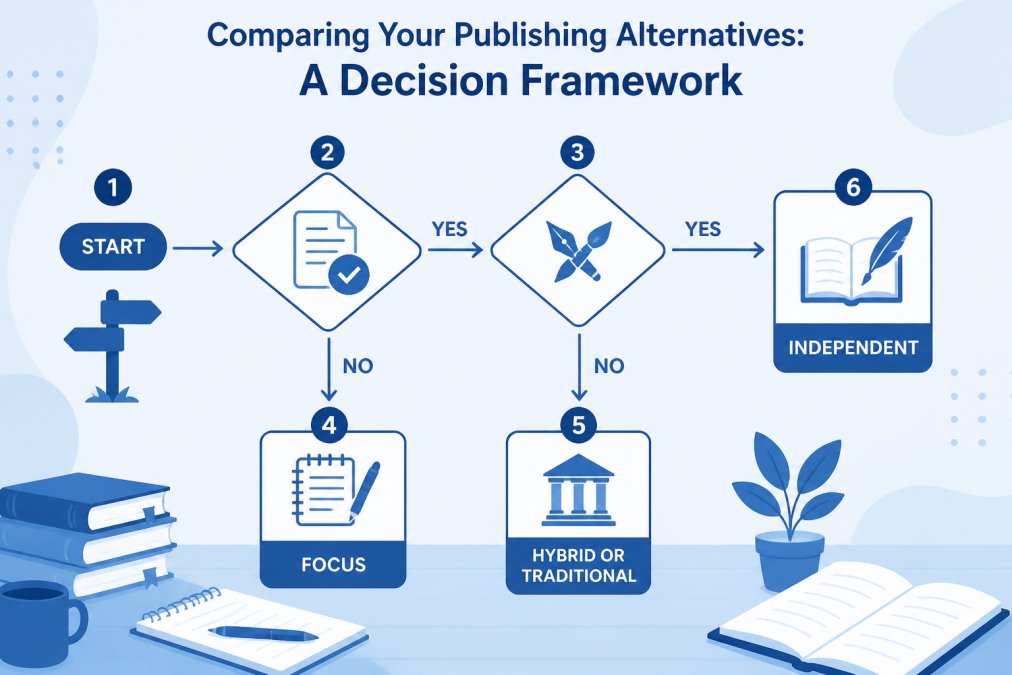
The step most authors skip is the second box. If the manuscript isn't developed, every path below it leads to the same place.
Working through the branches
Start with the manuscript, not the model. A developed manuscript can go either way; an undeveloped one cannot go anywhere useful. If you are unsure which side of that line you are on, the honest test is whether a reader who does not know you can describe the central conflict after ten pages.
If the manuscript is ready, the next question is control. Independent publishing gives you final say on cover, title, pricing, and release timing, plus a higher share per sale. Traditional publishing gives you an editorial team, a distribution network, and the credibility some reviewers and booksellers still attach to a recognised imprint. Neither is better in the abstract; they suit different books and authors.
If the manuscript is not ready, the answer is almost always development before production, a manuscript assessment, a structural edit, or sustained coaching, depending on how far the draft has come. Spending on production before the manuscript is developed is the single most expensive mistake new authors make.
You are not locked in
One thing the decision tree does not show is that these paths are not permanent. Authors move between them all the time. A self-published book that sells well can attract a traditional offer for the next one. A traditionally published author whose contract ends can bring the rights back and reissue independently. Some authors deliberately run both at once, often called being a hybrid author.
The practical implication is that the first decision is not the last one. Choose the path that fits the book in front of you, keep your rights tidy, and stay open to changing route when circumstances change.
A note on common misconceptions
A frequent misconception is that independent publishing is a lesser route, or the same thing as a vanity press. It is not. A vanity press takes payment to produce whatever you send it. Independent publishing is you choosing to run production and marketing yourself, ideally after the manuscript has been properly developed. The distinction is not who pays, it is whether the work was held to a real standard before it went out into the world.
The Business Side: Royalties, Rights, and Long-Term Strategy
Royalties, rights, and long-term strategy are where independent authors most often get caught out. This part of publishing has nothing to do with writing and everything to do with whether the book earns anything after launch.
How the money actually works
A traditional deal usually pays an advance against royalties. That advance is not a signing bonus, it is money paid up front that the book has to earn back before you see further royalty payments. Once earned out, royalties are typically calculated on net receipts, meaning the publisher's cut, retailer discounts, and returns are deducted before your percentage applies. The percentage is usually tiered, with a lower rate on print and a higher rate on ebook, and varies by format and territory.
Independent publishing flips this. There is no advance, but the royalty per sale is much higher because no publisher takes a share. The trade-off is that you carry production, editing, formatting, cover design, and marketing costs yourself, out of pocket before a single copy sells. Traditional publishing trades a smaller share of a larger machine for a larger share of a machine you have to build.
Rights are the real asset
Whether you sign a publishing contract or self-publish, understand what rights you are granting, for how long, and in which territories. Traditional contracts commonly seek world rights, or at least world English rights, plus subsidiary rights covering translation, audio, film, and serialisation. Each is a separate revenue stream, and each can be negotiated.
A common pattern is new authors signing away subsidiary rights they never intended to part with, simply because they did not know those rights were separable. If a publisher is not actively exploiting a right, it is reasonable to ask for a reversion clause returning it after a defined period. Independent authors keep all rights by default, a genuine advantage, but it also means nobody else is out there selling them on your behalf.
Marketing is a shared job, not a handed-over one
With a traditional deal, the publisher runs a book launch and handles bookstore distribution, though most authors are still expected to build an author platform. The publisher's marketing budget is usually concentrated on a small number of lead titles, and most books are not lead titles. Independently, the marketing budget, launch, and sales analytics are yours entirely.
Either way, the work that moves books is broadly the same: a clear hook, a readable sample, honest reviews, and a reason for a reader to pick up the next one. What changes is who pays for it and who is accountable.
Two things competitors rarely mention
- Tax and legal implications. Independent authors are running a small business, not a hobby, once the activity is regular and profit-directed. Income from royalties is generally assessable, and you may need to register for an Australian Business Number and account for GST depending on your turnover. The thresholds change, so check current figures with the Australian Taxation Office rather than assuming you are below them. It is also worth understanding how your author income interacts with any other work you do, and keeping clean records from the first sale rather than reconstructing them at tax time.
- Post-publication maintenance. A book is not finished at launch. Backlist titles keep selling when metadata is maintained, reviews are gathered, and the next book exists to sell the last one. A series with a consistent cover style and linked reading order will outsell the same books published as unrelated titles, because each new release sends readers back to the earlier ones.
The long game
The authors who build a career treat publishing as a multi-year project rather than a single event. That means planning the next book while the current one is still selling, keeping rights tidy, and reviewing what is actually working every few months rather than every few years.
Conclusion: Choosing the Path That Fits Your Story
The hardest part isn't choosing between traditional and independent publishing. It's accepting that neither route will rescue a manuscript that hasn't been properly developed, and that no amount of production spend fixes a story that doesn't hold.
That's the work writeinspire was built for. Our Writer Coaching & Guided Resources give you a professional story partner to shape structure, character, and pacing while you write, and our Creative Writing & Words Collaboration Agreement puts a draft through the same scrutiny the marketplace will apply, with honest feedback and a practical revision plan rather than flattery.


Get started with writeinspire and finish the manuscript that deserves to be read, on whichever publishing path you choose.
Frequently Asked Questions
Is traditional publishing still worth it for new authors?
Traditional publishing offers validation, advance payments, and bookstore distribution, but it moves slowly and gives you limited creative control. For new authors, the main benefit is editorial support and industry credibility. However, many writers now choose independent paths to keep more royalties and retain rights. The right choice depends on whether you prioritise prestige and reach over speed and control.
What are the risks of vanity publishing for first-time writers?
Vanity publishers charge fees to publish your book but offer little editorial rigour or marketing support. They often promise bestseller status or bookstore placement that never materialises. The real risk is paying thousands for a product that has not been professionally developed, leaving you with unsold copies and damaged confidence. Always check whether a publisher invests in your manuscript or just prints it.
How can I maintain creative control while publishing independently?
Independent publishing gives you full control over content, cover design, pricing, and release timing. To keep that control while still producing professional work, hire developmental editors, proofreaders, and cover designers as contractors rather than signing away rights. You retain copyright and decision-making authority. The trade-off is that you fund these services yourself and handle distribution and marketing.
Do I need a literary agent if I choose an alternative publishing path?
No. Literary agents work almost exclusively with traditional publishers to negotiate advances and contracts. If you pursue independent or hybrid publishing, you negotiate directly with editors, designers, and distributors. Some agents now handle hybrid deals, but most independent authors do not need one. What you do need is a properly developed manuscript and a clear understanding of your rights.
What tools and support help independent authors reach a professional standard?
Independent authors need three things: developmental editing, professional cover design, and a distribution plan. Tools for independent authors include writing software, formatting apps, and print-on-demand services. But the most important investment is manuscript development. Working with an experienced coach or editor who stress-tests your story the way the marketplace will is what separates a professional book from a hobby project.