

Table of Contents
- What Guided Story Development Actually Is (And Why It Beats Going It Alone)
- The Benefits of Guided Story Development: What Changes on the Page
- How the Manuscript Development Process Works Step by Step
- Creative Writing Coaching Benefits: Craft, Confidence and Momentum
- Questions to Ask a Potential Writing Coach Before You Commit
- Age-Specific Story Development: What Changes for Different Writers
- Inclusive Storytelling for Neurodiverse Writers
- Conclusion: Your Story Deserves the Structure to Carry It
- Frequently Asked Questions
Last Updated: September 16, 2026
What Guided Story Development Actually Is (And Why It Beats Going It Alone)
Guided story development is the practice of shaping a raw idea into a structured narrative with a mentor reading alongside you, rather than drafting alone and hoping it holds together. We have watched writers spend years circling the same half-finished draft, and the pattern is nearly always the same: the story was never given a structure strong enough to carry it.
The benefits of guided story development show up quickly on the page. Ideas stop drifting, scenes start earning their place, and endings finally arrive.
Here is the difference that matters. A passive approach gives you feedback after the fact, a note on a finished chapter, a comment in a writers' group. Guided development works inside the process, shaping the premise, the arc and the stakes while they are still soft enough to change. That is why writers who work this way finish manuscripts that others only talk about.
The Benefits of Guided Story Development: What Changes on the Page
The clearest benefit is structure. A guided writer learns to articulate the central question of their story, identify the conflict driving it, and understand what is at stake for the characters. Those three elements turn a collection of scenes into a narrative arc with momentum.
From scattered ideas to a structured narrative arc
Most drafts stall because the writer cannot see the shape of the whole. A mentor helps you map the arc before you write another word, so every scene has purpose, tension and consequence.
Why guided writers finish what they start
Accountability is unglamorous and it works. Regular sessions, custom exercises and deadlines keep a project moving through the weeks when motivation disappears. The Australian Society of Authors guidance on developing a manuscript notes that sustained structural feedback is one of the strongest predictors of a completed draft.
How the Manuscript Development Process Works Step by Step
The manuscript development process runs in clear stages, and each one builds on the last. Skipping a stage is the most common reason a draft collapses halfway through. What follows is how a guided session actually runs at each stage, not just what the stage is called.
- Clarify the premise. You answer three questions in writing: what the story is really about, whose story it is, and what changes by the end. A mentor pushes back on vague answers. If you cannot state the premise in two sentences, the draft is not ready to expand.
- Design the narrative arc. Together you map the conflict, the stakes and the turning points onto a single page. The mentor asks where the pressure rises and where it releases. A common pattern is that the middle sags because the stakes never escalate, this is where that gets caught, before another 20,000 words are written.
- Develop character. You build each main character around a want, a fear and a contradiction. The mentor tests whether the antagonist has a coherent logic of their own. Characters who only exist to obstruct the protagonist are the first thing a good mentor will flag.
- Shape scenes and dialogue. Every scene gets a purpose test: what changes between the first line and the last? Dialogue is read aloud in session so you can hear where it explains instead of reveals. This is the stage where most writers discover their narrator has been telling readers what to feel.
- Revise with structured feedback. Feedback arrives in layers, structure first, then scene, then line, never all at once. A mentor who marks up commas while the third act is broken is working in the wrong order. You revise in passes, and each pass has a single job.
- Prepare the submission-ready draft. Final polish covers consistency, rhythm and voice, plus a clean synopsis and opening pages if you are approaching publishers or agents. The Australian Society of Authors guidance on preparing a manuscript for submission is a useful checklist at this point.
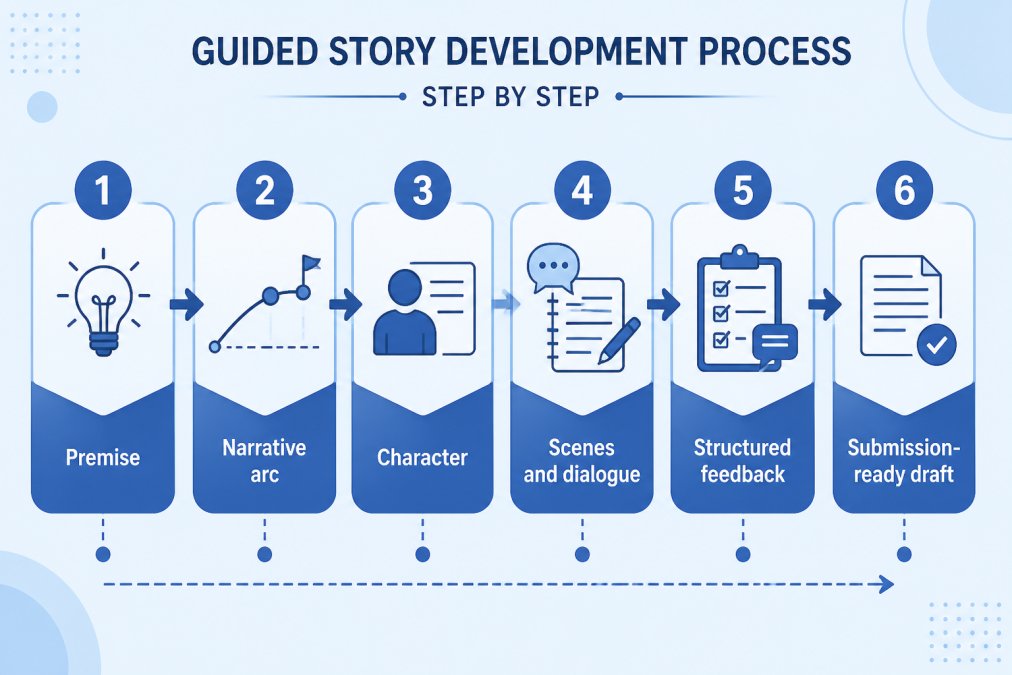
If you are working through that sequence alone, the third and fourth stages are where most writers quietly stop. A mentor keeps you moving through them, because the questions get asked out loud rather than left to a tired evening at the desk.
A practical rhythm many writers use is a fortnightly session with a written check-in in between. That gives you enough time to act on feedback and enough contact to keep momentum. The exact cadence matters less than the fact that it is fixed in advance.
Creative Writing Coaching Benefits: Craft, Confidence and Momentum
Creative writing coaching benefits reach further than a cleaner manuscript. Writers can develop sharper critical thinking about their own work, a stronger command of narrative structure, and the confidence to make bold choices instead of safe ones.
Momentum is the quiet benefit. When someone is expecting work from you, the blank page loses much of its power.
Questions to Ask a Potential Writing Coach Before You Commit
Before you commit, ask direct questions. A coach who cannot answer them plainly is not the right fit, however impressive their website looks.
Module 2 - Creative Story Mastery →
- Who is actually reading my manuscript, and what have they written or produced?
- How often will we meet, and what happens between sessions?
- Do you work on structure and craft, or only line-level editing?
- What do you expect from me each month?
- How do you handle a manuscript that has been sitting unfinished for years?
- What does progress look like after three months?
That last question separates real coaching from a pep talk. You want a process with milestones, not encouragement alone.
Age-Specific Story Development: What Changes for Different Writers
Most articles about guided story development treat every writer the same. In practice, the support a person needs shifts with age and stage, and naming those differences is where a guided approach earns its keep. Age is a guide, not a rule, but the patterns are consistent enough to plan around.
Early primary years (roughly 5-8). At this stage, story development is mostly oral. The work is sequencing, beginning, middle, end, and naming what a character wants. A mentor or parent asks "and then what happened?" and "how did that make them feel?" rather than correcting grammar. Picture prompts and story stones work well because they remove the pressure of spelling and let the imagination lead. The benefit here is confidence with spoken narrative, which later carries into writing.
Upper primary (roughly 9-12). Writers at this age can hold a plot in their head but often lose the thread by the middle. Guided sessions focus on cause and effect: why did the character do that, and what did it cost them? This is also when dialogue starts to matter, and when a young writer benefits from reading their work aloud to hear where it drags.
Teenage writers. The draft is usually ambitious and the self-criticism is loud. Guided development here is as much about permission as craft, permission to write a bad first draft, permission to change the ending. Mentors tend to work on voice and point of view, because teenage writers often have a strong instinct for both but doubt it. Structure comes second, once the writer trusts the material.
Adults returning to writing. The most common pattern is a manuscript or an idea that has been sitting for years.
Inclusive Storytelling for Neurodiverse Writers
That flexibility is where a good mentor earns their place. The structure holds the project together so the writer can focus on the part they love.
Conclusion: Your Story Deserves the Structure to Carry It
The hardest part of writing is not the sentence.
Frequently Asked Questions
How does guided story development differ from self-editing?
Self-editing means working alone with no outside perspective, which makes it hard to see structural problems in your own manuscript. Guided story development brings a trained eye into the process from the start. A coach helps you clarify what your story is really about, spot weak narrative arcs, and test whether your scenes carry tension and consequence. You still do the writing, but you get direction on structure and craft before problems become expensive to fix.
Can guided story development help overcome writer's block?
Yes, because most blocks are structural, not motivational. When you do not know what happens next, it usually means the premise, stakes or character motivation needs sharpening. Guided story development gives you a framework to work through those questions with someone experienced. Instead of staring at a blank page, you have a clear next step and a person who asks the right questions to get you moving again.
Is guided story development suitable for first-time novelists?
It is especially valuable for first-time novelists. Learning narrative structure, character development and pacing on your own takes years of trial and error. Guided story development shortens that learning curve by showing you how stories actually work while you write yours. You build craft knowledge and a finished manuscript at the same time, rather than finishing a draft and then discovering the structure does not hold.
What should I expect during a guided story development session?
Expect focused questions about your story rather than generic encouragement. A session usually starts with where your manuscript is now, what is working, and where it stalls. Your coach will examine premise, conflict, stakes and character motivation, then suggest specific exercises or revisions. You leave with clear next steps. Sessions work best when you bring pages and honest questions, not just ideas you want validated.