

Table of Contents
- What Does Professional Writing Coaching Actually Include?
- Writing Coach Rates in Australia: What to Expect
- How to Choose a Writing Coach Who Fits Your Budget and Goals
- Tax Deductions for Professional Development for Writers
- Tiered Budgeting Strategies and Payment Plans
- Budget-Friendly Alternatives to One-on-One Coaching
- Frequently Asked Questions
Last Updated: September 10, 2026
What Does Professional Writing Coaching Actually Include?
Budgeting for professional writing coaching starts with understanding what you're buying. Writing coaching is a structured, ongoing relationship in which an experienced writer helps you develop your manuscript, craft and habits session by session, rather than simply correcting what you've written.

At writeinspire, we offer over 30 years of experience in creative writing coaching, and the pattern is consistent: people who understand the shape of the service before they spend a cent get far more out of it. Most writers who stall aren't short on talent, they're short on structure, feedback and hard questions about their story.
That distinction changes what you budget for: not a fixed deliverable, but time, attention and accountability across months, not weeks.
Coaching vs. Developmental Editing: What You're Paying For
Writing coaching is ongoing guidance that builds your skills while you write, while developmental editing is a one-off assessment of a finished or near-finished manuscript.
The practical difference is who does the work. A developmental editor reads your draft and hands back a report on structure, character, pacing and marketability, which you apply yourself. A coach sits alongside you through the drafting, solving problems as they arise and holding you to a schedule.
Both have their place. If you have a complete manuscript and want a professional diagnosis, editing is efficient. If you have a half-finished draft in a drawer, coaching addresses what editing can't: the writing itself.
Writing Coach Rates in Australia: What to Expect
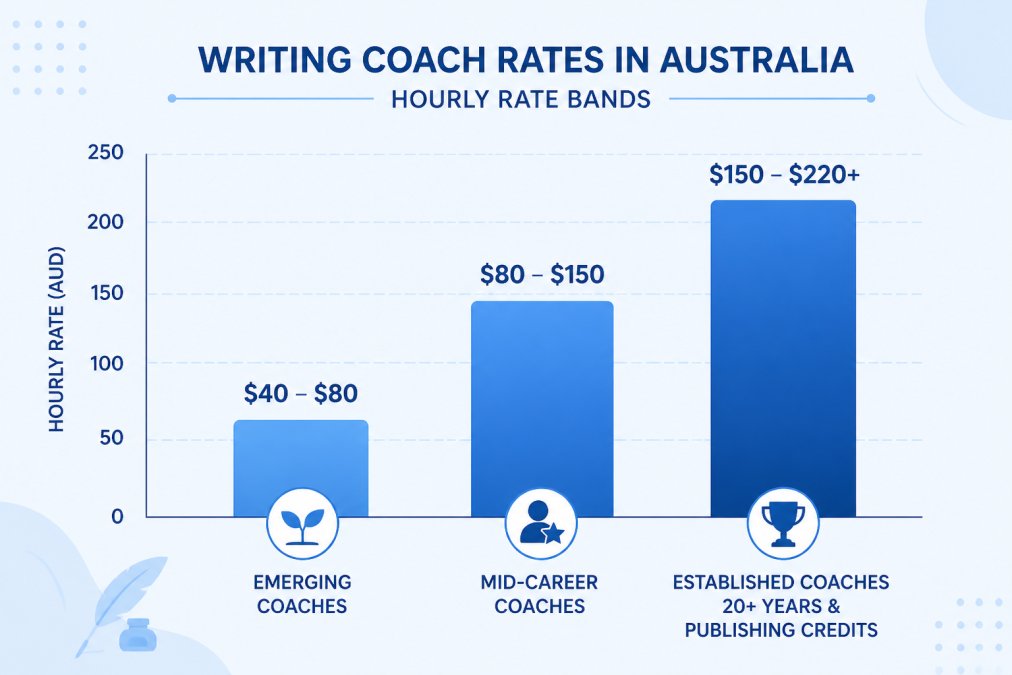
Writing coach rates in Australia vary widely, and there's no single going rate. What you pay reflects the coach's experience, the depth of feedback, whether sessions are one-on-one, and how much work happens between sessions.
Rather than quote a national average that won't apply to you, it's more useful to understand the pricing models you'll encounter, what pushes a figure up or down, and how to translate any quote into a weekly commitment you can plan around.
Hourly, Package, and Retainer Pricing Models
Each model suits a different writer, and choosing the wrong one is where budgets go wrong.
- Hourly: You pay per session. Flexible and low commitment, but the cost per hour is usually highest and there's no momentum between sessions.
- Package: A fixed number of sessions or a defined program at a set rate. Predictable, and usually better value per session. Best for writers with a clear goal, like finishing a draft.
- Retainer: A monthly fee for ongoing access and support. Suits writers working steadily over a long period, particularly on a full-length manuscript or script.
A common mistake is choosing hourly because it feels cheaper, then booking sporadically and never building momentum. For most writers with a manuscript to finish, a structured package works out better in money and progress.
What Actually Moves the Number Up or Down
Two coaches can quote very different figures for the same-sounding service. What's behind the gap:
- Experience and track record. A coach who has published, produced or edited across a long career will sit at the higher end. An emerging coach building a practice will sit lower.
- Session length and format. A 30-minute check-in and a 90-minute deep-dive are not the same product. Group sessions cost less per head than one-on-one, because the coach's attention is shared.
- Feedback between sessions. Written notes on pages, margin comments, or a short voice memo each week add real hours to a coach's workload. If it's included, it's priced in.
- Turnaround time. A coach who reads your chapter within 48 hours is charging for priority. A two-week window costs less.
- Specialism. Coaches who work in a specific genre, form or market can charge more because they save you time you'd otherwise spend explaining your world.
Turning a Quote into a Weekly Figure
Headline figures feel bigger than they are. Divide.
Take the total cost of a package and divide it by the weeks it runs. That's your real weekly commitment, a six-month program looks very different per week than as a single number.
Then compare that weekly figure against what you already spend on writing-adjacent things: unopened craft books, subscriptions, conference tickets, takeaway coffees. Most writers find the weekly figure smaller than they assumed, and the question shifts from "can I afford this?" to "is this the best use of what I can afford?"
Why the Cheapest Quote Isn't the Cheapest Option
A low hourly rate with no structure between sessions often costs more long-term, because you pay for the same problems twice. Finish a program without a repeatable process and you'll be back at the start on your next manuscript.
A better question than "what's your rate?" is "what will I be able to do at the end that I can't do now?" That tells you whether the figure is a cost or an investment.
How to Choose a Writing Coach Who Fits Your Budget and Goals
The right coach matches your project and offers a process you can sustain. Before comparing anyone on price, get clear on three things: what you're writing, where you're stuck, and how much time you can genuinely commit each week.
Then ask every coach the same questions:
- What have you written, published or produced yourself?
- How do you structure feedback between sessions?
- What happens if I miss a session or fall behind?
- What does a finished outcome look like for someone at my stage?
- Can I see how your program is laid out before I commit?
Anyone who can't answer those plainly isn't worth your money.
Vetting Credentials and Contract Red Flags
Credentials in this field aren't standardised, so assess track record, not letters after a name. Look for a body of work, a clear method, and evidence they've taken other writers from draft to finished manuscript.
Watch for these red flags:
- Pressure to commit to a large upfront payment before any conversation about your work
- Vague deliverables, with no session count or timeline in writing
- Promises about publication or literary agent introductions
- No refund or rescheduling terms stated anywhere
- A pitch that sounds more like a publishing package than a coaching relationship
What to Look For in the Agreement Itself
Most writers focus on the price and skim the terms, where the expensive surprises hide. Before signing, read the agreement for these five things, and ask for anything missing in writing.
1. A named deliverable and timeline. "Ongoing coaching" is not a deliverable. "Eight fortnightly sessions over sixteen weeks, with written feedback on up to 5,000 words between each session" is. If scope isn't written down, you can't tell whether you got what you paid for.
2. A clear cancellation and rescheduling policy. What happens if you miss a session, or the coach does? Is there a notice period? A fair agreement protects both sides and states the answer plainly rather than leaving it to goodwill.
3. A refund position. You don't need a generous clause, but you need to know whether one exists. "No refunds under any circumstances" on a long program is worth weighing carefully.
4. Scope boundaries. Does the fee cover your full manuscript, or only the pages you bring to sessions? Does it include query letters, synopses or submission support? Scope creep is the quiet way a fixed package becomes open-ended.
5. Who owns what. Your manuscript is yours. Confirm in writing that any notes, edits or materials the coach produces come with no strings attached, and that you retain full rights to your writing.
Questions That Reveal How a Coach Actually Works
Price tells you what something costs. These questions tell you what you're getting:
- "Can you show me a sample of the feedback you give between sessions?" Real coaches have examples ready.
- "How do you handle it when a writer disagrees with your feedback?" The answer shows whether they're coaching you or rewriting you.
- "What's the most common reason your writers stall, and how do you handle it?" A specific answer means they've seen it before.
- "What would make you tell me I don't need coaching right now?" A coach with integrity will have an answer.
Matching the Coach to Your Stage, Not Just Your Budget
Beginners and advanced writers need different things, and paying for the wrong one wastes money either way.
If you're starting out, you need structure, deadlines and someone who'll read your pages and tell you the truth. A coach strong on habit-building and craft fundamentals is worth more than a submission-strategy specialist you're not ready to use.
If you're finishing a full-length work, you need someone who understands your genre, market and the shape of a complete manuscript. That's a narrower skill set at a higher rate, but the right spend at that stage.
If you're between projects, a short, focused engagement, a manuscript assessment, a structural review, a few sessions on one problem, often serves you better than a long program you don't yet need.
Tax Deductions for Professional Development for Writers
Tax deductions for professional development for writers depend on whether the expense relates to your current income-earning activity, so treat this as a prompt to check your own situation, not a rule.
The Australian Taxation Office principle is that a deduction is available for expenses incurred in gaining or producing assessable income. For a writer earning income from writing, a coaching program that maintains or improves the skills used in that work is worth investigating. If you write purely for pleasure and earn nothing, that connection is harder to establish.
Keep every invoice, note what the program covered, and confirm your position with a registered tax agent before you claim. Rules change, and your circumstances decide the answer.
Australian Taxation Office guidance on deductions for work-related expenses
Tiered Budgeting Strategies and Payment Plans
A workable writing budget is built in tiers, not decided in one go. Rather than asking "can I afford coaching?", ask what you can commit each month and which tier of support that buys.
Here's a framework you can apply today:
| Tier | What You Commit | What It Buys | Best For |
|---|---|---|---|
| Starter | One session per month | Feedback on a chapter or outline, goal setting | Testing whether coaching suits you |
| Steady | Fortnightly sessions | Regular feedback, accountability between sessions | Writers with a draft underway |
| Intensive | Weekly or structured program | Full manuscript development with ongoing support | Writers finishing a full-length work |
Payment plans are worth asking about directly. Many coaches split a package across instalments, turning a large upfront figure into a manageable monthly one. It costs nothing to ask, and the answer tells you a lot about how the provider treats writers.
Calculating Your Return on Investment
The return on writing coaching isn't measured in dollars alone. It's measured in whether you finish, and what you finish is worth.
Run the numbers: divide the total cost by the weeks it runs for your real weekly commitment. Then ask what you're trading it against, a streaming subscription, a few takeaway meals, a stack of unread craft books. Framed weekly, most coaching looks far more affordable than the headline figure suggests.
The other half of the return is what you gain: a finished manuscript, a repeatable process for the next book, and a clear understanding of story structure, assets that don't expire when the program ends. A writer who finishes one book badly and learns why will finish the next one well.
Budget-Friendly Alternatives to One-on-One Coaching
If one-on-one coaching isn't within reach right now, several lower-cost options still build real skill. What matters is that your choice provides structure and honest feedback, not just encouragement.
- Structured short courses give you a method and a cohort without the price of private sessions.
- Writing workshops offer critique and deadlines, though the quality of feedback depends entirely on who's in the room.
- Accountability partners work well if you already understand craft and just need someone expecting pages.
- Guided programs with group support sit between a course and private coaching, and often include printed materials you keep.
A writers' group is a fine supplement but a poor substitute for a coach if the feedback is polite rather than useful. If nobody will tell you your second act sags, you'll keep writing a sagging second act.
For writers who want the structure of a program with ongoing support, the National Library of Australia's research guides for writers and similar resources can point you toward workshops and continuing education options worth considering.
Budgets are tight, time is tighter, and the manuscript in the drawer isn't getting shorter. If you're ready to stop circling and start finishing, writeinspire offers writing coaching and guided resources built around your project, including one-on-one consultation to sharpen structure, grammar and style, and structured programs that carry you from first spark to finished manuscript. With more than 30 years of experience and a focus on rigorous development rather than vanity publishing, we work with writers to create, edit, and format their work. Get started with writeinspire and finish the book you've been meaning to write.

Frequently Asked Questions
How much does a professional writing coach typically charge in Australia?
Rates vary widely based on experience and format. Always ask what's included: some coaches bundle manuscript assessment, regular check-ins, and editorial feedback, while others charge separately for each service.
Is professional writing coaching a tax-deductible expense for Australian authors?
If you're earning income from writing or running a writing business, coaching directly related to your current work is generally tax-deductible as a professional development expense. The Australian Taxation Office allows deductions for self-education that maintains or improves skills in your current profession. Keep receipts and a record of how the coaching connects to your income-earning activities. If you're pre-revenue, check with a registered tax agent about whether you can claim it.
What is the difference between a writing coach and a structural editor?
A writing coach helps you develop your craft, stay accountable, and work through story structure, character development, and voice and style as you write. A structural editor typically works on a completed manuscript, assessing big-picture elements like plot, pacing, and marketability. Coaching is ongoing and developmental; editing is often a one-off assessment. Some writers use both: coaching to finish the draft, then editing to polish it for submission.
How do I determine if a writing coach is worth the investment?
Start by clarifying your goal: finishing a manuscript, improving a specific skill, or preparing for publication. Then ask what progress looks like and how you'll measure it. A coach who offers a clear plan, sample session, and transparent pricing makes the decision easier. Consider the cost per session against the value of finally completing your project. Structured accountability and professional feedback can save years of stalled effort. Request a consultation before committing.