

Table of Contents
- Why Reading Matters for Writers
- Build a Consistent Writing Routine That Works
- How to Structure a Novel Manuscript
- Develop Character Voices and Dialogue
- Creative Writing Exercises for Beginners
- Editing Tips for Fiction Manuscripts
- Overcome Writer's Block and Keep Moving
- Seek Feedback and Refine Your Craft
- Frequently Asked Questions
Last Updated: September 27, 2026
Why Reading Matters for Writers
Reading is the foundation of becoming a better fiction writer. When you read widely, you absorb narrative structures, character development techniques, and prose styles without consciously studying them. Every book you finish teaches you something about pacing, dialogue, or how to build tension. Writers who read consistently often produce stronger manuscripts than those who focus only on writing.
The best writers are voracious readers. They study how other authors handle plot twists, reveal character motivation, and create worlds readers want to inhabit. Reading shows you what works. It also shows you what doesn't.
Start with genres you want to write in. Read the classics in your chosen field. Then branch out to adjacent genres. This broad exposure trains your instincts. You begin to recognise what feels authentic and what feels forced.
A practical tip: keep a reading journal. Note passages that move you. Write down why they work. This active reading sharpens your critical eye far more than passive consumption.
Build a Consistent Writing Routine That Works
The single biggest barrier to improving fiction writing skills is inconsistency. Writers often expect inspiration to strike. It rarely does. Instead, you need a routine that works with your life, not against it.
A consistent writing routine builds momentum. It trains your brain to enter creative mode at predictable times. Even two hours per week, scheduled and protected, produces better results than sporadic ten-hour writing binges.
Start small. Many writers assume they need big blocks of time. They don't. What matters is showing up regularly. Here's how to build a routine that sticks:
- Choose a time when you're naturally alert and have minimal distractions
- Commit to the same time daily or on set days each week
- Remove friction: have your workspace ready before you sit down
- Track your sessions so you can see the pattern forming
- Adjust only if life genuinely demands it, not on a whim
The 90-Minute Draft Method works well for many writers because it chunks writing into manageable sessions. This approach can prevent burnout and keep writing feeling sustainable.
How to Structure a Novel Manuscript
Structure is where many fiction writers struggle. They have a great idea and compelling characters, but the story meanders. Strong structure gives your narrative a spine. It creates momentum that carries readers through to the end.
The three-act structure remains the most reliable framework for fiction. Act One establishes the world and introduces the central conflict. Act Two develops that conflict through escalating complications. Act Three resolves the tension and delivers the climax.
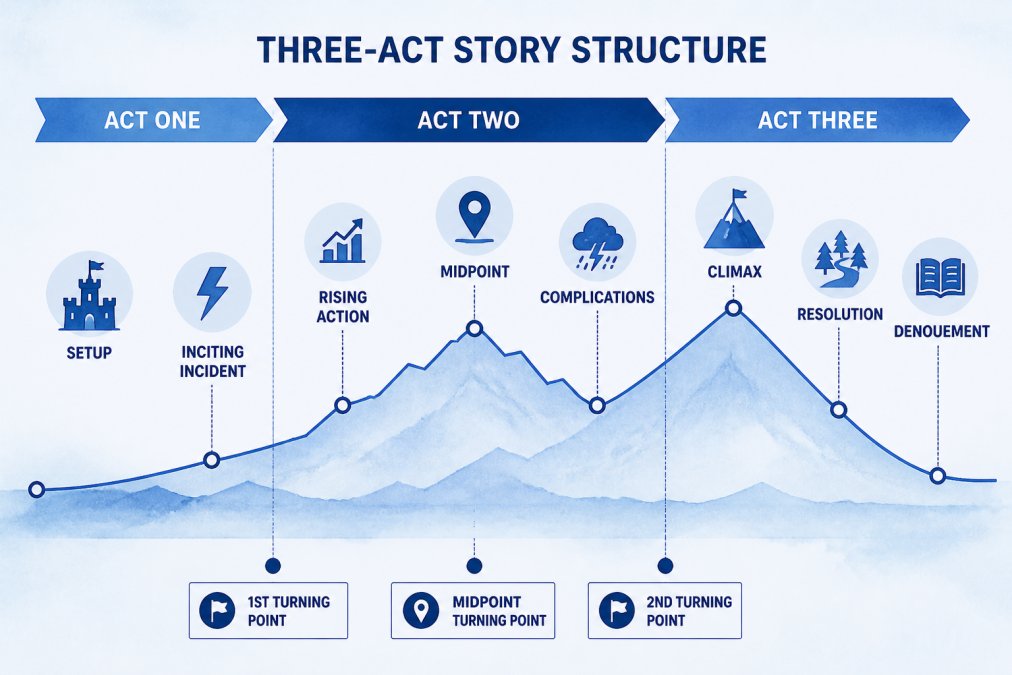
Within this framework, identify your key turning points. The inciting incident forces your protagonist into the central conflict. The midpoint raises the stakes. The climax delivers the confrontation your story has been building toward. The denouement shows the consequences of that confrontation.
Most manuscripts benefit from a clear outline before you draft. This doesn't mean rigid planning. It means knowing your story's major beats. Many writers use the Save the Cat framework or the Hero's Journey as templates. Others create their own structure based on their story's needs.
The structure should serve your story, not constrain it. If a scene isn't working, the problem is often structural. The scene might belong in a different position, or it might need to be cut entirely.
Develop Character Voices and Dialogue
Characters drive fiction. Readers connect with stories through characters. Strong character voices make your dialogue feel authentic and your narrative voice distinctive.
Each character should have a distinct way of speaking. This doesn't mean giving every character an accent or quirk. It means they have different vocabulary, sentence rhythms, and concerns. A surgeon speaks differently than a teenager. A character from the city speaks differently than one from rural areas. These differences should emerge naturally through dialogue.
Dialogue serves multiple purposes. It reveals character. It advances plot. It creates tension. Weak dialogue does none of these things. It's just characters exchanging information.
Here's how to strengthen your dialogue:
- Cut exposition. Characters don't naturally explain things to each other they already know
- Use subtext. What characters don't say often matters more than what they do
- Vary sentence length. Short sentences create urgency. Longer ones allow reflection
- Give each character distinct speech patterns
- Remove dialogue tags when the speaker is clear
- Test dialogue by reading it aloud
Your narrative voice, the voice telling the story, should also be distinctive. Is it close to your protagonist's perspective or more distant? Formal or conversational? The narrative voice shapes how readers experience your story.
Module 2 - Creative Story Mastery →
Creative Writing Exercises for Beginners
Targeted exercises build specific skills. They're low-stakes ways to practise without the pressure of your main manuscript. These exercises help you improve fiction writing skills through focused repetition.
Character sketches force you to develop depth. Write a character's background, motivations, fears, and secrets. Then write a scene showing them under pressure. Do this for minor characters too. Secondary characters with depth make your world feel lived-in.
Scene writing isolates the skill of creating tension in a single moment. Take a simple scenario, two people meeting for coffee, and write it three ways. First, make it tense. Second, make it comedic. Third, make it tender. This exercise teaches you how small choices create different emotional effects.
Dialogue-only scenes remove the crutch of narrative explanation. Write a scene using only dialogue and action tags. No internal monologue. No description. This forces you to show character and advance plot through what characters say and do.
Perspective shifts expand your range. Rewrite a scene you've already written from a different character's point of view. Notice what changes. Notice what each character knows and doesn't know. This deepens your understanding of your story's mechanics.
Timed writing builds confidence. Set a timer for twenty minutes and write without stopping. Don't edit. Don't judge. Just write. This trains your brain to generate ideas faster and quiets the inner critic that blocks many writers.
The key is practising deliberately. Random writing doesn't improve skills. Focused practice on specific challenges does.
Editing Tips for Fiction Manuscripts
Editing separates good writers from great ones. Many writers finish a draft and think they're done. The real work begins in revision. This is where you improve fiction writing skills through critical analysis of your own work.
First drafts are rarely publishable. They're often rough. They contain plot holes, inconsistent character behaviour, and pacing problems. Editing fixes these issues.
Start with big-picture editing. Read your manuscript and ask:
- Does the story arc work? Does each act build on the previous one?
- Are character motivations clear? Do characters' actions feel earned?
- Is the pacing consistent? Do slow sections drag?
- Are there plot holes? Are all promises made to the reader kept?
Only after addressing these structural issues should you focus on sentence-level editing.
- Repetitive words or phrases
- Passive voice that should be active
- Telling instead of showing
- Dialogue that doesn't sound natural
- Descriptions that don't serve the story
Overcome Writer's Block and Keep Moving
Writer's block stops many writers. They sit down to write and nothing comes. Fear, perfectionism, or uncertainty about the story can all trigger it. The solution isn't waiting for inspiration. It's understanding what's actually blocking you.
Here are strategies that work:
- Lower your expectations. Aim for a bad first draft, not a good one
- Skip the difficult scene. Write something else and come back to it
- Change your environment. Sometimes a new location sparks creativity
- Discuss the stuck point with another writer. Talking through problems often reveals solutions
- Set a timer and write without stopping. Momentum matters more than quality
Seek Feedback and Refine Your Craft
Feedback is essential to growth. You cannot improve fiction writing skills in isolation. Other readers see your work differently than you do. They catch problems you've become blind to.
Frequently Asked Questions
What are the core skills needed to improve fiction writing skills?
The foundation rests on five pillars: understanding narrative structure (how stories arc from beginning to end), character development (making readers care about who your characters are and what they want), dialogue that reveals character and advances plot, prose clarity (writing sentences that earn their place), and the ability to revise ruthlessly. Most writers focus on one or two and neglect the others. Balanced improvement means building strength across all five.
How can I improve my creative writing skills with daily practice?
Consistency matters more than duration. Thirty minutes daily beats three hours once a week. Set a specific time, remove distractions, and commit to writing something, even if it's rough. Track your progress beyond word count: note scenes completed, character moments discovered, or plot problems solved. Many writers find that pairing daily writing with daily reading (even 15 minutes) accelerates skill development because you're absorbing narrative patterns while producing your own work.
What are the most common mistakes new fiction writers make?
Starting without a clear story premise leads to manuscripts that drift. Telling instead of showing (explaining emotion rather than dramatising it through action and dialogue) weakens reader connection. Inconsistent character voices make readers lose track of who's speaking. Neglecting revision, treating the first draft as final, is perhaps the biggest mistake. Professional writers expect to revise multiple times. Finally, many new writers isolate themselves instead of seeking feedback, missing the chance to catch blind spots early.
How long does it typically take to improve fiction writing skills noticeably?
Most writers see meaningful improvement within 3-6 months of consistent, focused practice combined with deliberate feedback. However, reaching manuscript-ready quality typically takes 12-24 months depending on starting point and intensity of work. The key is not time elapsed but deliberate practice: writing with intention, revising based on feedback, and studying craft through reading and structured guidance. Shortcuts don't exist, but structured coaching accelerates the process significantly.