

Table of Contents
- Why the Most Expensive Creative Writing Workshops Aren't Always the Best
- What to Look For in Creative Writing Coaching Services
- The Self-Taught Curriculum: How to Structure Your Own Study
- 1. Structured Workbooks: Guided Practice for a Fraction of the Cost
- 2. Creative Writing Coaching Services: Personalised Manuscript Development
- 3. Self-Guided Creative Writing Courses: Learn at Your Own Pace
- 4. Writing Critique Groups: Free Feedback That Works
- 5. Mentorship vs. Workshop: Which Builds Better Writers?
- The ROI of Writing Education: Where Your Money Does the Most Work
- Choosing Your Path Forward
- Frequently Asked Questions
Last Updated: September 5, 2026
Aspiring authors often assume that serious craft development requires a hefty tuition bill. Yet the most expensive creative writing workshops are rarely the ones that turn a half-finished draft into a publishable manuscript. At writeinspire, we've spent over 30 years coaching independent creatives, and we've seen firsthand that structured, affordable education frequently outperforms prestige programs.
The real difference comes down to feedback quality, accountability, and consistent writing practice, not the price tag. This guide from writeinspire explores seven practical alternatives to expensive creative writing workshops that deliver genuine manuscript development without the premium cost. Whether you are drafting a play, a short story, or a full-length novel, these options help you build literary craft on your terms.

Below, we'll break down what each alternative offers, where it falls short, and how to structure a self-directed path that keeps your writing moving forward. But first, here is what most guides get wrong: they treat workshops as the only legitimate route to improvement. In practice, a well-chosen workbook or a focused critique group often builds better writing habits than a costly weekend retreat ever will.
Why the Most Expensive Creative Writing Workshops Aren't Always the Best
The biggest mistake writers make is equating high tuition fees with high-quality instruction. Expensive workshops often bundle costs like accommodation, catering, and venue hire, which inflate the price without adding anything to your skill acquisition. What you are paying for is the experience, not necessarily the editorial guidance.
A common approach in these settings is round-table feedback, where every participant comments on your work. While this sounds valuable, the quality of peer critique varies enormously. You might receive conflicting advice from writers at very different stages, leaving you more confused than when you arrived.
What most guides miss is that learning outcomes depend on the feedback loop, not the setting. A focused session with one experienced professional storyteller who understands your genre can transform a manuscript faster than a week of generalised comments. For many writers, particularly those balancing family or work commitments, the time away is as costly as the fee itself.
What to Look For in Creative Writing Coaching Services
When evaluating creative writing coaching services, the first question to ask is whether the program offers a clear curriculum or simply promises inspiration. Strong coaching provides a sequenced path from story idea to finished draft, with specific milestones along the way.

Look for services that emphasise rigorous manuscript development over vanity publishing. A coach who celebrates everything you write without pushing you to revise is not helping you grow. You want someone who will challenge your character motivations, question your scene structure, and demand that every line earns its place.
Flexibility matters just as much as expertise. If you have an hour or two a week to dedicate to writing, the coaching should adapt to your schedule rather than requiring big blocks of time. Many writers abandon projects because the process feels overwhelming, so seek out support that breaks the work into manageable, consistent sessions.
Credentials vs. Results: What Actually Matters
A long list of qualifications tells you little about whether a coach can help you finish your book. What matters is a track record of working with writers at your stage, from new storytellers finding their voice to established authors wrestling with a difficult second draft.
Ask direct questions before committing. Has the coach helped writers complete full-length manuscripts? Do they work across your chosen form, whether that is a stage play, a novel, or a collection of short stories? The right coach treats you as a collaborator in the creative process, not a student to be lectured.
The Self-Taught Curriculum: How to Structure Your Own Study
Self-directed study is the most affordable education available, but it fails without structure. A loose intention to "write more" rarely survives contact with a busy week. You need a deliberate curriculum that builds skill in a logical order.
Start with the fundamentals of storytelling: what makes a premise compelling, how conflict drives narrative, and why stakes keep readers turning pages. From there, move through character development, scene construction, and dialogue. Each element builds on the last, so resist the urge to jump ahead to polishing prose before your story structure is sound.
Writing prompts and writing exercises help maintain momentum between larger projects. Schedule a regular writing practice, even if it is only twenty minutes a day, and treat that time as non-negotiable. Over months, this consistency produces more pages than sporadic bursts of inspiration ever will.
1. Structured Workbooks: Guided Practice for a Fraction of the Cost
Structured workbooks offer the closest thing to a personal tutor at a fraction of the cost. These guided resources take you step by step through the craft, providing daily prompts and exercises that build on each other.
A strong workbook creates a feedback loop through reflection. You write, you review what you produced, and you capture ideas for future stories. This process builds creative consistency rather than chasing perfection. For example, the Write A Play in 30-Days workbook guides you through thirty focused days of stage-play creation, connecting your creative spark to story structure and scene craft until you complete a full play concept.
The limitation of workbooks is the absence of external feedback. You are your own editor, which means you may miss blind spots in your technique. Use them as a foundation, then layer in critique from other sources to catch what you cannot see.
2. Creative Writing Coaching Services: Personalised Manuscript Development
For writers serious about finishing a book, one-on-one coaching delivers the highest return on investment. Creative writing coaching services provide personalised manuscript development that adapts to your project, your schedule, and your skill level.
Our top pick is writeinspire, because the coaching model focuses on rigorous craft rather than empty encouragement. As an independent Australian creative service, it pairs you with a professional story partner who helps you formulate the core premise, develop the narrative arc, and strengthen characters until the story builds with real momentum.
This is not a vanity publishing arrangement. Expect to put in the work. The coach is there to build the book properly, shape it with craft, and keep it moving until it is real. For writers with a half-finished manuscript sitting in a drawer, this structured support is often the difference between a permanent draft and a published work.
3. Self-Guided Creative Writing Courses: Learn at Your Own Pace
Self-guided creative writing courses suit independent learners who want structure without fixed meeting times. These programs deliver a curriculum through modules, allowing you to progress when life permits.
The strength of this format is depth. A well-designed course explores each element of craft thoroughly, from finding a story to refining your language. The Creative Story Mastery program breaks the writing process into focused modules covering story development, character, scene, action, dialogue, and words. Each builds a comprehensive understanding you can apply directly to your current project.
The trade-off is the lack of deadlines. Without external accountability, it is easy to let weeks slip by between modules. Set your own schedule with clear milestones, and treat each completed module as a genuine achievement rather than a box to tick.
4. Writing Critique Groups: Free Feedback That Works
Writing critique groups offer something money cannot buy: a community of writers who read your work closely and respond honestly. The best groups provide a steady feedback loop that sharpens your instincts and catches problems early.
To find a good group, look beyond general writing communities toward genre-specific gatherings. A group of novelists will serve you better than a mixed group if you are writing a novel. Many libraries and community centres host free groups, and online forums connect writers across distances. The Australian Society of Authors resources can point you toward reputable writing communities and professional development opportunities.
The challenge is managing the quality of feedback. Not all critique is useful, and conflicting advice can stall your progress. Learn to distinguish between subjective preference and objective craft issues, and always filter suggestions through your own vision for the story.
5. Mentorship vs. Workshop: Which Builds Better Writers?
Mentorship and workshops answer different needs. A workshop provides a burst of intensive instruction and networking, while mentorship offers sustained, individualised guidance over the long arc of a project.
For most writers, mentorship wins. A mentor follows your work from first draft to final page, understands your strengths and weaknesses, and holds you accountable week after week. This continuity is what transforms a promising idea into a finished manuscript. Workshops, by contrast, end just as you are getting started, leaving you to apply the lessons alone.
That said, mentorship is a deeper commitment from both parties. You must be ready to receive honest criticism and act on it. If you are not prepared to revise substantially, no mentor can save the project. For writers ready to do the work, the results speak for themselves.
| Option | Best For | Key Benefit | Main Limitation |
|---|---|---|---|
| Structured workbooks | Self-motivated beginners | Daily guided practice | No external feedback |
| One-on-one coaching | Writers finishing manuscripts | Personalised accountability | Requires commitment to revision |
| Self-guided courses | Independent learners | Comprehensive curriculum | No fixed deadlines |
| Critique groups | Writers seeking community | Free, honest feedback | Variable advice quality |
| Mentorship | Long-term project support | Sustained individual guidance | Demands serious effort |
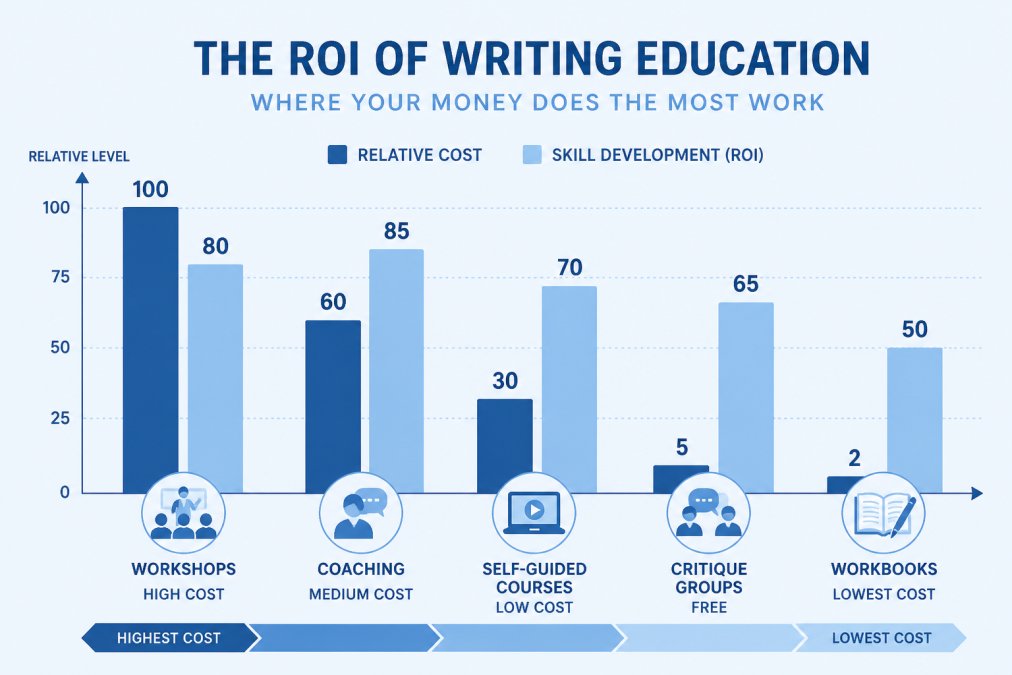
The ROI of Writing Education: Where Your Money Does the Most Work
Every writing education option asks for a trade-off between cost, time, and the quality of feedback you receive. Understanding this trade-off helps you spend where it matters most.
The most cost-effective path combines free resources with targeted paid support. Join a critique group for ongoing feedback, use a structured workbook to build daily habits, and invest in coaching when you need expert guidance on a specific project. This layered approach spreads your spending across the writing process rather than betting everything on one expensive workshop.
Where writers waste money is on instruction that does not match their current stage. A beginner attending an advanced masterclass gains little, while an experienced author taking a basic course stalls. Match the resource to your skill level, and you will see progress from every dollar spent.
The Australia Council for the Arts guidance on professional development notes that ongoing skill development is central to a sustainable creative career. Building a mix of affordable learning methods supports that goal far better than a single costly event.
Choosing Your Path Forward
The alternatives to expensive creative writing workshops are not compromises; for many writers, they are superior. Structured workbooks build daily discipline, coaching provides personalised accountability, self-guided courses deliver comprehensive craft knowledge, and critique groups offer community feedback. The best approach combines several of these to suit your schedule, budget, and current project.
The throughline across every option is consistent writing practice. No course, coach, or group can write your book for you. What they can do is provide the structure, feedback, and encouragement that keep you at the desk until the manuscript is finished.
Start where you are. If you have a story you can feel in your bones but cannot seem to finish, explore the Writing Coaching options at writeinspire, or pick up a workbook to build momentum this week. The fastest way to improve your writing is to write something today, and then get honest feedback on it tomorrow.
Choosing the right path for your writing development is a personal decision, and the options above give you room to experiment without overspending. At writeinspire, we believe every storyteller deserves access to rigorous coaching that respects their time and ambition. Our structured programs, built on 30 years of experience, focus on real manuscript development rather than empty promises. Explore the Creative Story Mastery modules or book a Writing Consultation to see how guided support can bring your story to the page. Get started with writeinspire and turn the book in your head into a manuscript you are proud to share.
Frequently Asked Questions
Are expensive creative writing workshops worth the investment?
Not always. The price tag often reflects venue, marketing, and the instructor's reputation rather than the quality of feedback you receive. A module from Creative Story Mastery or a coaching resource gives you structured, expert guidance that targets your specific weaknesses. Before paying for a workshop, check the syllabus, the instructor's publishing credits, and whether you'll get individual feedback or just a group critique. Often, you can replicate the core value through cheaper coaching or a well-designed workbook.
How can I improve my writing skills without a formal course?
You can build a rigorous self-led curriculum using structured workbooks like Write A Play in 30-Days ($59.95) or The 90-Minute Draft Method ($49.95). These guide you through story structure, character, scene, and dialogue with daily exercises. Pair that with a writing critique group for feedback and a few sessions with a writing coach when you get stuck. The key is consistent practice: write daily, read like a writer, and seek feedback on your drafts.
How do I find a reliable writing mentor or coach?
Look for someone with published work and teaching experience, not just a degree. Ask about their process: do they offer manuscript development, editorial guidance, or accountability? A good coach works with your existing draft rather than imposing a template. Services like WriteInspire's Writer Coaching & Guided Resources ($145) offer structured support for writers at any stage. Check their portfolio and ask for references before committing to a long-term arrangement.
What are the best free resources for aspiring authors?
Writing critique groups are the most valuable free resource. Look for local meetups, library groups, or online communities where writers exchange manuscript feedback. These groups teach you to analyse other writers' work, which sharpens your own editorial instincts. Complement that with free writing prompts, public-domain craft books, and literary journals to study how published authors handle scene, dialogue, and pacing.
What is the difference between creative writing coaching and a writing critique group?
A critique group gives you reader reactions and peer feedback, which helps you see how your work lands with an audience. A coach provides professional manuscript development, identifying structural problems and teaching you techniques to fix them. If you're stuck on craft fundamentals or need accountability to finish a draft, coaching moves you forward faster. Many writers use both: a group for regular feedback and a coach for deeper manuscript work.
This article was written using GrandRanker