

Table of Contents
- Getting a Book Published: The Two Pathways
- Self-Publishing vs Traditional Publishing: Which Path Fits Your Goals
- Manuscript Preparation and Editing Before Submission
- Creative Writing Coaching for Beginners: Building Your Foundation
- How to Find a Literary Agent and Submit Your Work
- Book Cover Design, Metadata, and ISBN Registration
- Marketing Your Book and Building Your Author Platform
- Understanding Publishing Contracts and Advances
- Frequently Asked Questions
Last Updated: September 2, 2026
Getting a Book Published: The Two Pathways
Getting a book published in 2026 means understanding that you have two fundamentally different routes forward. The path you pick determines whether you're working with gatekeepers or building your own gate.
At writeinspire, we've worked with writers navigating this exact decision. The difference between them isn't talent, it's clarity about what they actually want from publication. Some writers chase the validation and distribution of traditional publishing. Others want speed, creative control, and direct earnings. Both are legitimate. Neither is automatically "better."
The traditional route involves finding a literary agent, pitching your manuscript, securing a publishing contract, and waiting for a publisher to handle editing, design, printing, and distribution. It's slower and requires patience with rejection, but it offers professional credibility, bookstore placement, and an advance against future royalties.
Self-publishing means you control the timeline, the design, the pricing, and the marketing. You keep more of the revenue per book sold and can publish in weeks instead of years. The trade-off is that you're responsible for hiring editors, designers, and marketers yourself, and you carry the financial risk.
Self-Publishing vs Traditional Publishing: Which Path Fits Your Goals
The choice between these two routes comes down to what you're optimising for: speed, control, and direct income, or validation, distribution reach, and professional positioning?
Traditional Publishing: What Publishers Want in 2026
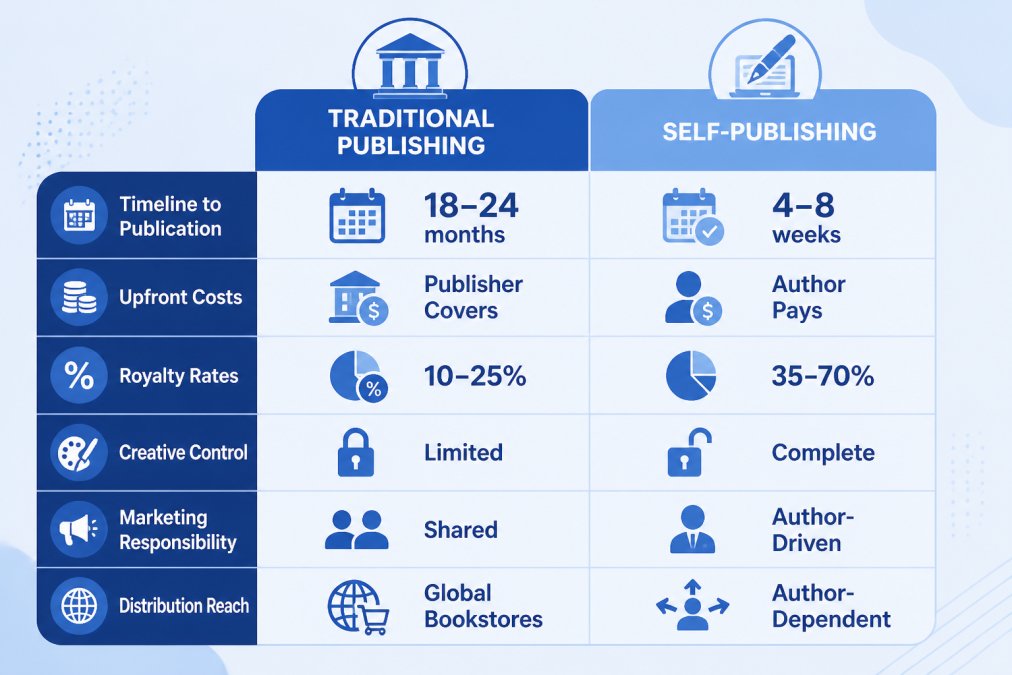
Publishers in 2026 are looking for manuscripts with clear market positioning, strong narrative structure, and authors with existing platforms. The traditional publishing pathway typically takes 18-24 months from agent representation to bookshelf. Publishers handle the costs of editing, cover design, typesetting, and initial print runs. You receive an advance, though advances have compressed significantly since 2020. Most debuts now receive advances in the low thousands rather than the five-figure sums that were common a decade ago.
What you're getting for that wait is professional credibility, ISBN registration through the publisher, distribution to bookstores and libraries, and the ability to say your work was vetted by an industry professional. The catch: publishers own significant control over your cover design, title, pricing, and publication date. You also surrender a percentage of royalties (typically 10-25% for print, 50% for e-book), which means you earn less per copy sold than a self-published author.
Self-Publishing: Speed, Control, and Direct Earnings
Self-publishing means you hire professionals directly and manage the entire process yourself. You keep 35-70% of the revenue per book sold, which is substantially more than traditional publishing offers. The timeline is dramatically shorter, a manuscript can move from final edit to published e-book in 4-8 weeks. Print-on-demand technology means you don't need to print 1,000 copies upfront; books print one at a time as they're ordered.
The downside is that you're responsible for every decision and every cost. You need to hire an editor, a cover designer, and a formatter. You're also responsible for your own marketing and distribution strategy. Bookstores won't stock self-published books unless you have significant sales numbers. Most self-published books sell through online retailers like Amazon, or directly from your own website.
Self-publishing works best if you have an existing audience ready to buy. If you're starting from zero, building that audience is the real work.
Manuscript Preparation and Editing Before Submission
Before you submit to agents or publish independently, your manuscript needs to be genuinely finished. Most first manuscripts need 3-5 rounds of revision before they're ready. The first draft is about getting the story down. Subsequent passes address structure, prose quality, consistency, and final polish.
Many writers rush through this process and then are confused when agents or readers reject their work. The issue isn't effort, it's that the manuscript genuinely isn't ready yet. It needs the rigorous stress-testing that comes from multiple revision cycles.
A good editor identifies structural problems, flags pacing issues, highlights unclear passages, and helps you see what's working and what isn't. If you're self-publishing, hiring a professional editor is non-negotiable. If you're pursuing traditional publishing, getting editorial feedback before querying agents significantly increases your chances of representation.
Creative Writing Coaching for Beginners: Building Your Foundation
If you're new to writing or you've been writing for years without finishing anything, coaching creates structure and accountability that solo writing doesn't provide.
A good coach helps you identify what story you're actually trying to tell, understand your characters deeply, learn the craft of storytelling, and break your own patterns. Coaching is different from a writing group or an online course, it's one-on-one, focused on your work and your process, designed to move you toward completion.
The writeinspire approach focuses on rigorous manuscript development rather than encouragement. You're paying for someone who will stress-test your story the way the marketplace will, identify what's actually working, and guide you through the rewrite decisions that make the difference between a finished manuscript and a publishable one.
How to Find a Literary Agent and Submit Your Work
If you're pursuing traditional publishing, finding the right agent is the critical first step. Agents are gatekeepers to publishers. Most major publishers won't look at unsolicited manuscripts; they only accept submissions from agents they know and trust.
Finding an agent starts with research. Identify agents who represent books in your genre, are actively taking submissions, and whose client list suggests they might be interested in your work. Publishers Marketplace and the Acknowledgments pages in comparable published books are good starting points.
Once you've identified 15-20 agents who seem like good fits, prepare your submission materials. Most agents want a query letter (a one-page pitch of your book and yourself), a synopsis (a 1-2 page summary of your plot), and the first 5-50 pages of your manuscript.
The query letter is crucial. It's a sales pitch, not a summary. A strong query letter has a hook (what makes this book different), a brief description of the plot and main character, your relevant credentials or platform, and a clear statement of your genre and word count.
Rejection is the normal outcome. Most agents receive hundreds of queries per week. A rejection doesn't mean your manuscript isn't good; it usually means the agent didn't feel it was the right fit for their business. Persistence matters.
Understanding Manuscript Submission Guidelines
Every agent and publisher has specific submission guidelines. These aren't suggestions, they're requirements. If an agent says they want the first 10 pages and a synopsis, you send exactly that. Following guidelines exactly is a form of professionalism.
Most guidelines specify format details: double-spaced, 12-point standard font, standard margins. They specify what materials to include and how to send them. Read the guidelines carefully. If something is unclear, email and ask rather than guess.
Book Cover Design, Metadata, and ISBN Registration
Your book cover is a sales tool. It communicates genre, tone, and quality in about two seconds. A weak cover signals that your book isn't professional, even if the writing is excellent.
If you're self-publishing, hire a professional cover designer. A good designer understands genre conventions, typography, and how your cover will look as a thumbnail on Amazon as well as in print.
Metadata is the behind-the-scenes information that helps readers find your book: title, subtitle, author name, book description, keywords, and categories. Your book description on Amazon or in a bookstore catalogue is often the deciding factor in whether someone buys it. Your keywords and categories determine which searches your book appears in, which directly affects discoverability.
ISBN (International Standard Book Number) is a unique identifier for your book. If you're self-publishing in print, you need an ISBN. If you're publishing only as an e-book, ISBN is optional. If you're traditionally published, the publisher assigns the ISBN.
Marketing Your Book and Building Your Author Platform
Publication day is not when your marketing starts. Marketing starts months before you publish, and it's ongoing after you publish.
An author platform is your existing audience: your email list, social media followers, podcast listeners, speaking engagements, and media presence. Publishers love authors with platforms because those authors can drive initial sales. If you're self-publishing, your platform is even more critical.
Building a platform takes time. Start an email list. Share your writing process on social media. Write guest posts for relevant publications. Speak at writing conferences or community events. Every small action builds visibility and credibility.
Your marketing plan should include pre-launch activities (building buzz, reaching out to reviewers), launch activities (coordinating a launch day, asking your audience to buy and review), and ongoing activities (continuing to write, speaking, building your audience). Most books sell the majority of their copies in the first 4-8 weeks after publication, so launch momentum matters.
Reviews matter too. Early reviews from credible sources signal quality to potential readers. If you're self-publishing, you'll need to reach out to reviewers directly.
Understanding Publishing Contracts and Advances
If you're pursuing traditional publishing, understanding your contract is essential. Publishing contracts are complex legal documents, and you should have a literary lawyer or an agent review them before you sign.
Key contract terms include:
- Grant of rights: Which rights does the publisher own (print, e-book, audio, foreign translation, film and TV)? What rights do you retain?
- Advance: The upfront payment against future royalties. This is recouped from your royalty earnings.
- Royalty rates: What percentage of revenue do you earn? This varies by format and sales volume.
- Term: How long does the publisher own the rights?
- Reversion clause: Under what circumstances do rights revert to you?
- Subsidiary rights: Who controls foreign translations, audio editions, film and TV rights?
Don't assume an agent or publisher is working in your best interest just because they're a professional. They're working in their own business interest. A good agent will negotiate on your behalf and explain what different contract terms mean.
Getting a book published in 2026 is more accessible than ever. You have genuine options, real tools, and multiple viable pathways. The barrier isn't access anymore; it's clarity about what you want and commitment to the work required to get there.
If you're ready to move from thinking about publishing to actually doing it, writeinspire offers one-on-one guidance tailored to your manuscript and your specific publishing goals. Whether you're refining a manuscript for agent submission or preparing for self-publication, having someone who understands both the craft and the business side of publishing makes the difference between a manuscript that sits in a drawer and one that reaches readers.

=== FAQ ANSWERS (audit these too, same rules) ===
[1] Q: How hard is it to get a book published in Australia? A: Getting a book published depends on your chosen path. Traditional publishing is competitive, agents receive hundreds of submissions weekly, but offers credibility and wider distribution. Self-publishing is more accessible; you control the timeline and process entirely. Most authors succeed by completing a polished manuscript first, understanding submission guidelines, and choosing the pathway that matches their goals. Neither route guarantees success, but both are achievable with a professional manuscript and clear strategy.
[2] Q: What should I know about creative writing coaching for beginners in Australia? A: Creative writing coaching helps you develop fundamental skills: character development, plot structure, pacing, and voice. A good coach stress-tests your story the way publishers will, examining clarity, emotional payoff, and whether your ending delivers on your premise. Look for coaches with publishing experience and a track record working with emerging writers. Coaching differs from generic writing groups because it provides structured feedback tailored to your manuscript's specific needs, not just encouragement.
[3] Q: Do I need a literary agent to get published in Australia? A: For traditional publishing, most major publishers only accept submissions through literary agents. Agents handle manuscript assessment, publisher pitching, and contract negotiation. Self-publishing doesn't require an agent. Finding an agent involves researching those who represent your genre, following their submission guidelines precisely, and sending a professional query letter with sample pages. Agents work on commission (typically 15%) only when they sell your work, so there's no upfront cost to you.
[4] Q: What's the difference between self-publishing and traditional publishing in the Australian market? A: Traditional publishing handles editing, design, distribution, and marketing, you receive an advance and royalties but have less creative control and longer timelines (18-24 months to publication). Self-publishing gives you complete control, faster publication (3-6 months), and higher royalty rates (60-70% on e-books), but you manage costs and marketing yourself. Traditional offers credibility and bookstore placement; self-publishing offers speed and autonomy. Your choice depends on your timeline, budget, and how much control you want over your book's presentation.
[5] Q: What manuscript submission guidelines should I follow in Australia? A: Research each agent or publisher's specific requirements, they vary widely. Most want a query letter (one page), 1-5 sample pages, and a synopsis. Follow their preferred submission method (email, online form, or postal mail). Check their website for genre focus and submission windows. Australian publishers and agents often prefer manuscripts formatted in standard manuscript style: double-spaced, Times New Roman, 12pt, with your name and contact details on the first page. Never submit before your manuscript is genuinely finished and professionally edited.
[6] Q: How much does it cost to get a book published in Australia? A: Traditional publishing costs you nothing upfront, the publisher covers editing, design, and production. You may receive an advance against future royalties. Self-publishing costs vary: professional editing, cover design, formatting, and ISBN registration. Marketing costs depend on your strategy. Many authors invest in a quality self-published book. Avoid vanity publishers who charge thousands upfront; they often provide poor service and limited distribution.
[7] Q: What are Australian publishers looking for in 2026? A: Publishers seek manuscripts with strong commercial potential, authentic voice, and clear target audiences. They want stories that feel fresh within established genres, characters readers care about, and narratives that deliver on their premise. Publishers also value authors willing to build their own platform (social media presence, email lists, speaking engagements) to support marketing. Niche genres and diverse voices continue to gain traction. Above all, they want a finished, polished manuscript that's been professionally edited and stress-tested before submission.
Frequently Asked Questions
How hard is it to get a book published in Australia?
Getting a book published depends on your chosen path. Traditional publishing is competitive, agents receive hundreds of submissions weekly, but offers credibility and wider distribution. Self-publishing is more accessible; you control the timeline and process entirely. Most authors succeed by completing a polished manuscript first, understanding submission guidelines, and choosing the pathway that matches their goals. Neither route guarantees success, but both are achievable with a professional manuscript and clear strategy.
What should I know about creative writing coaching for beginners in Australia?
Creative writing coaching helps you develop fundamental skills: character development, plot structure, pacing, and voice. A good coach stress-tests your story the way publishers will, examining clarity, emotional payoff, and whether your ending delivers on your premise. Look for coaches with publishing experience and a track record working with emerging writers. Coaching differs from generic writing groups because it provides structured feedback tailored to your manuscript's specific needs, not just encouragement.
Do I need a literary agent to get published in Australia?
For traditional publishing, most major publishers only accept submissions through literary agents. Agents handle manuscript assessment, publisher pitching, and contract negotiation. Self-publishing doesn't require an agent. Finding an agent involves researching those who represent your genre, following their submission guidelines precisely, and sending a professional query letter with sample pages. Agents work on commission (typically 15%) only when they sell your work, so there's no upfront cost to you.
What's the difference between self-publishing and traditional publishing in the Australian market?
Traditional publishing handles editing, design, distribution, and marketing, you receive an advance and royalties but have less creative control and longer timelines (18-24 months to publication). Self-publishing gives you complete control, faster publication (3-6 months), and higher royalty rates (60-70% on e-books), but you manage costs and marketing yourself. Traditional offers credibility and bookstore placement; self-publishing offers speed and autonomy. Your choice depends on your timeline, budget, and how much control you want over your book's presentation.
What manuscript submission guidelines should I follow in Australia?
Research each agent or publisher's specific requirements, they vary widely. Most want a query letter (one page), 1-5 sample pages, and a synopsis. Follow their preferred submission method (email, online form, or postal mail). Check their website for genre focus and submission windows. Australian publishers and agents often prefer manuscripts formatted in standard manuscript style: double-spaced, Times New Roman, 12pt, with your name and contact details on the first page. Never submit before your manuscript is genuinely finished and professionally edited.
How much does it cost to get a book published in Australia?
Traditional publishing costs you nothing upfront, the publisher covers editing, design, and production. You may receive an advance against future royalties. Self-publishing costs vary: professional editing, cover design, formatting, and ISBN registration. Marketing costs depend on your strategy. Many authors invest in a quality self-published book. Avoid vanity publishers who charge thousands upfront; they often provide poor service and limited distribution.
What are Australian publishers looking for in 2026?
Publishers seek manuscripts with strong commercial potential, authentic voice, and clear target audiences. They want stories that feel fresh within established genres, characters readers care about, and narratives that deliver on their premise. Publishers also value authors willing to build their own platform (social media presence, email lists, speaking engagements) to support marketing. Niche genres and diverse voices continue to gain traction. Above all, they want a finished, polished manuscript that's been professionally edited and stress-tested before submission.
This article was written using GrandRanker