

Table of Contents
- What Story Arc Development Really Does
- How Story Arc Development Builds Reader Engagement
- Character Arc Development Examples That Work
- How to Structure a Story Arc From Start to Finish
- Tools for Tracking Story Arcs as You Write
- Common Mistakes That Derail Arc Development
- Why Arc Development Matters for Your Finished Manuscript
- Frequently Asked Questions
Last Updated: September 19, 2026
What Story Arc Development Really Does
Story arc development is the process of shaping your narrative into a structured framework that carries readers through a compelling journey. It's not just about plotting events in sequence, it's about creating emotional momentum that makes readers care about what happens next. When you develop your story arc with intention, you're essentially building the backbone that holds your entire manuscript together.

At writeinspire, we've seen how mapping the arc helps writers refine their stories. Plot holes become apparent, character motivations clarify, and endings either feel earned or they don't. The arc is where all of that gets exposed and refined.
The core elements of story arc development include identifying your inciting incident (the event that kicks everything off), raising stakes progressively, building to a climax that forces your protagonist to change, and then showing the consequences of that transformation. Without intentional arc development, even the best prose falls flat because readers don't feel the narrative tension pulling them forward.
How Story Arc Development Builds Reader Engagement
Reader engagement isn't about constant action or clever dialogue. It's about making readers emotionally invested in whether your protagonist succeeds or fails. Story arc development creates that investment by establishing what's at stake and then systematically raising those stakes.

When you deliberately structure your narrative arc, you're controlling pacing and tension. Early scenes establish the protagonist's world and their internal conflict. The inciting incident disrupts that equilibrium. Rising action escalates external pressure while the protagonist grapples with internal resistance to change. The climax forces a decision that reveals their true character. The resolution shows who they've become.
This progression matters because readers follow the emotional thread, not just the plot events. If your character arc doesn't align with your plot arc, if external events happen but your protagonist doesn't transform, readers feel the disconnect. They finish your manuscript thinking, "That was fine, but I didn't care." That's the arc failing to do its job.
Consider how character motivation shapes engagement. A protagonist who wants something (external goal) but fears something (internal conflict) creates narrative tension. As the story progresses, these forces collide. The reader watches to see which will win. That's arc development working at its most basic level.
Character Arc Development Examples That Work
There are three fundamental character arc development patterns, and understanding them helps you choose the right one for your story.
A positive arc shows your protagonist growing toward their better self. They arrive broken or incomplete, face challenges that force growth, and emerge transformed. Think of a cynical character learning to trust again, or a coward discovering courage. This arc satisfies readers because it mirrors real human potential, we all want to believe we can change.
A negative arc shows your protagonist declining into their worse self. They start with potential but make choices that corrupt them. This arc unsettles readers, which is exactly the point. It works when you're exploring how good intentions curdle into something darker, or how someone chooses comfort over integrity. The negative arc is harder to execute because readers expect redemption, so you need to earn their acceptance of decline.
A flat arc shows your protagonist staying fundamentally unchanged while the world around them transforms. This isn't a failure, it's a deliberate choice. The flat arc protagonist is often a catalyst for other characters' growth, or they're so grounded in their values that external chaos can't shake them. This arc works for mentors, antagonists, or characters whose stability is their strength.
Each arc type serves different thematic purposes. If your story explores redemption, you need a positive arc. If you're examining corruption or tragedy, a negative arc cuts deeper. If you're writing about resilience or moral clarity, a flat arc might be your answer.
How to Structure a Story Arc From Start to Finish
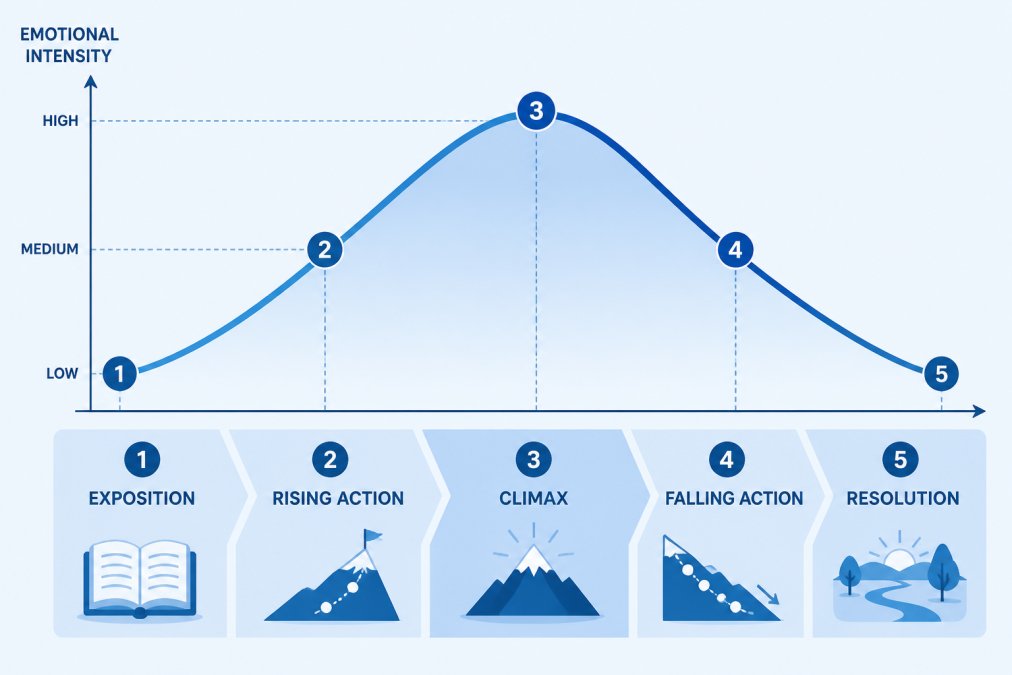
Structuring your story arc requires understanding the five-stage narrative progression: exposition, rising action, climax, falling action, and resolution.
Exposition establishes your protagonist's ordinary world. Show readers who they are before everything changes. This isn't backstory dumping, it's revealing enough about their current state that readers understand what they have to lose. Most writers underdevelop exposition because they're eager to get to the exciting bits. But exposition is where readers decide whether they care about this character.
Rising action escalates both external pressure and internal stakes. Events compound. Choices become harder. Your protagonist tries solutions that don't work. Each attempt should reveal character while moving toward the climax. This is where most of your manuscript lives, so make each scene earn its place by advancing both plot and character arc.
Module 2 - Creative Story Mastery →
Climax is the moment of maximum tension where your protagonist can no longer avoid the central conflict. They must act, choose, or confront the truth they've been evading. The climax isn't necessarily the most action-packed scene, it's the scene where everything that matters comes to a head. A quiet conversation can be a climax if it forces transformation.
Falling action shows the consequences of the climactic choice. What breaks? What survives? How is the world different now? This section often gets rushed because writers think the story's over once the climax hits. But falling action reveals whether the protagonist's growth is real or temporary.
Resolution shows the new equilibrium. Your protagonist has changed or hasn't. The world has shifted or it hasn't. Readers see what their investment in this character has earned them. A strong resolution doesn't tie everything into a neat bow, it shows the character in their transformed state and lets readers imagine forward.
Tools for Tracking Story Arcs as You Write
Tracking your arc while drafting keeps you from losing structural clarity. Some writers work with detailed outlines before writing. Others discover their arc through revision. Neither approach is wrong, what matters is having a system that works for your process.
A simple spreadsheet can track each chapter or section: what scene happens, what external event occurs, what internal shift the protagonist experiences, and how stakes have risen. This doesn't require fancy software. A document with scene-by-scene notes works just as well. The point is making your arc visible so you can spot where it sags or where a character's transformation doesn't feel earned.
Many writers find it helpful to sketch their arc visually. Draw a simple line graph with rising tension toward the climax, then falling action toward resolution. Mark where major scenes fall on that graph. Does tension actually rise, or do you have a flat middle section? Visual mapping makes structural problems obvious.
The Creative Story Mastery program from writeinspire includes structured frameworks for mapping character arcs alongside plot progression. This kind of guidance helps writers see the relationship between what happens externally and how their protagonist transforms internally, the core of effective arc development.

Some writers use index cards, one per scene, arranged on a wall or table. Moving cards around helps you test different sequences and see where the arc breaks. Others use dedicated writing software with scene-tracking features. The tool doesn't matter. Visibility does.
Common Mistakes That Derail Arc Development
The most common mistake is confusing plot with character arc. Plot is what happens. Character arc is how the protagonist changes in response to what happens. A manuscript can have an exciting plot but a flat character arc, and readers will feel empty afterward because nothing changed that mattered.
Another frequent error is making the protagonist's transformation too sudden. Real change is gradual, even when it's triggered by a single event. Your character should resist their growth, backslide, doubt themselves. That struggle is what makes transformation believable.
Why Arc Development Matters for Your Finished Manuscript
A well-developed story arc is the difference between a manuscript that agents request and one that gets a form rejection. It's the difference between readers finishing your book and setting it down halfway through. Arc development isn't a nice-to-have, it's foundational.
Frequently Asked Questions
What are the primary benefits of using a structured story arc?
A structured story arc gives your narrative direction and purpose. It clarifies what your story is really about, builds emotional stakes for readers, and prevents your plot from wandering. With a clear arc, you know exactly where each scene belongs and why it matters. This foundation transforms a collection of scenes into a cohesive, compelling story that readers can't put down.
How does a well-developed story arc improve reader engagement?
Readers connect emotionally when they see a protagonist face real obstacles and change as a result. A well-developed arc creates narrative tension by raising stakes progressively, making readers care about the outcome. When character transformation aligns with plot progression, readers feel invested in the journey. This emotional connection is what separates stories people remember from ones they forget.
Can you give me an example of a story arc in practice?
Consider a character who begins as cynical and self-protective (inciting incident: they're forced into a situation requiring trust). Through rising action, they gradually lower their defences, facing internal conflict alongside external obstacles. At the climax, they make a choice that reveals their transformation. By the resolution, they've genuinely changed, not magically fixed, but authentically different. This positive arc shows character growth that readers believe and feel.
How does story arc development help prevent writer's block?
When you understand your story's arc before writing, you have a roadmap. You know what each section needs to accomplish, which keeps you moving forward instead of second-guessing every scene. You can see how character motivation drives plot progression, and you understand the relationship between internal conflict and external goals. This clarity reduces the paralysis that comes from not knowing what happens next or why it matters.